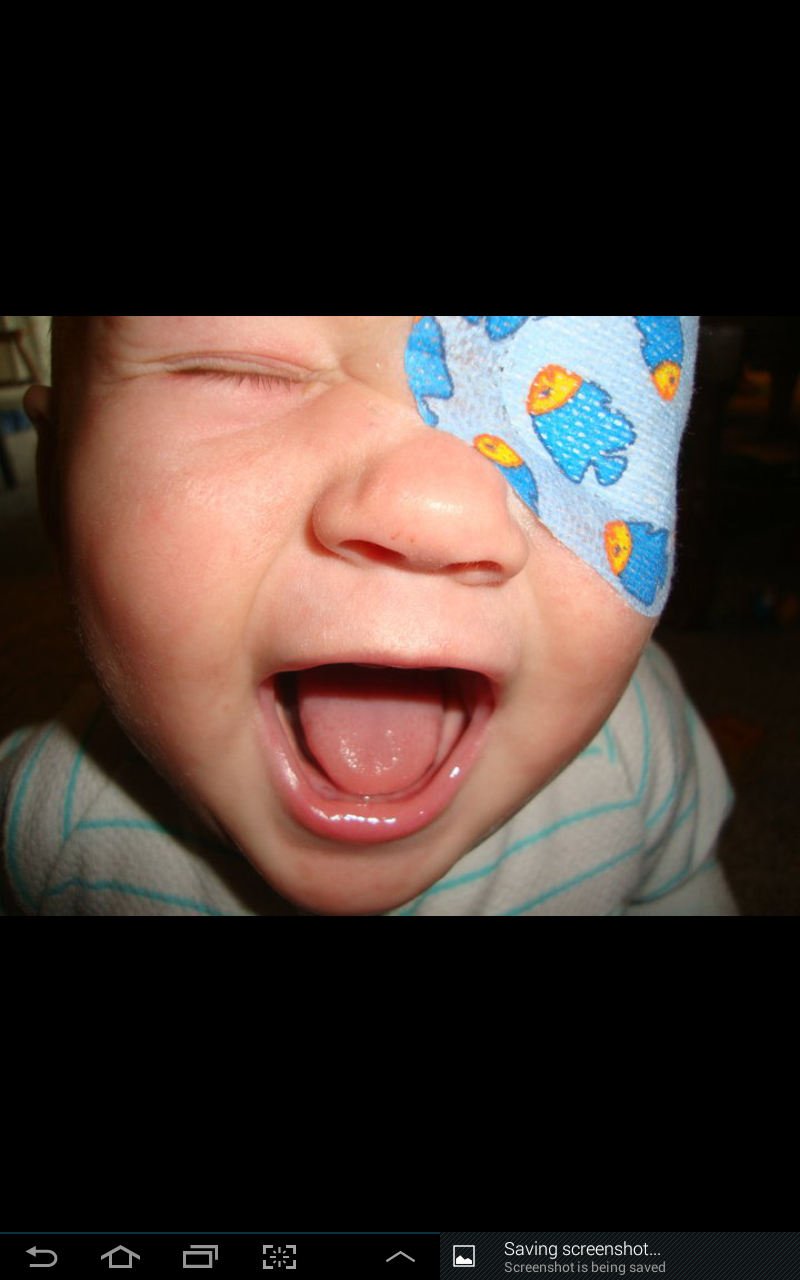
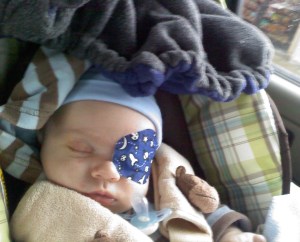
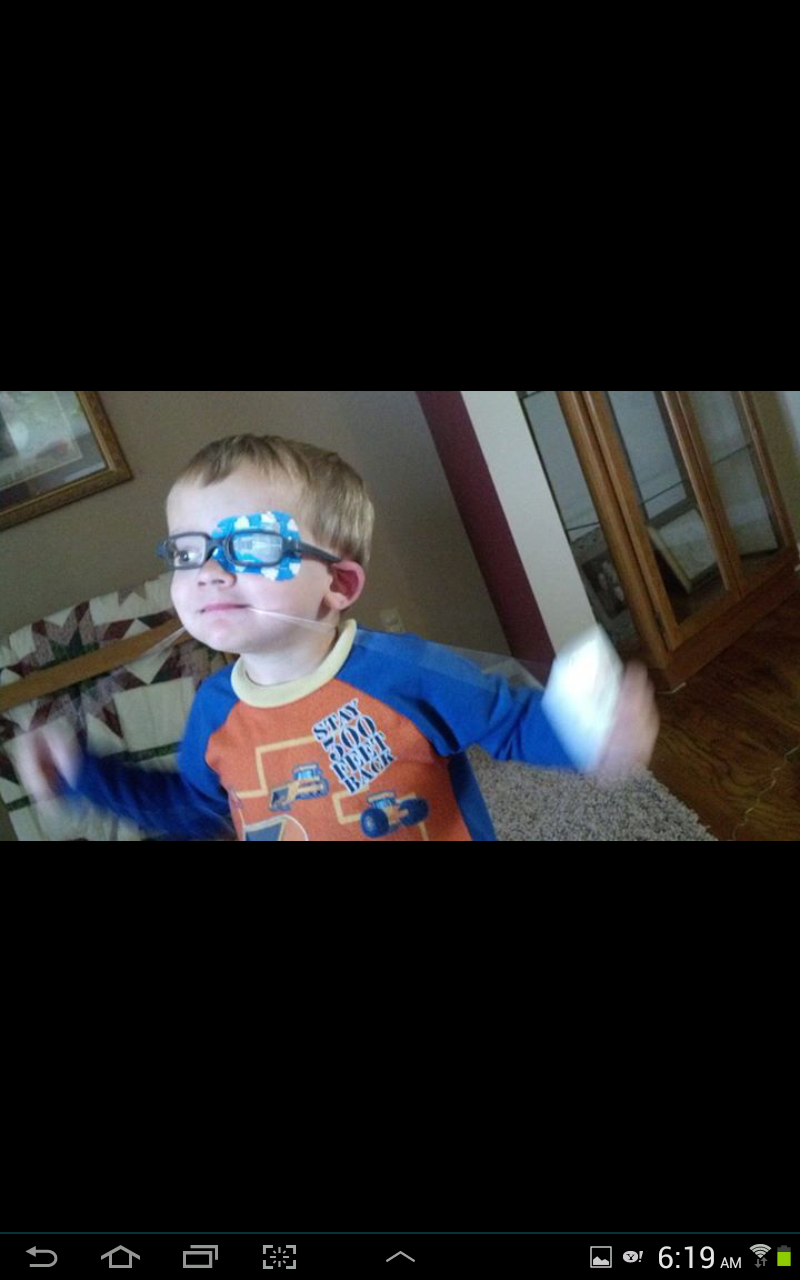
Jessica D is putting together a calendar with pictures of kids with glasses, eye patches, or other vision issues, and little blurbs of why your little one wears glasses or what vision impairment they may have. All proceeds from the sale of the calendar will go 50/50 to help with next years Great Glasses Play Day and the other half to Children’s Eye Research Foundation!
Given just how cute pictures of our kids are, there wouldn’t be a fair way to choose, so she will randomly choose from the pictures sent to her. If you’d like to enter a picture of your child, send it in an email to jessica_j13@hotmail.com
And speaking of pictures, if you haven’t already, you should look at some of the pictures from the Great Glasses Play Days this year! Some are up on the website, but there’s even more on the facebook page!
SNP Teacher left a comment asking for some advice. I’m hoping someone out there has some experience and insights to share. – Ann Z
Do you have any advice for keeping glasses on a severely disabled child? She is almost 5, but functions more in the range of a 12 month old. I am her teacher. The parents are unable to keep them on her either. Her vision loss is in the – 6 range and she has amblyopia as well, so I understand how important it is for her to wear them. Our longest period of wearing the glasses was 45 sec with adult support during a preferred activity. Any suggestions are welcome!
Lindsay blogs about her son Jack, who was born with cataracts, at Jack’s Journey. She shared this lovely letter that she’s written to her new baby girl. – Ann Z
Dear Emma,
Someday, you might be reading this blog and wondering why I wrote all of this for your brother. Well, now that you’re at the wise old age of 3 months, it’s high time I explain a few things to you. After all, by this age, Jack had already had 2 surgeries and was wearing glasses!
First off, I love you baby girl, but you are a terrible sleeper. It’s enough for me to put on matching shoes every day!
But that’s not the only reason. You see, your brother was born with cataracts. They’re kind of like special beauty marks on your eyes, except that he couldn’t see past them! He had to have two surgeries to remove them and now he wears his glasses, or the special contacts that go on his eyes.
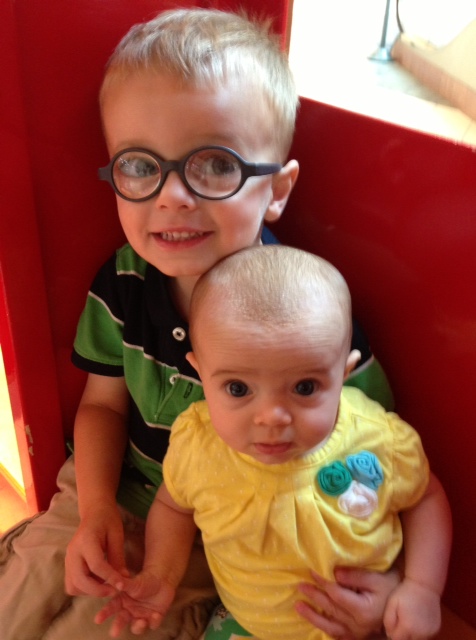
Emma and her big brother, Jack
You were born into the world of eye doctor appointments, glasses and contact lenses. You were 10 days old when your eyes were dilated for the first time. The doctor and your mommy and daddy wanted to make sure that if you had cataracts too, we caught them right away. So far, so good – you’ve already had 2 eye doctor appointments and several trips to the pediatrician!
You’ve never known your brother without glasses. Now that you’re grabbing things, they’re one of your favorite things to grab when he comes in for one of his many kisses a day. You’re very lucky for many reasons. One is that you don’t have cataracts, but I think you are the luckiest because you have a brother that did. Your brother is the strongest, bravest, neatest kid I’ve ever met. He is such a good big brother and loves you so much.
You may be wondering why you have to keep going to the eye doctor, or why you keep getting those special dilating drops once a year. Well, it’s because we know. We are now highly educated in the field of eyes…baptism by fire, some may call it. We know what to look for in pictures if your eyes cross, we rejoice when your pictures come out with red eye in them. We feel guilty for staring at your face, relieved there aren’t a pair of glasses on them. (Don’t get me wrong, Jack pulls off glasses better than anyone I know, but there’s just something about staring at his glasses-free face sometimes.) We constantly panic when we think we see a white fleck in your eye, only to be a reflection.
There was a time when we were scared we couldn’t have you, for fear that what Jack was going through was so bad, we couldn’t possibly do it again. At the end of the day, our family has so much love to give, and the good news is, not only could we do it again, I have pure faith that you would be a fighter, just like him.
So if you ever wonder why Jack has a blog and you don’t, please know that you a big part of his story, and “eye” love you, too!
Festivities for the Great Glasses Play Day kick off in just a few hours. I can’t wait to hear how all the celebrations go, and I’m looking forward to making some new friends at our event in St. Paul.
Even if you’re not able to make one of the meet-ups, make sure you take a look at the online celebrations that are happening on Sunday, August 4. It’s a great way to participate, have fun, show how much you love that your child can see better (even if you don’t always love the glasses), and help raise awareness of how important it is to catch and treat vision issues early. Plus, you’ll be entered in a giveaway for some fun prizes!
Thanks to Dr. Nate at Bright Eyes News, I just found this fantastic video for kids that’s all about eyes. The video is hosted by JohnJohn a young boy who loves learning fun facts and doing fun experiments. In his Eyes video, he explains the different parts of the eye and talks about some of the common eye diseases. And of course there’s experiments, and some of them involve cookies. I think science experiments should always involve cookies (and I’m a science librarian, so I should know).
There’s been a lot of discussions on the facebook group recently about how to nurse kiddos when they are wearing glasses. I know we took Zoe’s glasses off, but she was 14 months old when she got her glasses, so at that point she was mostly only nursing before nap and bedtime.
While I’m curious to know what others do/did, I think this is a clear case of there being no right or wrong answers. You should just go with what seems to be the most comfortable for you and your child. If your child really wants to be looking around, and gets upset when you take their glasses off, then I’d try leaving them on. If the glasses look like they’re uncomfortable, I’d take them off. I will say, this was not anything they covered in breastfeeding class, though!
Every one is writing letters to their eye patches these days (Melissa shared hers recently, too)! Missy shared her own letter to her son, Austin’s patch. What would you say in a letter to your child’s glasses, contacts, or patch? – Ann Z
Dear EyePatch,
I despise what you do to our mornings. “A” dreads getting out of his bed because of you. He will lay there awake and tell me to go away when I check on him to avoid contact with you. We are inserting a cuddle session sans you in the mornings to avoid this.
I appreciate that you have given my child not only usable vision in a previously blind eye, but much better than the doctor’s expectation. I think that I have decided that because of this fact alone, I partially love you.
You are a part of our lives to a point that you were missed in the four months that you were gone. Just to clarify, you were only partially missed. It just felt wrong to not have you around. You know kinda like a wart on someone’s nose. You get so used to it that when it is gone, something is just off. That is the way I feel about you. You are a wart on the nose of my life.
The times that we spend together are wrought with more tantrums and tears than when he is without you. Honestly I have shed many tears concerning you and the reason you stick around (pun intended). We still count the minutes until you are done for the day.
We treat you like the annoyance that you are. You are stepped on, stuck to the couch, thrown under beds. Yet you are a part of the day. You never give up. Kinda like us. We are persistent. We will always be. We need you despite the fact that you annoy us greatly and affect every day in one way or another. In the long run we are grateful for the part you play in the vision of an eye that didn’t see anything until you made it see.
You are a part of my son’s face. I never ever ever ever EVER thought I would say that. When you are gone for the day, I am relieved, but I still look twice before I remember that we are done with you at the moment.
Anyway, I guess it is good that I have reached this point, because I have to put up with your annoying stickiness for at least another 6 years. Ortopad will love us/our wallets completely, even if we don’t love them completely.
Sincerely Missy and Austin and Everyone Else in This Family
Maybe your child failed a vision screening at the pediatrician’s visit and you were given a referral, or maybe you’ve noticed that there seems to be something off about the way he looks at things, or maybe her teacher mentioned that she crosses her eyes, or maybe you’re being proactive and making sure his vision is checked early. Whatever the reason, now that you have an appointment with an eye doctor scheduled, you’re wondering what that eye exam is going to be like and wondering how to prepare.
I’ve been to many, many eye exams with Zoe in the past 5 1/2 years. I think every exam, I’ve forgotten to prepare in some way or another. So this is a compilation of all the things that I’ve wanted to remember. Not all of these tips will be relevant for your child, depending on your child’s age and temperament and how he responds to doctors.
Yes, she’s sporting some fantastic face painting. No, it’s not required for an eye exam.
Eye exams for kids are not quite the same as they are for us, though there are definitely similarities. The aim of the exam is to find out how healthy your child’s eyes are, how clearly your child is seeing, how well her eyes are moving, and how well her eyes work together. The eye doctor will also look into your child’s eyes to make sure the structures of the eye are healthy, and to see the shape of their eye.
Note: This does not address the special case of exams under anesthesia (EUAs), which are exactly what they sound like: eye exams that are done while your child is under anesthesia. These are done only in very specific cases where needed for certain diagnoses. You can read more about EAUs here.
Scheduling the appointment
Most pediatric eye exams will take at least an hour, and part of that will be waiting while dilating drops take effect. Ask the office how long the appointment will be, and try to schedule the appointment around your child’s naptime.
Things to bring
Diapers (if needed)
Toys to play with while waiting for the appointment, and waiting for the drops to take effect.
Snacks – especially if the exam is scheduled over a time when your child is likely to be hungry
Sunglasses if your child’s eyes will be dilated. (I always forget the sunglasses!)
click to download the pdf of the Eye Exam Notes form.
List of medicines that your child is currently taking
Medical history for your child, and any family history of vision problems
List of questions that you have for the doctor
Note pad to write down information you get from the doctor.
For those last four items, I put together an eye exam notes page that you can download and print. It has space for you to record some information before the exam, and space to write notes during the exam.
Things to know about the eye exam
A good pediatric eye doctor really will be able to get a good idea of your child’s vision. They will have a variety of eye charts and tests to determine your child’s vision, regardless of their age or verbal abilities.
You will be doing some waiting, especially if your child’s eyes will be dilated, which is likely, especially if this is your first exam.
Even though most of the exam does not hurt, a lot of kids respond nervously, especially when the doctor is looking in their eyes.
Dilating eye drops sting, but it’s temporary.
Preparing your child
Obviously, it depends on your child’s age, how much they’ll understand about going for an eye exam, but if they’re old enough, it’s a good idea to talk about the eye exam at least a day or two before you go in and to introduce them to some of the things that will happen at the exam. You can reassure them that there will be no shots. Mostly, the exam will be like playing games: watching toys and naming shapes.
One of the eye charts at Zoe’s exam. This is a Lea chart.
If your child is verbal, you might practice drawing different shapes or letters on a piece of paper or chalk board and have your child name them when you point to them (it doesn’t matter what shapes you use, you just want to get them used to the ideas of naming the different shapes). But keep it light, and let your child know that the doctor will be trying to figure out if there are ways to help them see better. The eye charts are not testing how smart your child is, they’re checking to see how clearly they can see. This was a huge deal for my daughter after she started kindergarten. Even though she had been to many eye exams by that point, she still started getting worried about getting the “right” answer rather than letting us know what she could and couldn’t see. Prevent Blindness America also has a practice eye chart for kids aged 3-5 who can identify the letters H, O, T, and V.
You may also want to practice eye drops and looking in your child’s eye, two other events that will happen at the exam. Your child will likely have drops to dilate their eyes, it helps the eye doctor get a better view inside the eye, and see the shape of the eye. But very few kids like getting the drops. If you have a small bottle, you can pretend to put drops in a stuffed animal or doll’s eye and then in your child’s eye. Have them tip their head back, close their eyes, say “drop!” and then have them blink. Then you might use a magnifying glass to look closely in your child’s eyes.
Taking Notes
The eye exam notes sheet mentioned above has some common questions you might want to ask the doctor at the exam, and space to record your own questions and notes about your child’s vision and the treatment plan, if there is one. Wehn possible, having a second adult at the exam is very helpful. Zoe was often completely worn out by the end of the exam and throwing a fit. So one of us would be handling her, and the other could pay attention to what the doctor said. Even with that, we always found ourselves with a few questions that we forgot to ask or thought of later. You should always be able to contact your doctor and ask those questions.
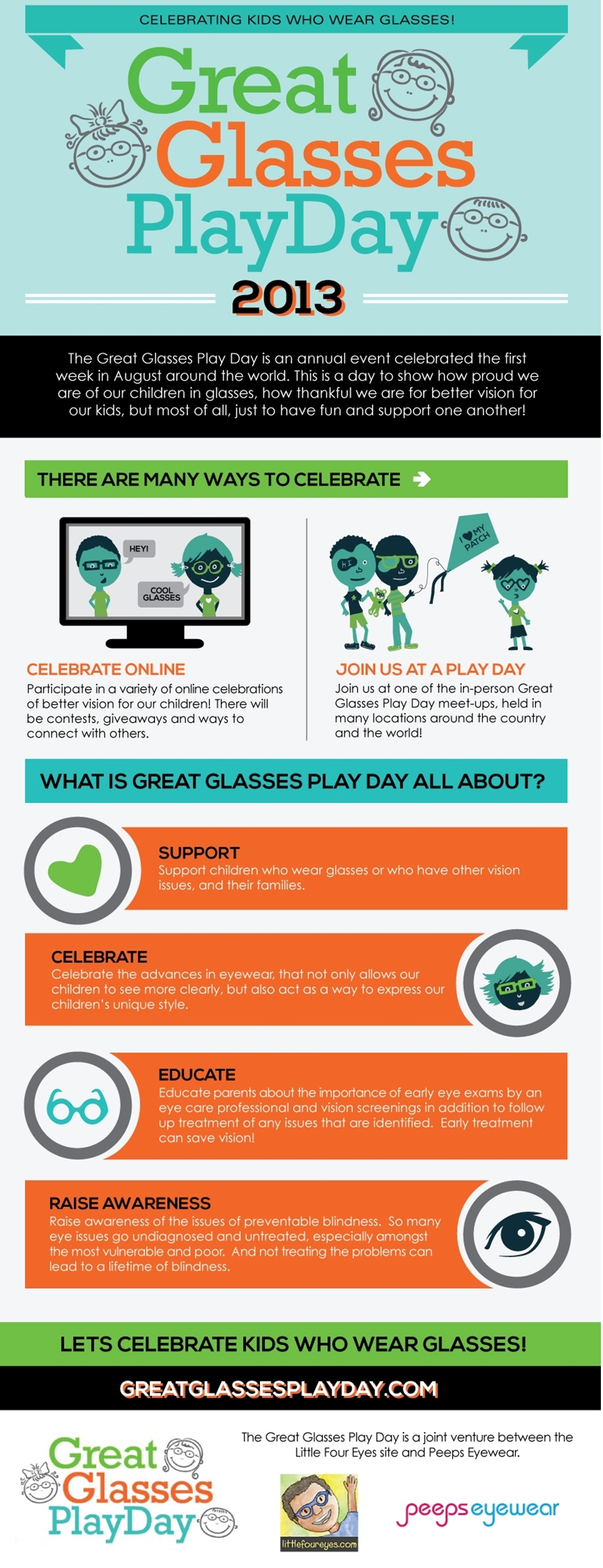
Last year, when we started the Great Glasses Play Day, I hoped that we’d have at least one or two locations for local meet-ups. Thanks to some amazing volunteers, we had 5 (Portland, Philadelphia, outside Washington DC, Madison, and Minneapolis), and it was awesome and fun. And now this year, we have 16 confirmed locations so far! Huge huge thanks to all the volunteers that are helping to make this happen. If you don’t see a location near you on this list, it doesn’t mean you can’t participate, we’ll be posting more ways for you to celebrate at home and on line! I really hope you’ll join us.
Oh, and if you’re an eye care provider or optical shop, take a look at our Supporters page to see how easy it is to support the Great Glasses Play Day!
This beautiful infographic was designed by the very talented Jessica Butler of Eye Power Kid’s Wear
Consumer Reports magazine has a feature in their August, 2013 issue called “Save Big on Eyewear.” The article isn’t free online, but if you don’t have a subscription, you can still read their Eyeglass Store Buying Guide. I’d still recommend seeing if you can find a copy at a library if you’d like a more in-depth introduction to buying glasses.
That said, while the article is great in terms of buying glasses for adults, I think it doesn’t address some of the specific concerns that come with buying glasses for a young child. So I wrote a lengthy letter to the editor. I don’t know whether or not it will be printed (it’s far longer than most of the letters they publish), but I thought I’d share it here:
Dear Editor,
Your August 2013 feature on Saving Big on Eyewear had fantastic information for purchasing glasses for adults. I wanted to add a few more tips for families that may be buying glasses for their children, particularly young children. My daughter started wearing glasses at a year old, and I had a hard time finding much information on buying glasses for toddlers and preschoolers. It’s estimated that 1 in 20 preschoolers, and as many as 1 in 4 school-aged children need glasses to see clearly, so I thought the following might be helpful for those families.
Research the stores. Selection and expertise for young children’s eyewear is not a given at all stores, so call ahead and ask what selection they have for your child’s age, and if they have opticians who are experienced in fitting young children. The younger your child, the smaller selection a store is likely to have, but there are some great, comfortable, and stylish options out there. Optical shops that specialize in children’s eye wear will have the best selection, but may be pricier than other shops. Some shops may be willing to order a variety of frames for your child to try on.
Lens choices. Polycarbonate and Trivex are the absolute best choices for kids’ lenses because they are so impact-resistant. Most vision insurances will fully cover polycarbonate lenses for kids.
Warranties. While an extended warranty against loss and damage may not make sense for adults, it can be a lifesaver (or at least a pocketbook saver) for families with a young child. Be sure to also ask about warranties for prescription changes because children’s prescriptions can change quite rapidly Most shops will replace lenses for free if there’s a prescription change in the first few weeks or months. If your child’s eye doctor wants a follow up appointment after they get their glasses, make sure you schedule it in the window when changes are covered. Finally, some scratch-resistant coatings come with a one-year warranty against lens scratches. Make sure you understand what is covered by that. I personally have used that warranty many times with my daughter.
Second pair. I highly recommend a second pair of glasses for children. As you mention in the article, a second pair means not needing to pay for a rush job if there’s loss, damage, or a change in prescription. Many shops will also offer significant discounts if you order two pair of glasses at the same time.
Ann Zawistoski
Owner and author at Little Four Eyes, an online community for parents of young children in glasses (http://littlefoureyes.com)
I feel like this is really awkward because we both know that I have put this off for a long time and you have just been too professional to say anything. I appreciate that.
It has been 2 1/2 years to the day since we first met. 30 months. That is a long time for a relationship between a person and a band-aid.
I really hated you the first time I saw you. Actually, if I am being honest, I not only hated you, I resented, despised, loathed and cussed you. I did not understand why you were in my life if not to just stress me out and make me even crazier.
The new Monster Truck version in all it’s glory.
In my defense, you made me cry a lot. It was hard to see you constantly interrupting my perfect life and stealing my sanity and making me feel like I was hurting my baby by forcing you on him all day, every day.
As time went on, my hatred of you turned into annoyance. I was so annoyed by your constant presence. You seemed to smug to me, just sitting there, taunting me. Annoyance often manifested itself into resentment, which made me even more agitated with you because it wasn’t the fault of anyone else that you were so happily camped out in our lives.
My resentment very gradually turned into acceptance. Over the course of many, many months, I came to accept that you are a part of our lives. I begrudgingly began to admit that you do, in fact, belong here.
Through all of my crazy range of emotions, you remained a stable presence in our lives. You have changed colors and designs. You smell a little differently at times and sometimes you are a little stickier, which I appreciate, especially in the summer months. You have survived stuck to the bottom of shoes, my coupon organizer, cereal boxes and dog bowls. We have left you behind at Target, Dollywood, the pool and, most often, the sandbox. You have been sweated on, cried on, pulled off, cut to make you into a better shape, crumpled, stuck on other people, animals and walls and basically abused every day of your life.
Yet, you have remained constant.
A long time ago, (29 months ago, maybe?) I put a post on a Facebook that said, “Dear eyepatch, I hate you” and someone commented, “Don’t hate the eyepatch, he has work to do!” I was very irritated at this comment because I really did hate you, mostly because you had work to do. But, now, I realize she was right and, despite my anger toward you, you have definitely done your job so far.
So, here we are, all these months later and, despite constant abuse, you continue to do your job 12-14 hours a day, every single day. Don’t get me wrong, the time I spend with you is still not anywhere near fun or enjoyable, but it is tolerable and I feel like that is a nice place to land.
I know we have about 4 years left together and, while I cannot promise not to get mad at you, I do recognize your efforts.
We’re less than a month away now from the 2nd annual Great Glasses Play Day, and we’re starting to get details on many local events. We’ll start posting those details on the Great Glasses Play Day site next week!
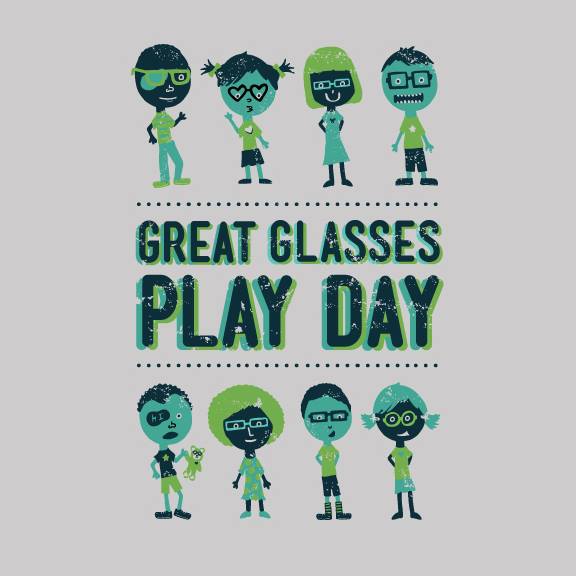
We also have fantastic t-shirts this year, designed by the very talented Jessica of Eye Power Kid’s Wear. Jessica has a fun post up on her own site about the process she went through to design those shirts. As a not-very creative type, it’s really interesting to see the process for how these things can take shape, and I love the results.
As we get closer to the big day, I’m starting to get really excited! I hope you’ll all be able to join in the celebration, either in person or online!
Vicky, who runs the facebook group, Kids in Specs UK, has a short survey about support for UK families when they learn their child needs glasses. It is completely confidential. She wants to use it to highlight to NHS services how important it is to provide parents/carers with some support after a child is prescribed glasses or is diagnosed with a visual problem. The survey includes 2 questions about “this website”, it is referring to the Kids in Specs UK facebook group, which you should definitely check out if you’re looking to connect with other UK families.
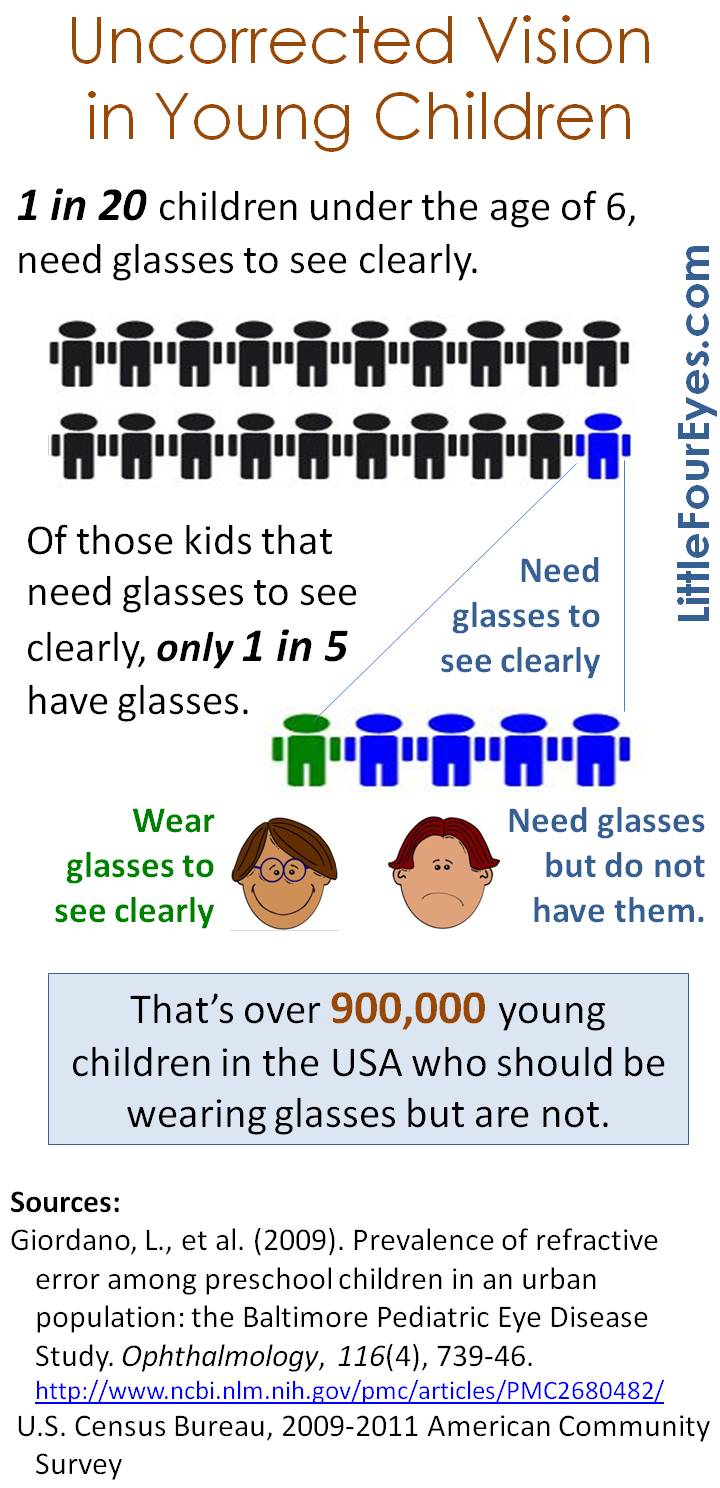
Do you know what keeps me up at night? It’s the fact that there’s a really high percentage of kids out there who need glasses to see well, and they don’t have them. It sounds overly dramatic to say that, but there are a lot of kids out there, who, if they had glasses, would have good vision. But they don’t have glasses, so they don’t see well. And I think that’s a real problem.
Having watched Zoe, and so many other kids in the Little Four Eyes community, flourish and do so well in their glasses, it hurts to think that there are so many kids who are struggling to see unnecessarily. Who don’t know that they could be seeing the board in school more clearly, who don’t know that the fuzzy squiggles on a page should be sharp, distinct letters, who don’t realize that the green smudges on the trees are individual leaves.
How big of a problem is it? Big enough that I decided to try to make an infographic to help visualize it.
And if you think that’s bad, there are studies that show an even bleaker picture: According to a study of first graders in California published in 2011, 8% of those children should be wearing glasses. Less than 1/2 of one percent of those children who need them had glasses.
And it’s not just a problem in the US. The World Health Organization estimated in 2004 that nearly 13 million children between the ages of 5 and 15 are visually impaired due to a refractive error that would be corrected with glasses.
There’s a lot of reasons for this, but they’re all equally upsetting to me:
The vision problems aren’t caught. Either because the child’s vision hasn’t been checked, or because a vision problem was missed during a screening.
Even when a vision problem is found, a lot of parents don’t take their child for a follow up appointment with an eye care provider, either because they cannot do so financially, they don’t understand the importance, or they don’t believe their child needs glasses.
Even when a child is given glasses, many are not wearing them a year later, usually because the glasses have been lost or broken.
I know that I can’t solve all these problems, and thankfully, there are a lot of great groups out there already that are working on these issues. But I do think that we as parents here in the amazing Little Four Eyes community are in a unique position to help.
We’re doing some things already:
The community here at Little Four Eyes has helped many parents feel better about their child needing glasses, and I hope has inspired at least a few to go ahead and follow up with an eye appointment and getting glasses if they’re needed.
I’ve started a photo album on our facebook group (you must be a member to see it) for photos that can be shared with non-profit and educational groups. I am occasionally contacted by groups who are looking for pictures of kids in glasses to use in educational materials If you are willing to share a picture of your child, please upload the picture to that album, or if you’re not on facebook, email it to me at ann@shinypebble.com.
The Great Glasses Play Day this August is not just a day to get together to celebrate our kids in glasses, but it’s also a chance to raise awareness of just how important it is to catch and treat vision issues early.
But I know there is more that we can do. I’m hoping to create materials for doctors to give to parents who’ve just learned their young child needs glasses, based on what I’ve learned through this group. I’d love to connect other parents who are interested in spreading awareness with childrens’ librarians and early childhood educators to help get the word out to parents before they take their child to a screening or exam. And I know a lot of you probably have great ideas and connections, and I’d love to hear about them!
More reading:
Prevalence of Refractive Error among Preschool Children in an Urban Population: The Baltimore Pediatric Eye Disease Study, 2009, Ophthalmology 116(4): 739–746.e4. http://www.ncbi.nlm.nih.gov/pmc/articles/PMC2680482/
Leah wrote asking if there were other parents of children with Ehlers-Danlos syndrome. Her son was just recently diagnosed and she wanted to touch base with other parents to see how it had affected their children’s vision. Her son Nolan’s vision went from “normal” to amblyopic with significant astigmatism in the course of one year, but has been fairly stable since then. She’s wondering if there is likely to be significant vision changes with growth.





 For Little Eyes