Your stories: New Eyes New World

Many thanks to Cassie for giving us her permission to re-post her lovely story of watching her daughter really see on her first day in glasses.  You can read the original, and more of her posts at her blog, Love Me Vegan. – Ann Z

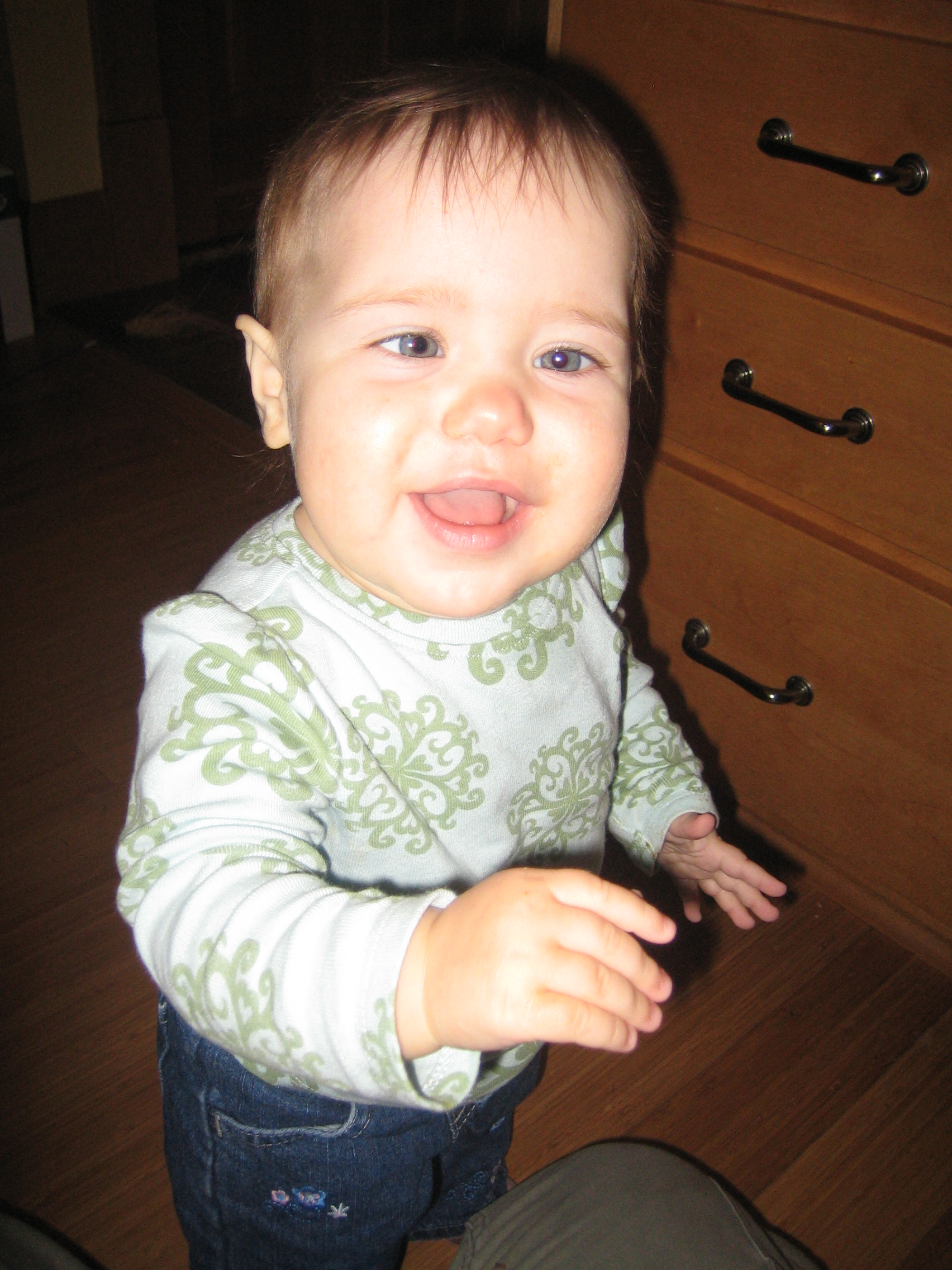
The phone rang at about 1:30 yesterday afternoon. My 16 month old daughter’s glasses were back from the lab and ready to be picked up from our Optometrist’s office. I couldn’t wait any longer than ten minutes before I woke my little Ivy up from her afternoon nap. We were on our way to Ivy experiencing her world in a whole new way. During the drive, I couldn’t help but think of how I was going to react. Would I smile, would I be nervous, would I cry? How would my daughter react? Would she cry, would she try to pull the glasses off, would she be happy? I had no clue. My body was on autopilot as I found myself pulling into a parking spot.

We entered the office and one of the wonderful staff members saw us walk in. She was on the phone with a patient getting insurance information. She waved to me and kindly asked the patient to hold. “Hi, Ivy!” she proclaimed. She finished up with the phone call and then what seemed like the entire staff, minus our optometrist, was waiting to give my daughter her glasses.

The adorable purple plastic frames were handed to me. They felt so small sitting in my hands. I couldn’t help but think of how these tiny glasses were going to do huge things for my sweet little girl. I placed them on her head, then took a half step back and sat on the floor with Ivy to allow her to react.

My body was still next to hers as she began to look around. She studied my face, looked down at my shoes, then hers, looked at the carpet, then at the lights, the staff, and back to my face. My heart began to burst inside as my baby girl was pretty much seeing clearly for the first time. Warm tears flooded my eyes and then rolled down my cheeks. A man in the waiting room began to tear up as well. We take it for granted, but the gift of sight is such a beautiful thing.


After Ivy and I got home, she wanted to look at everything. She got her books out and began to flip through the pages. Being able to see the texture of her “Touch and Feel” books added a whole new element to reading. She could actually see where to touch and didn’t need us to guide her. Watching Ivy pick up and examine her toys was such a joyful experience. The best of all, was how she observed her daddy’s face; that tugged at my heart. I couldn’t be happier that my sweet little girl can now clearly see what is going on around her!
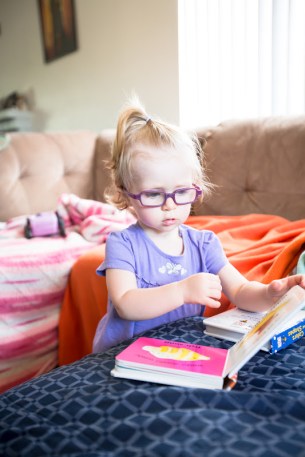
The only thing I worry about with Ivy and her glasses is her self esteem. After much research, we have learned it is best to avoid commenting on the glasses to the child. For example, saying, “You look so cute in your glasses!” sounds really sweet, which I would have thought too, but we have learned, if a child hears that repeatedly, then they may start to believe they are only cute when they wear their glasses. It is best to comment on a specific aspect of the glasses, like if they have a design or a color that helps bring out certain features of the child. And, if you don’t know what to say about the glasses, then just pretend like they are not there and comment on something completely unrelated. Helping Ivy find her own individuality and uniqueness is my husband and I’s goal. We want our little girl to embrace who she is and to be confident in herself. We love our little girl and can’t wait to watch her grow!

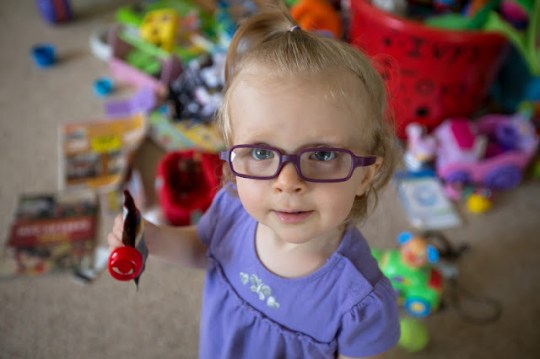
Open thread: Signs your young child needed glasses

It’s a question that all of us with a young child in glasses have heard over and over: “How did you even know your child needed glasses?”  It’s hard when your son or daughter isn’t reading, might not even be talking, to have any sense of whether they’re seeing well.  And if you look for information on signs of vision problems, most books and websites talk about sitting too close to a tv, or trouble reading a chalkboard, or difficulty reading.  Useful, but so much not for the very young kids.  I’d like to pull together a list of signs of vision problems for parents of very young children.  So what led you to have your child’s vision checked?   Are there signs that you may not have paid attention to at the time, but in retrospect are ones you’d tell other parents to watch out for?

(For us, Zoe’s eyes were turning in quite noticeably and significantly starting around 8 months old.  Even with them turning so much, I almost ignored it and let it go.  When I did bring it up to her pediatrician, I fully expected her doctor to tell me it was nothing.  Zoe’s doctor didn’t see her eyes turning at that appointment, but thank goodness she still trusted me and what I was describing, and referred us to an eye doctor.)

Books about patching: Reviews of “The Pirate of Kindergarten” and “PatchLand Adventures: Fishing with Grandpa”

I’ve noted before that while there are quite a few books for kids about wearing glasses, there are even fewer that talk about wearing an eye patch.  I thought I’d review two of the books that are out there, “The Pirate of Kindergarten” by George Ella Lyon and “Patchland Adventures: Fishing with Grandpa” by Carmen Swick.

The Pirate of Kindergarten

“The Pirate of Kindergarten” by Gearge Ella Lyon is a 2011 winner of the Schneider Family book awards, which is awarded to a book that “embodies an artistic expression of the disability experience.”  It follows the  story of kindergartner, Ginny.  Ginny is smart and determined, and she loves reading.  The only problem is that Ginny sees double.  Two of every chair, two of the bunny she tries to cut out of paper, two of each word and letter she tries to read…  Not surprisingly, it leads to a lot difficulties for her as she tries to get through kindergarten:

But Ginny’s eyes played tricks.  She read “cat cat ran ran fast fast.”  She thought everyone saw this way.  She didn’t know they were tricks.

When other kids laughed, Ginny really tightened her mind the way you tie a knot in a rope.  Then she could remember to read only “Cat ran fast.”

Eventually, it is vision screening day.  The nurse giving the eye test recognizes that Ginny is seeing double and kindly explains that “most people see only one.”  Ginny is then sent to an eye doctor and prescribed glasses, and given a patch to start wearing that day.  The patch immediately solves her double vision and she becomes a Kindergarten Pirate who can do all the things she’d struggled with previously.

The writing in this book is lovely.  You can’t help but feel for Ginny, who is trying so hard, not even aware that she’s facing difficulties that others don’t have because she sees things differently than her classmates.  The illustrations by Lynne Avril are fantastic, too, depicting not just the Ginny’s double vision, but also her confusion because of it.  You see double letters and numbers swirling all around her.  Zoe definitely loved the book (though she hasn’t had to patch for over a year, a point that may be relevant as you’ll see).

Despite that, I have some serious hesitations in recommending this book.  Most kids who need to wear an eye patch are not doing so because they see double, they’re doing so because they have amblyopia.  And a child who is dealing with amblyopia will more likely have nearly the exact opposite experience as Ginny’s.  An amblyopic child often does not know they have a vision problem because their strong eye is seeing just fine, and because their brain has suppressed the vision of one eye, they won’t see double.  And once they are given a patch, they will have difficulties seeing, as opposed to Ginny’s immediate visual improvement with the patch.  Furthermore, one of the results of patching treatment may be double vision if the amblyopia is due to strabismus – that means the visual input from both eyes is being recognized (see Amber’s post about her daughter seeing double).

I worry that this book could confuse the issue of why a child needs to wear a patch, and make it harder for them to explain to others what they’re going through.  And I would hate for a child who is going to start patching as amblyopia treatment to read this book and think that they will immediately see better because of their patch (certainly we hope the longer-term outcome is improved vision).  It is a great book for depicting what it’s like to live with double vision, though, and if your child is dealing with that, I do recommend it.  It is also a great book for depicting the struggles that others go through that we so often are unaware of.


PatchLand Adventures

“PatchLand Adventures: Fishing with Grandpa” by Carmen Swick is a book based on her son’s experiences with patching.  Preston’s best buddy is his dog, Beau, and they do everything together, including wearing an eye patch to treat amblyopia.  In this first Patchland Adventures book, Preston and Beau go fishing with grandpa.  After a busy day of fishing, he heads to bed with his eye patch under his pillow.  That leads him to dream of a world wear all the animals wear patches (and fly planes and play baseball).  The next morning, he and his dog head to his eye doctor appointment where he learns that his eye is getting stronger, but he still needs to continue patching.  His eye doctor also explains a bit about amblyopia and patching treatment.

It’s kind of funny that this book, with a talking dog and dreams of other animals wearing patches, is really quite realistic, in some respects.  I really appreciated the Preston’s honesty in the very first page of the book where he talks to his dog about needing to patch:

“Mom says we have to put on our eye patches on so our weak eye can get stronger.”

“I don’t want to wear it either, but we can do anything with a patch on.”

This book is unique, too, in that it shows only the middle part of the patching journey – that long hard slog through patching every single day.  It does not talk about the beginning of the patching journey, when a child first starts dealing with patching, and it doesn’t show an ending of the patching either.  While Preston’s vision has improved at the end of the book, he still needs to continue patching.  When Zoe first read this book over a year ago, she was in the midst of patching, and about to head out to her first follow-up visit.  I really appreciated the fact that this book helped to raise the possibility that her doctor might tell her she’d need to continue patching (and indeed, that’s what happened).  Zoe enjoyed the book, and I think, related to the character of Preston, who did not like wearing an eye patch, but still did so and continued to pursue his favorite activities while patching.

The story is told all through dialogue between the characters, with Preston narrating the dream.  It is laid out a little like a comic book, with each page a separate panel, and the dialog set near the character speaking it.  The illustrations, by Joey Manfre, are simple and bold.  It is not my favorite style of illustration, but it fits the story.

The author, Carmen Swick, has written two other stories about Preston’s PatchLand adventures.  Book two “Camping at Mimi’s Ranch” is expected to be published this fall.  She writes more about her family’s experiences on her blog Patch Land Writings.

Full disclosure: I did receive a copy of her book for free last year when Zoe was going dealing with amblyopia.  I do not believe that has influenced my review.

Reader request: anyone’s child with antimetropia (one eye farsighted and the other nearsighted)?

This comment came in yesterday, and I have permission to re-post it here, as Giri is looking for other parents facing the same situation.  – Ann Z

Hello, My 12 month old son got a prescription for glasses, which more of them saying is rare (OD +6.50 +1.0 x90 / OS -7.50 Sph) Dr. recommended to go for Polycarbonate lenses. Any one faced this kind of prescription – having one plus and minus at this age? As am not having any knowledge, checked with few known places and response am getting is differs. Is there a possibility that it will get better when he grows? Also how rare this kind and anything serious with this? His Retina and Optical nerve looks fine. No other symptoms or developmental issues so far.

Any info or experience greatly appreciated. Thanks in advance for your help.

Ann here again: I’ll note that polycarbonate is a great lens material for children because it is far less likely to shatter.  “Antimetropia” is the term for one eye nearsighted (minus prescription) and the other eye farsighted (plus prescription).   Does anyone else have a child with this condition?  Any insight or thoughts?

Preparing for Your Child’s Surgery

So your little one is having surgery? Take a deep breath. Now let it out. Good! I think this whole process is just as hard (if not harder) on the parent as it is the child. If you’re anything like me, you want to be doing something during this waiting stage. Planning was something I could do and turned out to be very helpful.

Two of my three children have had surgeries before the age of two (only one was eye related). And we are preparing for a second eye surgery on our Strabismus boy, Joel at the end of the month. As we revisit this list in our home, here are some things we do to prepare for a child’s surgery.

Prior to the Surgery:

  • Know Your Dates. A lot of dates were probably thrown at you when your child was scheduled for surgery. Pre-Op appointment and physical, surgery date, post-op visit. If you have a master family calendar, make sure these dates are on there. Also share with necessary friends and family members.
  • Get a Schedule in Place. Once you know your dates and have them on your calendar, sit down to think about them for a moment. I made a schedule of our day. Who is going to be taking your child to the surgery? Do you have someone coming to stay with your other children? I attached my schedule if that can be of any help to you. You might also want to consider asking a third person to come along to surgery with you (I asked my sister to come with us). She was our runner, our note taker, and our sane person. Since my husband and I were focused so closely on Joel, my sister was a great help at being able to see things a little clearer than we were at the time. She took detailed notes whenever we spoke to a doctor and was always there if we needed anything.
  • Start a List of Questions. You know all those questions that keep popping into your head while you’re in the shower? Write them down. There is no such thing as a stupid question. I like to use one of those magnetic notepads on my refrigerator. That way I can go back and look at it. Some of the questions I end up looking up myself online. Some I have kept for our next doctors appointment. It is always good to keep a list. Once I get into that doctors room my mind always goes blank. If I forget my list, I forget to ask something every time.
  • Have a back up plan. Our kids are little. Things happen that might require you to have to reschedule your surgery date. We had to. Joel got a cold three weeks prior to surgery. By his surgery date he was fine, but they still would not do the surgery. We were told with a child so young he needed to be illness free for four weeks. This might vary, but know you may need to be flexible.
  • Talk it out. Let your children know what is happening. If you child is old enough to understand what is happening, talk to him about it. Also talk to any siblings and explain it to them. Let them know Mommy and Daddy will be spending a lot of time with their brother/sister for a couple days and that doesn’t mean you don’t love them. Let them know they are an important part of the family and you would love their help.

The Day Before the Surgery:

  • Pack a Bag (for both of you). Make a list of what you need to take with you to the hospital for you and your child. Yes, both of you. I pack three different bags. One for Joel’s things, one for things I would need during surgery, and an overnight bag for me just in case Joel was admitted overnight for some reason. The overnight bag you can leave in the car. You probably won’t need it, but it’s better to be prepared.

What I packed for Joel:

        • Change of Clothes (Button down the front shirt – he came home with arm restraints so something that was easy to slip on was very helpful)
        • Extra diapers and wipes
        • Sippy Cup
        • A little snack (A few crackers in case he was hungry)
        • Stuffed Animal / Favorite Blanket

What I packed for me: (Day of the surgery)

        • Fully charged cell phone (You know your family will want to know!)
        • Bottled Water and Snacks (Take care of yourself – you’re no help to your child if you are not functioning properly)
        • Camera (I like to get everything on film)
        • Book to read (I don’t think I actually read it, but it was good to have)
        • Notepad (A lot of information came at us when the doctor talked to us post-surgery. I was in a state where my mind needed things written down or I would not have remembered anything
  • Prepare Your Home. Think ahead to anything you might want to have ready for when you get home. Do you want to have some easy to prepare food waiting for you? Do you have your child’s room ready?
  • Prepare Your Child. Let them soak in a nice, warm bubble bath. There might be bathing restrictions after surgery. Lay out their clothes for the next day. If they have an early morning surgery time, you might just want to let them ride to the hospital in their jammies.

On the Big Day:

  • Get an early start. Get up early. Take a shower. Get yourself ready. All before your child gets up. Take a few minutes for yourself to think and organize your thoughts. The rest of the day might be chaotic and this will give you a few minutes to center yourself. This is always extremely helpful for me if I know a busy / potentially stressful day is coming.
  • Know what to expect. Do you know how long the surgery will take? That your child might be angry / in pain when coming out of anesthesia? That there might be bloody tears or his eyes might wander differently as he recovers? If your Doctor and Anesthesiologist don’t offer a full list of what to expect, be sure to ask. It is easier to obtain this information now than post surgery when you also have your child to worry about.Another thing I wasn’t prepared for was that Joel lost his voice from having the breathing tube down his throat during surgery. He came out of surgery very raspy and you could tell his throat was sore. Cold apple juice was the one thing he wanted to sip on in the recovery room.
  • Remember your instructions. Don’t forget if your child cannot have anything to eat or drink in the morning. It is so easy to give your child their morning sippy cup without thinking. Stick a note on your fridge reminding yourself no food or drink if that will help you.
  • Get there early. Allow yourself plenty of time to drive to the hospital, park, and find where you are supposed to be. This will also allow you a few extra snuggle minutes with your child before they are taken back into surgery.

This is by no means a complete list, but will hopefully give you a good start when preparing for your child’s surgery. I’d love to hear any other tips or tricks you’ve found when going through this process. I’ll also be back later to talk about helping your child recover from surgery (and things to look for), so feel free to leave any questions you would like to see covered on the recovery process too.

Sample Eye Schedule.

Patching Your Toddler Full Time: Yes It Is Possible!

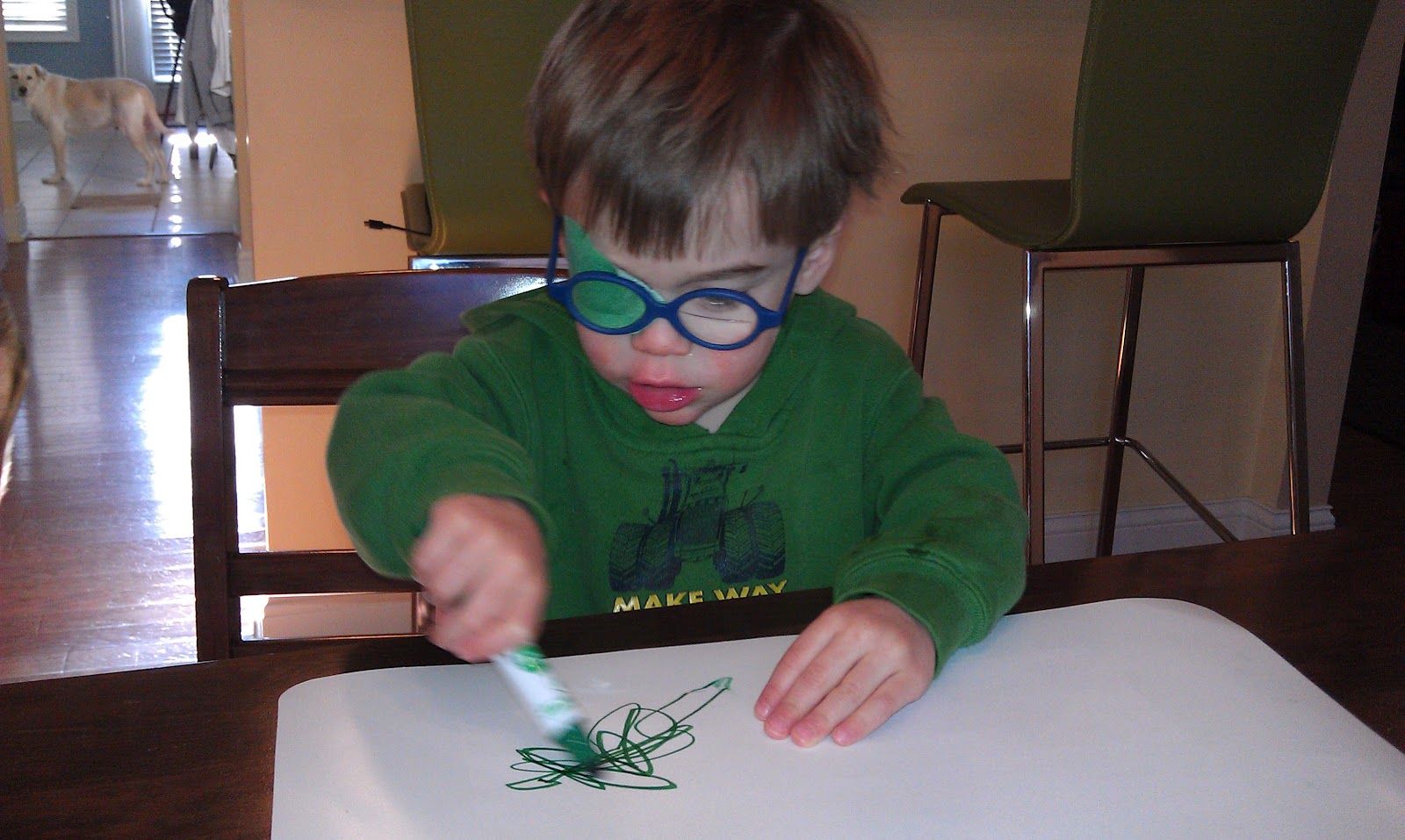
Before my son Joel’s first Strabismus surgery earlier this year, we were patching four hours a day. I could do four hours a day. We’d start patching first thing in the morning when he was fresh. I used lots of distractions and praise. By Noon he was ready for the patch to come off. But that was no big deal because he was allowed to take the patch off.

Fast forward to today. We have one surgery under our belts. It was not as successful as the Doctors had hoped. We went in for a check-up and the Doctor decided she wanted to do a second surgery at the end of the month. To do this, we need to get on an “aggressive patching plan” to realign his eyes. Full time patching. All waking hours. On a toddler. Wow! Our Doctor actually told us just to brace for a couple weeks of hell and just power through it.

I hate to subject any child to two weeks of hell if it isn’t totally necessary, so we’re working to find ways to make full time patching as stress free as possible. It may not be stress free, but if there is patching in your future, here are a few of my tips and tricks to make your life a little easier.

  • Read this post. It was previously posted on the Little Four Eyes site and Melissa does a great job of giving an overview of patching in their house. It is always great to hear what others are doing and what works for them.
  • Get a Game Plan. Sit down with your spouse. Decide how things are going to work. Do you have enough patches? Do you need any other supplies? Are you committed to being firm about patching? Understand each of you might be stressed out through this process (as well as your child). You will need each other’s love and support.
  • Don’t Take “No” for an Answer. If your child thinks he can get out of wearing his patch by pulling it off, he will. Stand firm. If he pulls it off, put another on. Don’t let his behavior dictate your treatment plan. It’s for his own good. Love him enough to stand firm.
  • Celebrate Patching. Find ways to make patching fun. Get siblings involved. My boys all colored patches together and then “patched” their stuffed animals. It was a great way for them to all be involved in the patching process and it allowed Joel to see his “friends” wearing patches too.
  • Make sure your child gets plenty of sleep. A well rested child is, usually, a happy child. Children are less likely to act out when they are well rested. I have found when I have a well rested child he is less likely to pick at his patch or rub his eyes. It also helps to avoid overstimulation.
  • Don’t forget to love on your other kids. I found this one out on day one. I was spending so much time doting on Joel and his full time patching endeavor, I was neglecting my other two boys. They quickly reminded me they also need my love and attention and we got that fixed. If a patching related incident is taking up a good deal of my time, I try to include the other two. I let them be my “assistants” and help our “patient” with his eye patch.
  • Having trouble getting the patch on? Try holding your child on your lap and put the patch on from behind. (This was also helpful for me to ensure I was patching the correct eye). For toddlers, find something to occupy their hands (and thus their mind). I put three Pez into a Pez dispenser. Joel loves working to get his treat and doesn’t even notice when I slip on the patch.
  • Is he still not leaving the patch on? Have you tried diverting his attention to another activity? Giving lots of praise or a reward for wearing his patch? Restraining his arms? The last one may sound harsh, but we found arm restraints were a big help at first. After Joel got used to having the patch on, they were no longer needed. (Our arm restraints were provided by our doctor at surgery number one. If you ask your eye care professional, they might have something that would work for you.)
  • Experiment with the “equipment.” There are different types of patches out there. Some have a heavier “stick” than others. (Ortopad kid patches are less sticky, while Nexcare patches stick a little harder to skin). If your child has sensitive skin, be conscious of how you are removing the patch. If the patch is on tight, try baby oil around the area or putting a warm wash cloth over the patch to loosen the hold. You can also use Milk of Magnesia to soothe irritated skin. 
  • Make yourself a “care basket.” I don’t know why, but for some reason having all my supplies in a cute basket just makes me happy. And it puts everything you need at your finger tips. Your spouse, other caregivers, or family members will know right where to pull supplies from if needed. Our care basket includes: Milk of Magnesia, baby oil, a wash cloth, Q-Tips, cotton balls, two types of patches, and Pez candy for a little reward.

You are not alone. There are others going through the same thing. Link up with others on the Little Four Eyes Facebook page. And when it gets really tough, just take a good long look at that little face. The face of your precious child. They are worth the extra work, the hassle, the tears. You are doing this for them and their vision and that’s a very admirable thing!

 ***
Thanks for reading my first ever Little Four Eyes post. I am a new Contributor here and looking forward to discussing our children and their precious eye sight with you. Stop on over to the Regular Contributors page and read a little more about me. And don’t hesitate to leave me a comment – I’d love to hear from you!

Happy Great Glasses Play Day!

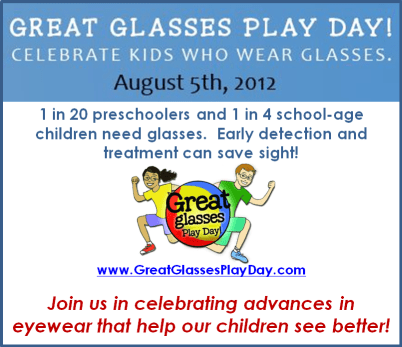
The day has arrived.  I hope you’ll celebrate the Great Glasses Play Day with us!  Celebrate our children who wear glasses, their unique style,  and the advances in eyewear  that help our children to see!  (I feel like I’m saying “celebrate” a lot, but heck, it’s the Great Glasses Play Day, let’s celebrate!)

Please feel free to share this picture on facebook or twitter or Pinterest or your blog to help us celebrate (you can right-click on the image to save it and share it).

Interview with Kristin Ellsworth on giving back

I’ve been talking a lot about the Great Glasses Play Day that’s happening this Sunday.  And it would not have happened at all without Kristin Ellsworth, the founder of Peeps Eyewear and the author of “Princesses Wear Glasses.”  She is the Program Chair for Prevent Blindness Wisconsin and was recently appointed to its Board.  She and her husband live in Madison, WI and have three daughters, the youngest proudly wears glasses.

I met Kristin about a year ago and was blown away by her energy and her passion for children’s vision and her work to make sure that children who need glasses love their glasses.  I’ve often thought about ways of giving back and helping other families with children who have vision issues, and I’m inspired by how much Kristin does.  I wanted to share an interview I did with her, focusing on her work with Prevent Blindness Wisconsin.  – Ann Z

Tell me a little about your daughter getting glasses.

My daughter was three years old when my sister noticed one of her eyes turned in slightly. I hadn’t noticed it. My husband and I took her to a pediatric ophthalmologist who diagnosed her with Strabismus and Amblyopia. I was shocked, I had no idea she wasn’t seeing clearly. We began patching her strong eye in order to stimulate her weaker one. We also found her a pair of glasses that she seemed fine wearing.

What inspired you to write your book, Princesses Wear Glasses?

One day my daughter was playing dress-up when everything got quiet. I peeked around the corner and saw her staring at her image in the mirror. I asked her what was wrong and she said, “Princesses DON’T wear glasses.” Then she threw her glasses to the floor. I was surprised because she was only three years old and hadn’t been exposed to a lot of princess things. She started hiding her glasses around the house and refused to wear them. It became a problem, so I got out some paper and markers and created a story about an adventurous girl who saves the day wearing her glasses – she just happened to be a princess, too! My daughter loved the story and stopped hiding her glasses. I decided I could do something to help other young children feel good about wearing glasses.

What led you to start volunteering with Prevent Blindness Wisconsin?

I was fortunate my daughter’s vision problem was caught early. What I learned was 1 in 20 preschool children and 1 in 4 school age children have a vision problem. I didn’t know this and most of my friends didn’t either. I also learned that up until the age of eight, the brain is rapidly developing. If vision problems are caught early, vision can often improve.

That is where Prevent Blindness Wisconsin comes in. The organization helps vision screen thousands of children. I volunteer in a number of ways. I present to groups to raise awareness and to recruit vision screeners. I contribute and help raise funds for the organization, and I vision screen.

What have you learned from volunteering?

I’ve learned a lot more work needs to be done to address this issue in our nation. Many parents I talk with are not aware that early childhood vision health should be on their radar. Vision health laws and services for children vary state to state. A number of states, including Wisconsin, do not have uniform vision screening and testing guidelines, so it is very important that parents stay informed.

What do you do at screenings?

It involves two tests, a wall chart test (with shapes instead of letters for kids who cannot read) and a stereopsis test (used to help detect if the two eyes are working together). If a child fails the vision screening, he or she is referred to a doctor. It is important parents know a screening does not replace a comprehensive vision exam by an eye doctor.

Do you think having a daughter who needed glasses early has helped you in doing the volunteering?

Absolutely—I take vision screening very seriously since I saw how vision issues affected my daughter. I want to make sure children are screened properly and get comprehensive vision exams. The earlier a child’s vision issue is caught, the better.

What is your favorite part about volunteering for Prevent Blindness Wisconsin?

My favorite part is vision screening children. It motivates me to keep working on Peeps Eyewear and give back to organizations like Prevent Blindness Wisconsin. There are so many rewards, especially coming back to a preschool and seeing one of the children we screened the year before happily wearing glasses.

Is there anything else you would like to add?

Just that I want to thank Little Four Eyes for supporting families and children with glasses. With Peeps Eyewear, I hope to encourage children who wear glasses to imagine they can be anything they want to be. I hope they will identify with less-commercial characters who wear glasses that spark imaginative play, not define it. Every child is unique. It’s time for young children to celebrate wearing their glasses!

link round up – taking photos, patching kits, and the Great Glasses Play Day

I thought I’d do a quick link round-up, since it seems like there’s a whole lot going on right now:

  • Celebrate the Great Glasses Play Day with me on Sunday! – I know I’ve been talking about it a lot, and the day is nearly here!  Check out the list of all the different ways to celebrate.  Everyone who celebrates (and lets us know they’re celebrating) will be entered in a giveaway for some great giveaways!
  • Tips for photographing people in glasses – what I love about this article is that the author, Jodi, is a photographer, but also the mother of a child in glasses.  Her tips are practical and very helpful.
  • Tips for choosing glasses for your child – the picture on this page drives me crazy, since the boy is wearing adult frames, which obviously don’t fit him, but I thought this was a great list of tips to think about when choosing color, shape, and fit of glasses for your child.
  • Patching kits – the Children’s Eye Foundation has put together patching kits.  They contain 30 patches, 10 each from 3 different companies (Ortopad, Nexcare, and Krafty) so you can try different types before you commit to buying a full set.  Let me just say how fantastic this is – from reading the comments here and on facebook, it’s clear that different kids do better with different brands, and what a great way to find out which ones work best for your child.  The kits also come with coloring pages, a calendar with stickers to track your child’s patching progress, and pages of tips and tricks.  The kits are $15 in the US.  They will ship internationally, but shipping will cost more.  If you don’t want to buy the kits, the coloring pages, calendar, and page of tips and tricks are available for download for free (scroll to the bottom of this page to download).
  • Ohio Amblyope Registry – this is a program for Ohio residents that provides free patches and free information for families of children with amblyopia.  They also have some good information about amblyopia and its treatment up on their website.

Great Glasses Play Day update and request for help

I’ve been behind on posting – I apologize!  I’ve been busy working with Kristin Ellsworth on the first annual Great Glasses Play Day.  It’s been a lot of work so far, but I’m getting very excited about how it’s shaping up.  We have events lined up in 7 locations across the world  for families to come together and for kids in glasses, or contacts, or patches to get together and play.  And we have a lot of ways for people to celebrate online or even have their own party on that day.

It’s been kind of amazing to see this take shape.  Four and a half years ago, I kept hoping I’d find some group of parents with kids in glasses who wanted to get their kids together, but if it existed, I never found it.  Once I started Little Four Eyes, that idea fell to the background as I got to know all of you so well online.  But thanks to a lot of people who kept bringing up the idea of local get togethers on the facebook group, and especially to Kristin who has really put so much in to making this happen, it’s going to actually happen this year.  I can’t wait to see and hear about kids getting a chance to see others their age in glasses, and for parents to meet others who are going through similar struggles.


The day has received a tremendous amount of support from the optical and eye care industry, and a lot of interest from many of you as well.  But we need help in making sure the word gets out to other families, and so I’m asking you all for help.  Can you help spread the word – by sharing the link to the Great Glasses  Play Day site on facebook, or blogging or tweeting about it, or sharing the information with any parenting groups you’re a member of, especially those in the locations where the events are being held.  Or, if you know of a great parenting list or website that we might list the event, would you let me know about it?

I hope to see some of you in person in Minneapolis and celebrate with the rest of you virtually this August 5th!

Book review: Arlo Needs Glasses

I mentioned in my last post that there’s a photo contest for the new book, Arlo Needs Glasses, and I promised to provide a review.  The contest runs through July 31, so be sure to check that post out – it also has the very cute trailer for the book, featuring the author’s dog, Arlo (in glasses!).


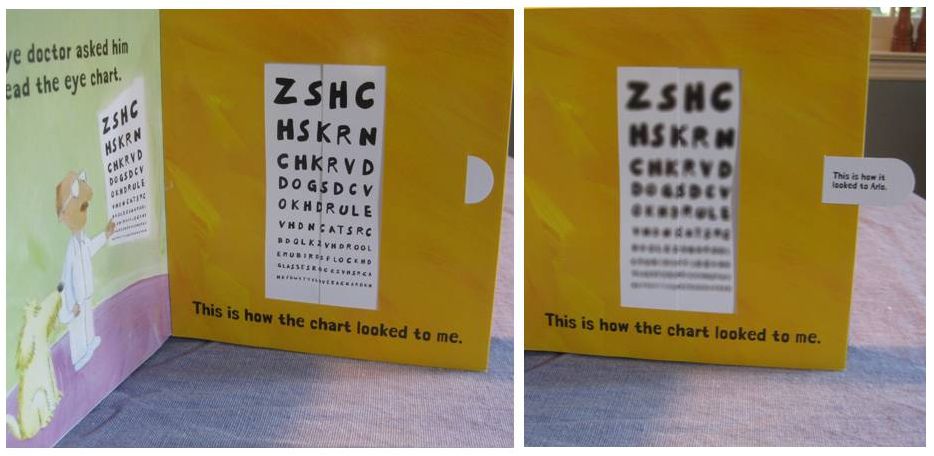
Arlo Needs Glasses is by Barney Saltzberg, children’s book author, illustrator and musician.  The book, recommended for children ages 3 and up, is bright, fun, and interactive.  There are balls that fly through the air, books that pop-up, eyes that look left and right, and four different pairs of glasses to try on.

But first, the story.  The story is a fictional tale about Saltzberg’s dog, Arlo.  Arlo used to be great at catching balls, but one day, Arlo stopped being able to catch the balls.  After trying a few different things to help him, the narrator decides that Arlo must need glasses.  You get to see some of the tests and equipment that Arlo uses at the eye doctor’s, and once it’s confirmed that Arlo needs glasses, you get to see, and try on some of different frame styles for Arlo.

The eye chart as it appears for the narrator (left) and for Arlo (right)

Continue reading “Book review: Arlo Needs Glasses”

“Arlo Needs Glasses” photo contest

There’s a new book for kids who need glasses, Arlo Needs Glasses, by Barney Salzberg.  You can see the extremely adorable trailer video below:

I’ll be posting my own review in the next post.  (I’ve posted it – 6/27/2012)

To celebrate the release of the book, the publisher, Workman, is holding a photo contest on Pinterest in which 5 participants can win an autographed copy of the book.

To enter:

Share funny photo of your dog wearing glasses for a chance to win a signed copy of “Arlo Needs Glasses” by Barney Saltzberg. Be silly, but promise to not put your pup through too much embarrassment.

Enter between June 25 — July 31 by posting your photo on your Pinterest board with the hashtag #ArloNeedsGlasses. Then follow Workman’s board: www.pinterest.com/workmanpub. Workman will the post photos to the “My DogNeeds Glasses!” board: Pinterest.com/workmanpub/my-dog-needs-glasses.

Five photos with the most likes and re-pins by July 31st will win an autographed copy of “Arlo Needs Glasses from Workman”. Entrants must be U.S. residents.

You can read the full rules here.

Your stories: A Green One

June is Cataract awareness month, so we’re featuring stories from families that have dealt with pediatric cataracts.  Many thanks to Melissa for sharing her update on Anderson!  You can read more of Melissa’s writing at A perfect boy, a not so perfect eye. – Ann Z

In honor of Cataract awareness month, I wanted to share some thoughts about where we are in our cataract journey. My son, Anderson, is 2 ½ and has been patching since he was 11 months due to a unilateral cataract. It has been nearly impossible rough for all of us. This was originally posted on my blog, A perfect boy, a not so perfect eye.

We have entered a new phase of the Eye. To be fair, it is really quite relaxing as Eye phases go. Sort of a comical phase, if you will. Anderson insists on always wearing a green eye patch. Always. We have no idea where this tireless obsession/demand for, “A GREEN EYEPATCH! I WANT A GREEN ONE!” came from, but it has been going on for a few weeks. The night before “a few weeks ago” I ordered about 200 patches, only about 30 of which were green. So, after I realized this green situation was here to stay I had to quickly order another load to ensure the green ones don’t run out.

toddler boy wearing glasses and a patch for a cataract

Continue reading “Your stories: A Green One”

Your stories: Has it been a year?

June is Cataract Awareness Month, so we’re featuring stories about families dealing with pediatric cataracts.  Thank you so much to Crystal, for sharing her son Grant’s story. You can read more of Crystal’s writing and more about Grant at her blog, Sight Restored. – Ann Z

Has it been a year? A year since I told you about our precious Grant? My goodness, how time flies!

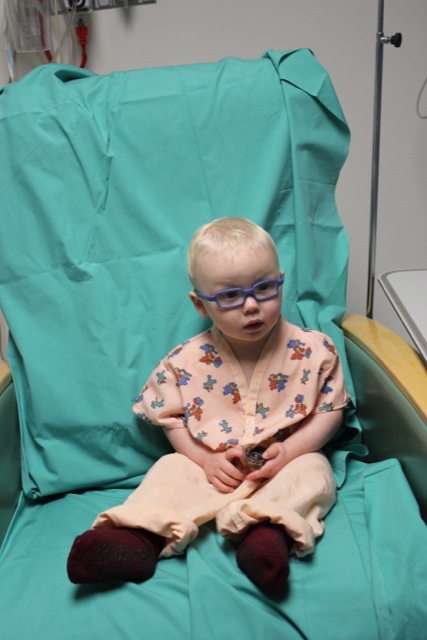
baby boy in glasses for cataracts

A lot has happened in the last year. Here’s a little bit of it:

Continue reading “Your stories: Has it been a year?”

Reader post: June is Cataract Awareness Month

Many thanks to Sheri from Stewart Snippets for writing this, and giving her permission to re-post it.  You can read the original here.  June is Cataract Awareness Month, and so I’m publishing a series of posts on pediatric cataracts.  If you’d like to write something this month, please let me know – Ann Z

June has been designated Cataract Awareness Month.  If you Google or Bing “Cataract Awareness Month”, you will likely find a whole lot of information about cataract surgery for seniors.  You need to Google or Bing “pediatric cataracts” to find information about cataracts in children.  This is because:

  • Cataracts present at birth are known as congenital cataracts* and affect approximately 1 in 2,000 children**.
  • Cataracts in children (emphasis mine) are uncommon* (approximately 1 in a thousand to 1 in 10,000 (emphasis mine) children).
  • Cataracts developing as humans age are relatively common, affecting roughly 60% of people over the age of 60, and over 1.5 million cataract surgeries are performed in the United States each year.***

Our son, Adam (aka Buzz), suddenly developed bilateral cataracts (i.e., cataracts in both eyes, not just in one) when he was about 2.5 years old.  As you can see from the statistics above, this is very rare.  As you can imagine, as parents, we were flabbergasted, floored, and flummoxed.  Since it is the age of computers, my husband and I ran to the computer to Google, Bing, and whatever else we could think of to find information about other children who’ve had cataracts.  We wanted to know what we could expect.  Unfortunately, we found very little information pertaining to our exact situation.  We found lots of information on congenital cataracts (i.e., cataracts that are present in a baby’s eye(s) at birth).  We were able to glean some information from what we could find, like what the surgery might be like but since most babies are fitted with contacts or glasses and do not have intraocular lenses (IOLs) placed as our son was going to, we had no frame of reference to prep ourselves for what was to come.

Continue reading “Reader post: June is Cataract Awareness Month”