Beyond patching: Stella’s vision therapy now includes MFBF

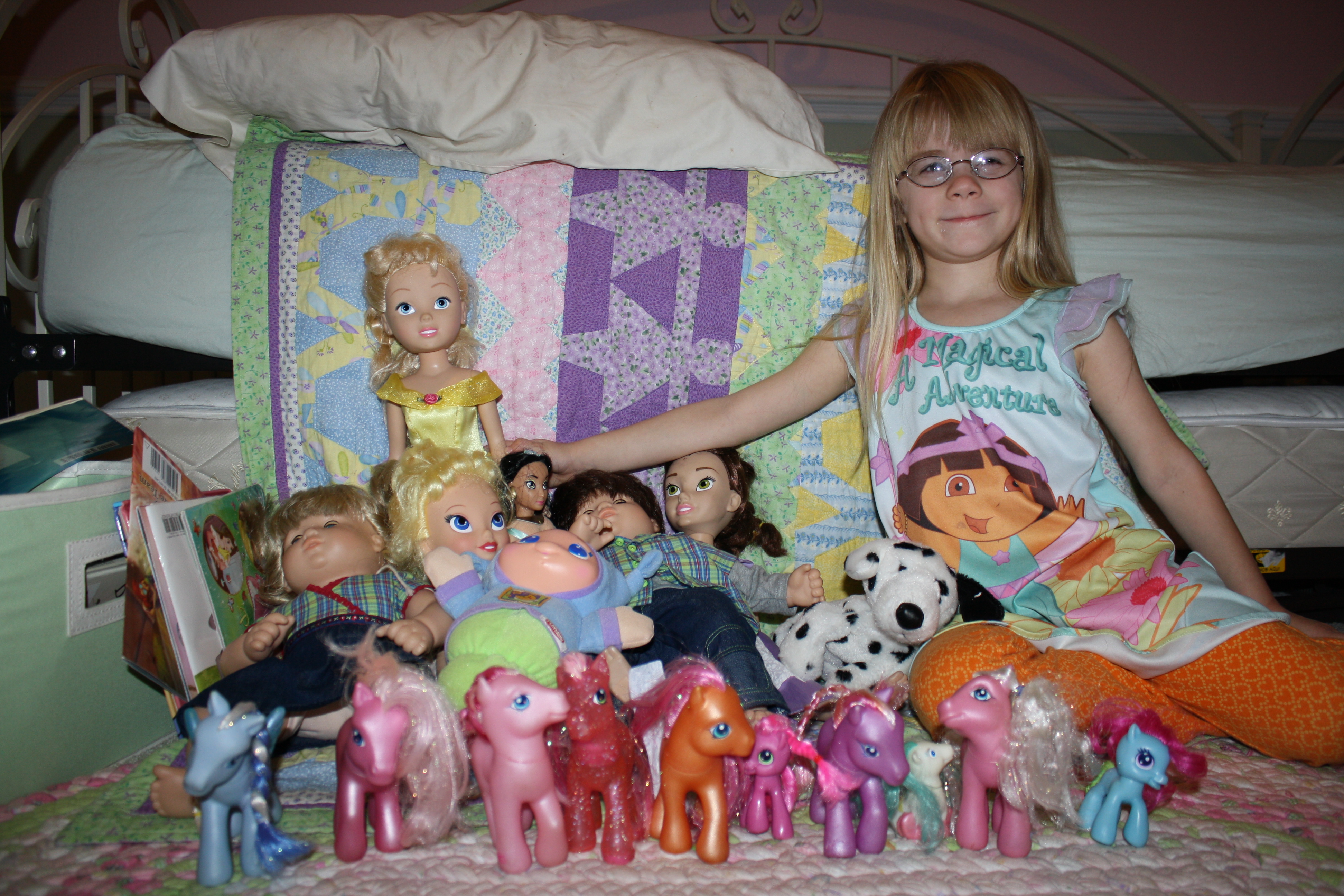
The Treat Game: Stella's baby helps find matches during vision therapy
The Treat Game: Stella's baby helps find matches during vision therapy at home

Stella’s developmental optometrist views patching as a first step in amblyopia treatment. Patching (in our case, Magic tape over the lens of the stronger eye) boosts the acuity of the weaker eye. Stella’s lazy eye is growing stronger, and vision therapy is more and more focused on training her eyes to work together for strong binocular fusion, in an effort to encourage stereoscopy, prevent or minimize regression and provide a lasting fix.

Stella’s daily patching time now feels pretty turn-key, even though (as is my nature) I do it on the fly. She does a solid hour, at least, first thing in the morning, kicked off by some video watching. Sometimes it says on and patching is done by late morning. Sometimes patching is completed in two or three chunks. I seize opportunities strategically. If she’s engrossed with a toy that demands a ton of hand-eye coordination, I’ll throw on her patch to give her amblyopic eye a workout. We’ve got patching down! Vision therapy? Or more accurately, getting 20 to 30 solid minutes of vision therapy done at home? Still a challenge. But as her weaker eye improves, the nature of  her vision therapy is changing. The latest exercises seeming to provide more improvement bang for our frustration buck. So we’re trying harder than ever.

Ever since Stella’s vision therapy progress evaluation which showed great gains, we’ve been doing a bit of what Susan Barry discusses on page 150 of Fixing My Gaze: monocular fixation in a binocular field (MFBF). This means that instead of being completely excluded via the patch, the stronger eye is merely put at a disadvantage. Her dominant eye is still able to receive and contribute visual input, allowing the eyes to work together, but the amblyopic eye is forced to do the heavy lifting. Several doctors/researchers, over several decades, have endorsed the effectiveness of this approach (Brock, Cohen and Hess for starters). Our experience with MFBF is limited but growing.

Almost every day, Stella dons a green-tinted patch over her strong eye and watches a video on our TV, the center of which is covered by a transparent red sheet. Her strong eye can’t see what’s in the red area thanks to the green tint, but it can still see what’s going on the periphery. In order to take in all the action and view the complete picture, her un-patched amblyopic eye has to pick up the slack and garner what is usually the most important part of the scene (whatever is centered, like close-ups of facial expressions, etc.). Her eyes are working together but her weaker eye has to perform at a higher level, setting the stage for binocular fusion. This work counts as patching time, so hooray for that!

Continue reading “Beyond patching: Stella’s vision therapy now includes MFBF”

A sticky situation

After a couple of weeks of wearing the Ortopad patches that we got from the doctor’s office, Zoe asked for patches that were a bit “sparklier.” The doctor’s office only had the boy patterned patches, which are actually pretty cool – space ships, and pirates, and airplanes – but still, she’s the one wearing the patch, and if it’s sparkly patches make patching easier, well then, sparkly patches it is. I bought a pack of the Ortopad Elite, which have glitter accents. She loves the patterns, but WOW are those patches sticky. I wasn’t sure I’d be able to get the first one off her face at all, and she was really upset with how much it hurt. We ended up trying a few things, including me putting the patch on my hand first to try to get some of the adhesive off before putting it on her face. But what seems to work best so far is for me to put a fairly thick layer of moisturizer around her left eye before putting the patch on. It keeps it from sticking quite so strongly, though it’s still staying put.

I can’t help but imagine Zoe 40 years from now noticing that her left eye has far fewer wrinkles than her right eye and wondering why.

Edited to add: I should add that Amblyopia Kids had a good article recently about stickiness in adhesive patches that’s definitely worth a read.

New eyecare links on the resources page

I’ve recently learned about, and subsequently added some new links on the resources for parents page, and wanted to bring them to your attention.  Thanks to everyone that has suggested sites, and please, keep them coming!  If there’s a helpful website or great community out there, I want to list it.

Reference resource

Communities for specific vision issues

Blogs by eye care professionals

  • Dr Lea & Children’s Visions – Dr. Lea Hyvärinen is a Finnish pediatric ophthalmologist.  She may be most well-known by people here as the developer of the LEA symbols (the pictures of a house, an apple, a circle and a square that are commonly used as an eye chart for children).  Her blog managed by her daughter, and is so far, a way of making available her writings about children’s vision development.
  • The VisionHelp Blog – VisionHelp is a blog written by a group of leading optometric vision specialists in the U.S.  They seek to increase awareness and understanding of vision treatment and vision therapy.

Patching in the Pre-K

Thank you, thank you, thank you to everyone who left kind words and advice on my last post.  It really meant a lot to me.

Zoe started patching at daycare the same day that she moved from the preschool room to the pre-kindergarten room.  When I emailed the daycare center the day we learned she’d start patching, the director called and asked if I thought we should delay Zoe’s move to the pre-k room until she’s done patching.  I couldn’t think of anything worse to do – she’d been looking forward to moving to the next room with the big kids, and telling her we were delaying because of patching is a sure way to make her really resent patching even more. We decided to patch first thing in the morning, so that we could put the patch on, and her teacher would only need to take it off later that morning.

Zoe’s been using Ortopad patches that the ophthalmologist’s office provided us.  They’re the boy patches, but so far, Zoe hasn’t minded the patterns.  We also got one of the Ortopad patch posters – it’s a fish, and each patch is one of the fish’s scales.  One of Zoe’s concerns was how to get her patches home from daycare to put on the poster.  So I made her a “patch card.”  I folded a piece of construction paper in half, and cut the middle out of one of the halves.  Then I cut a piece of parchment paper (used in baking) to fit inside and stapled it together.  (I tried gluing it first, but the glue wouldn’t stick.)  She takes the card to daycare, and when she’s done patching, they put the patch on the parchment paper.  The patch easily comes off the card once we’re home and Zoe puts it on the poster.

Zoe's patch card for taking her patch home from school.

I also sent a page of instructions along with Zoe on that first day of her patching.  I know that it was probably unnecessary (her teacher has had at least one other boy who patched in her class), but I couldn’t help myself.  Here’s what I sent:

  • Zoe needs to wear her patch until 11 am each day.  We’ll keep an extra couple of patches in her cubby box in case the patch falls off.
  • While she’s wearing her patch, she can’t see quite as well, though she’s been able to pretty much do all her normal activities.
  • When she’s done patching, it’s easier to take off the patch if you use a damp washcloth/paper towel to get the edges wet.  Pull the patch off from the inner corner of the eye out.  It still hurts a bit.
  • Save the patch on Zoe’s patch card.  We’ll take it home each evening to put on her patching chart.

It’s gone well so far, she said one boy laughed at her the first day, but no other reports of that happening.  Mostly she seems annoyed that the kids all think she’s hurt her eye when she’s wearing the patch.  I’m guessing that mostly comes from the young toddlers (they all start out in the same room together) who don’t understand the explanations they’re given.

Her teachers have also been asking how many days she needs to patch for.  I’m stumped on that one.  Her next appointment is after 6 weeks of patching, and I’d love for that to be all she needs, but I know that it may not be.  Anyone have good tips for managing expectations for the follow-up appointment – both with Zoe and with others who ask about it.  I want her to feel that her efforts are worth something, but I also don’t want her feeling crushed if she needs to patch longer.

Making Eye Appointments FUN!

We are frequent visitors of our PO office. I like to joke that we need a “Fast Pass” like they have at Disney!  As a parent, I struggle with how to not only make our eye appointments survivable, but fun. I bring my normal “bag of tricks” including books, crayons, puzzles, and other fun little things to keep them occupied.   As you all know, most visits are at least 1 hour, much longer if they need to dilate eyes and cooperation is really essential.  I just read an article that stated you only have on average 12 minutes with the DR and need to make the most of this time.  Well, my kids are usually a little board and not so cooperative by the time we are called back into the exam room.   When Elliana was younger, we would bring a bag of M&M’s (the only time she got sweets) every time she answered the PO’s questions (didn’t matter if the answer was right or wrong) or read the letters, she got an M&M.  This worked fantastic.  But then we needed to change it up to keep things exciting.  So, we planned a trip to get a slushie through the drive through on the way home from the visits.  Again, this worked out well, but I didn’t like the fact that I was rewarding good behavior with food again.  So, back to the drawing board.  When I stopped at a consignment shop and found a gigantic bag of My Little Ponies for $3.00, I knew I had hit the jackpot.  Now, for the last year, I bring a new pony to each visit.  I give my daughter the pony when the eye exam begins and the pony helps her read the letters.  Elliana can then add the pony to her collection.  It is a WIN- WIN situation.  She looks forward to her eye visits and meeting the new pony, the PO can get her testing in, and I am glad to find a non-sugar food way to make the appointments fun!

Your stories: intermittent exotropia and conflicting treatment options

This story was sent in by Sheetal.  She’d love to hear from anyone else dealing with intermittent exotropia. – Ann Z

My daughter has intermittent extropia. Her eye drifts outwards intermittently. We discovered it when she was about 7 months, but doctor said not to do anything about it then. We started patching when she was about 1 1\2 years; we patched only one eye (right eye) to make the left eye stronger. We did it for about four months. We went for a follow up in November 2010; she was 2 years by then. Doctor said, he sees the drift and he says he will have to do surgery soon. He also told us that her vision is fine in both the eyes. (20\20)

I really panicked, because though I see the drift in her eyes, I don’t see it all the time and I see it occasionally, maybe 5-10 times a day and it is different on different days. Whenever the drift is there, it stays for few seconds and she corrects it. Drift usually comes when she is looking at certain angle, I don’t see it when she is looking straight at things. So I was completely shaken when doctor said surgery is the only option.

I subsequently took appointment from 2 other doctors.

The second doctor told me that the drift is about 20-25 prism units, but he suggested not to do anything, he is very experienced and he told me to wait, according to him 1\3 of the cases stays the same, 1\3 gets better on their own and 1\3 gets worse. So he told us to keep a watch and I have appointment with him in April. (He also advised is against patching because he of the binocular vision). He also mentioned an interesting fact, that small kids have to look up at everything because their height is small, but as they grow everything is at an eye level and that helps in getting the drift better.


We went to the third doctor and he also mentioned that the drift is about 20 prism units.

He knew my first doctor and he said, he didn’t agree with him as far as the surgery goes, he said surgery is the last option and he recommended to continue patching and suggested pencil pushup exercise.


Now, I am a little relieved that surgery is off for now but am confused that there are different statements from different doctors. Am not sure if whatever I am doing is right, fear of something going wrong is always there.

Now I am patching the right eye for 1 1\2 hours and left eye for 1\2 hour alternate days.

We also try doing the Pencil Pushup exercise with her, we got 100 sticks from dollar store and we stick stickers on the tip and move it from back to front, she does it or few minutes and then looses attention.

book about patching awarded the Schneider Family Book award by the American Library Association

The American Library Association announced its 2010 Youth Media Awards this week.  One of the awards, the Schneider Family Book award “honors an author or illustrator for the artistic expression of the disability experience for child and adolescent audiences.”

This year’s Schneider Family Book award for children’s books was awarded to “The Pirate of Kindergarten” by by George Ella Lyon, illustrated by Lynne Avril (find it at a library or buy it from Amazon).  The book is about a young girl, Ginny, who struggles in kindergarten because she is seeing double.  Glasses and an eye patch help her to see better, and become the pirate of kindergarten.

I have not read this book, but will be seeking it out from our library to read with Zoe.  Has anyone else read it?

Thank you to Joanna for posting this on the Little Four Eyes facebook group.  And congratulations, and thank you to George Ella Lyon and Lynne Avril!

why the vision screening at the pediatrician’s office wasn’t good enough

Zoe had her 4 year old well-child visit a month and a half ago.  At that visit, they did the normal preschool vision and hearing screenings.  I was pretty interested to see how they differ from the actual exams, as Zoe’s had full exams of both her eyes and ears in the past 6 months.

The hearing screening seemed pretty good, not a lot of room for subjective calls by the nurse or for Zoe to cheat on it, though I’ll readily admit, I know a lot less about hearing tests.  The vision screening was another story, though.

The nurse led Zoe to a hallway and had her stand at a mark on the floor and read lines on the Lea chart (square, circle, house, and apple shapes) with one eye covered.  She did fine with her left eye, but when she tried to read the chart with her right eye, I watched her try to cheat by moving the paddle away from her eye, and moving forward a foot or so past the line to see better.  She still couldn’t read the same line that she did with her left eye.  The nurse said nothing and I was not referred to get her vision checked out further.  Now it may well be that the nurse figured that since Zoe wears glasses, she is already seeing an eye doctor and didn’t need a referral, but I was still pretty annoyed at not getting any feedback.  Still, I knew her regular eye appointment was coming up, and thought (hoped) that there was maybe a chance that she was seeing fine.  So I decided to wait until her regular visit to see what her eye doctor thought.

That visit was today.  Sadly, it was again clear that her right eye just wasn’t seeing nearly as well as her left, and according to her ophthalmologist, a stronger prescription wouldn’t do anything to help it.  In other words, we’re now looking amblyopia square in the face.  Zoe did her first patching session this afternoon.  Tonight when we read Fancy Nancy Spectacular Spectacles, she asked whether Bree needed to patch, too.  She’s worried about kids laughing at her at daycare.

Knowing now that Zoe really was struggling to see with her right eye, I’m even more upset by the casualness of the vision screening.  In our case, it ended up not having horrible consequences, we still caught it and we’re treating it.  But what if Zoe wasn’t in glasses and didn’t have regular full eye exams?  What if I didn’t know how to spot her cheating and what that might mean?  Not treating amblyopia has serious implications.  I strongly recommend that all parents get full eye exams (not screenings) for their kids at least before they start school if not earlier, and not rely solely on a screening.

Oh, and I’m happy to take any patching wisdom that any of you have to offer.

A warning about Nintendo’s upcoming 3D device

Nintendo 3DS, expected to hit stores in March, comes with a warning about possible harm to the eyes of kids under age 6
Nintendo 3DS, expected to hit stores in March, comes with a vision-related warning

Jessica Gottlieb is a prominent blogger known for sharing strong opinions on motherhood, social media, and other assorted and engaging topics. Her son happens to have strabismus and amblyopia. He visited regularly with a pediatric ophthalmologist from age four months until earlier this month. Now nine years old, his vision has come a long way. He continues to wear an eye patch for a couple hours each day.

I thought the Little Four Eyes community would be interested Jessica’s recent thoughts on a piece of tech news: Nintendo’s 3D Gaming Device Comes with a Warning for Children Under Six. The soon-to-be-released gadget will come with a warning about potential injury to the eyes of children under age six, whose vision is still developing. Jessica has a valid concern about the device and its warning. The reason her son still wears a patch is because, at age nine, his eyes are still growing and changing (per the renowned doctors charged with caring for his vision).  So why does Nintendo set the cut-off age at six when we know that eye development continues beyond then? What is the real risk?

This area of concern seems likely to grow as gaming systems evolve without much regard to their impact on young eyes. As if we didn’t have enough on our parental minds, ay? Extra caution certainly seems warranted, especially when it comes our children with visual issues such as strabismus and amblyopia. Thanks for the heads up, Jessica.

Parents/experts, what do you think? How much do you worry (or not) about the effects of video games and emerging forms of 3D entertainment, and screen time in general?

My daughter is only two and her screen time is generally limited to 30-60 minutes of TV (age-appropriate videos) a day, only while wearing her patch as it helps with compliance to our regimen, but I know this will get trickier as time goes on. What guidelines do you have in place for your child? How have viewing/gaming habits and limits changed or become harder as they’ve gotten older? What have optometrists, vision therapists, or ophthalmologists told you about the impact of TV, computers and video games on your child’s vision?

Happy new year! Happy 3 new pictures in the photo gallery!

I thought I’d start the year out with some new beautiful faces in our photo gallery!  Take a look.

Hope the new year has started well for everyone.  Leave a comment with any topics you’d really like to read about here.

vision-related charities

It’s the end of 2010, and I know that a lot of people do end-of-year charitable giving.  If that’s you, and you’re looking for charities to support, please consider contributing to organizations that help prevent blindness and restore sight.  We all know how important vision can be, and how treatable and preventable many vision problems are, especially in children.   Unfortunately, when not treated, many of these conditions lead to blindness.  According to the World Health Organization, 80% of blindness is preventable, and 90% of blind people live in low income countries where treatment is difficult to find or afford (from Vision 2020, a program of the WHO and the International Agency for the Prevention of Blindness).

Here are a few organizations that are dedicated to helping treat vision problems and prevent blindness – if you know of others, please let me know:

  • ORBIS International – works in many countries around the world to provide the tools, training, and technology necessary for local partners to develop their own capacity to provide quality eye care services that are affordable, accessible and sustainable.
  • Unite for Sight – has provided eye care services to more than 1,000,000 people worldwide, including more than 36,000 sight-restoring surgeries.
  • SEVA Canada – (I mentioned SEVA Canada in a recent post, and will be donating all my earnings from Amazon this month to SEVA Canada.)  They help communities in 7 countries and regions develop their own capacity to deliver affordable eye care services. SEVA has a Gift of Sight catalog that lets you specify where your money goes.
  • Lion’s Club International Foundation – prevents blindness and restores sight through the SightFirst Program, and a number of other sight initiatives.
  • Vision 2020 member organizations – The Vision 2020 website lists 111 international organizations that are committed to eliminating avoidable blindness.  The list includes links to contact the individual organization to learn more about how you can help.

Here’s to a bright and wonderful 2011 for everyone!  Happy New Year!

Past worries and current realities

Zoe's first day in glasses

Three years ago, Zoe got her glasses.  It was the day after Christmas – she was 14 months old.  She wore the glasses well for a while in the store, and I was optimistic that getting her to wear them might actually be easy.  Hah.  She didn’t wear them so much the rest of that evening or the rest of the week, for that matter.  I’ve recently found myself re-reading through posts that I wrote those first couple of days when Zoe got her glasses (day 1; day 2 – my day 2 post says that Zoe is much better at wearing glasses, that was a wishful thinking), and reliving that time.

I’m surprised by how emotional I get looking at those first pictures of Zoe in her glasses.  Even now, three years later, knowing how much I have come to love Zoe’s glasses, I get a lump in my stomach remembering looking at her that first day, trying to get used to those little red wire-frame glasses on her face – or off her face, flung across the room.  After she went to bed, I kept going through pictures of her I’d taken that day, trying to convince myself that this was the new face of my daughter, and that I was ok with it.  It probably  sounds a little overly dramatic, especially to anyone who’s never been there, but it really was hard.

In my posts, I identified some of the things that worried me the most, and it’s interesting reading what worried me then from this vantage point 3 years later.

My fears when Zoe first got glasses:

  • that she’d look so different in glasses,
  • that we’d lose her glasses,
  • that she’d end up needing surgery,
  • that I’d always have this visible reminder that she wasn’t perfect
  • that she’d always be known as the kid with glasses,

Looking at that list now, nearly every one of my fears was realized.  The only one that never really came to pass was seeing the glasses as a reminder that she’s not perfect.  They’ve always just been something to help her see, and I’m happy for that.  But she does look different in her glasses, and it was startling just how different she looked at first – at 14 months, she all of a sudden looked like a kid in glasses, rather than a baby.  Now, the glasses have become so normal, that it’s not so much that I think she looks different in glasses, as it is that I think she looks funny without them.

We did lose her glasses once – she threw them out of her stroller – but Chris was able to retrace our steps and find them, thank goodness.  And she did need surgery 6 months later, and that was very hard.  But that feels like such a long time ago now.  The thing that has stayed the same from that list is that she was and still is, the kid with glasses.  It’s stopped bothering me, though.  I like that people remember Zoe, and that she stands out.  Besides, she wears her glasses very well.

picture of a 4 year old in glasses
Zoe, three years after getting glasses

I spend very little time now, worrying about Zoe and her glasses.  I occasionally worry about the expense, and about keeping her glasses from getting broken, either by her, or by other kids, or by me.  I worry that her eyes will cross again.  I worry about her being teased about her glasses as she gets older.  She loves her glasses a lot, and I think it will be very hard for her to hear someone tease her about them.  But I think that’s a pretty common worry for any parent, that their child will be teased for something they love.

For other parents who’s kids have had glasses for a while, what were your top fears when they first got glasses?  Any new worries that cropped up later?

The older sibling with glasses

Zoe, Hazel (now 2 months old) and I are at the dinner table while Zoe finishes her cookie. “Pretty soon,” Zoe tells Hazel, “you might get glasses like me and mommy!” She says this as if getting glasses is like sledding or eating ice cream: something to look forward to as you grow up.

I ask Zoe if she thinks Hazel would look good in glasses. “Yeah,” Zoe replies. “then she won’t look plain like she does now.”

It’s almost enough for me to want Hazel to get glasses early like her sister. Almost.

Gymnastics as vision therapy, Kamerin Moore as inspiration

Kamerin Moore, floor exercise, Japan 2009
Kamerin Moore competing in Japan in 2009. (Image copyright 2009 L. Smith)

Stella and I recently started attending the open gym at a local gymnastics academy. It’s only $6, she loves it, and it’s so strenuous that she tires herself out and sleeps well. I casually mentioned this fact to her vision therapist, whose recent recommendations have included movement exercises like crab and other animal walks. The therapist lit up at the mention of Stella’s gym time. She said that parents often ask what sports are best for kids with binocular and other vision issues, a question that has been asked here at Little Four Eyes, too. Their immediate answer is always “gymnastics.”

Stella’s vision therapist then told me about another young girl in vision therapy who started gymnastics classes. At first, the girl’s vision actually seemed to be getting worse. But that wasn’t really the case–it was initial fatigue, as gymnastics can heavily engage the visual system. After three weeks or so, the girl adjusted and a new rate of visual improvement unfolded. So, in many ways, gymnastics is vision therapy. Stella and I will be signing up for a “parent and tot” class post haste!

Being the research junkie that I am, I started digging around online to find out about the connection between gymnastics and vision. I quickly found some inspiration, or perhaps reassurance, for parents of kids in glasses. Her name is Kamerin Moore, now 15 years old, and she reached the highest level of competition in gymnastics: international elite. In 2008, she made the U.S. Junior National Team. She’s wracked up some incredible achievements–all while wearing glasses.

Kamerin clearly doesn’t let anything stop her. She had two shoulder surgeries last year to correct bone issues that had been present since birth but had worsened as her growth sped up. So she hasn’t been competing, but is slated to make a triumphant return very soon. This time around, she’ll be wearing contacts. But again, she paved the way to greatness in glasses!

Head to kamerinmoore.com to learn more about Kamerin and her impressive gymnastics career. You’ll find many fabulous pictures of a bespectacled Kamerin competing and wearing hard-earned medals.

(Stay tuned–I will contact her in an attempt to find out what type/brand of glasses she wore. She’s been quoted as saying they’ve never fallen off or gotten in her way. Clearly!)

Your stories: The kid with glasses

Isa wrote this great story of her son getting glasses the summer before starting kindergarten.  The story was originally posted on her blog Raising SOS and is reprinted here with her permission. – Ann Z

Guess who?

At back to school night, it was easy to pick out Samuel’s self-portrait.

It wasn’t the blonde bed head that tipped us off. It was the blue, rectangular eyeglasses. The funny thing is that I stopped noticing the glasses shortly after he started wearing them. To me, he just looks like Samuel, but to many parents at our school, Samuel is “the kid with glasses.” I get it. I know the girl with club feet, the boy with an eye patch, and the two lonely black kids. I also understand that I really don’t know them at all.

Other parents often ask me how I found out that Samuel had a vision problem. What they are really wondering is if their children will need glasses too. They wonder if there is a medical explanation for their kids’ wiggling, short attention span, and confusion about the numbers 6 and 9. I hate to report that the glasses didn’t solve any of these problems.

We got the official diagnosis, at his five year-old check-up, but we would have figured it out much sooner if we were paying attention. A referral to the optometrist unearthed the fact that Samuel’s “blinking face” was not an attempt to sabotage our family photos, or the early sign of a social disorder; he probably just had a vision problem. Samuel is nearly blind in one eye when looking at objects up close like letters and numbers—all the rage in kindergarten—and had been compensating with his good eye. We had grown so accustomed to his tilt-blink-and-grimace move that we had almost stopped noticing it.

The optometrist informed us that glasses would allow Samuel’s eye to strengthen over time. If he wore them enough, he would likely grow out of them in a few years. It was good news.

I was devastated.

I didn’t want a foreign object on my son’s face. I didn’t want Samuel to look different from the other kids. I didn’t want to nag him to, “put on his glasses.” I was already on his case enough and wanted to reserve a bit of nagging for say, when he started piano lessons.

I really didn’t want eyeglasses in our family photos.

I realized my hypocrisy. I genuinely thought that other people’s kids with glasses were cute. (I also think that triplets are cute, but I do not want a set of my own.) My darling niece wears glasses. One of my best friends’ daughters wears glasses. I love these girls, glasses and all. The husband wears glasses for Pete’s sake and I fell in love with his sexy, smart looks.

Was I really that (gulp) shallow? How could I be so oddly vain about my child when I care little about my own looks—evidenced by my lack of makeup and daily uniform of ponytail, flip flops and stretched out yoga pants.

With prescription in hand, we visited the eyeglass shop to choose Samuel’s new frame this past June. I adopted a weird, overly enthusiastic tone when pointing out his choices.

“Wow, those are really cool! Look at the boys in the poster (gesticulating madly)! They are wearing their glasses at the skate park! How super awesome!”

I started to hate the sound of my own voice. I knew Samuel could see right through me with his newly attuned, five year-old parental-bullshit-o-meter.

Or maybe not. It turned out that he did want glasses just like the boys at the skate park. These specs also happened to have rectangular frames just like Dad’s. Astonishingly, Samuel happily wore the specs all summer. No need for nagging. He loved wearing his glasses. Still, I steeled myself for public kindergarten.

Look at me

Kindergarten started and none of his classmates commented on his glasses. Three months into school, I see why. First of all, kindergarteners are pretty forgiving. A kid with a peg leg, turrets and a penchant for licking can still be pretty popular. One of Samuel’s new friends has a face covered in tiny clear warts. Another wears athletic socks on his arms for “warmth” and another wears mismatched tye-dye separates that highlight his flaming red hair. There are kids who rely on the free “community snack” at recess and wear the clothing we donate to the free clothing exchange.

I stopped worrying about Samuel and his designer glasses.

A few weeks ago, my cousin, a professional photographer, took family photos for our holiday card. We started the shoot indoors with Samuel wearing his glasses, but quickly realized that the camera flash reflected badly off his lenses. We ditched the glasses for the rest of the session.

The photos came out beautifully—thanks to my cousin’s talent and an arsenal of juice boxes. This year, I managed to mail a bonafide Christmas card as opposed to the procrastinator’s New Year’s Card.

The photos look like us—a much cleaner, more color-coordinated version of us—and capture a moment in our family history. A moment when our three small children could still be easily bribed with a juicebox. I adore the photos and know that someday I’ll look back at them to remember what our little kids looked like.

The only thing that will be missing is Samuel’s glasses.

Photo shoot outtake