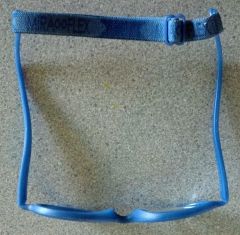
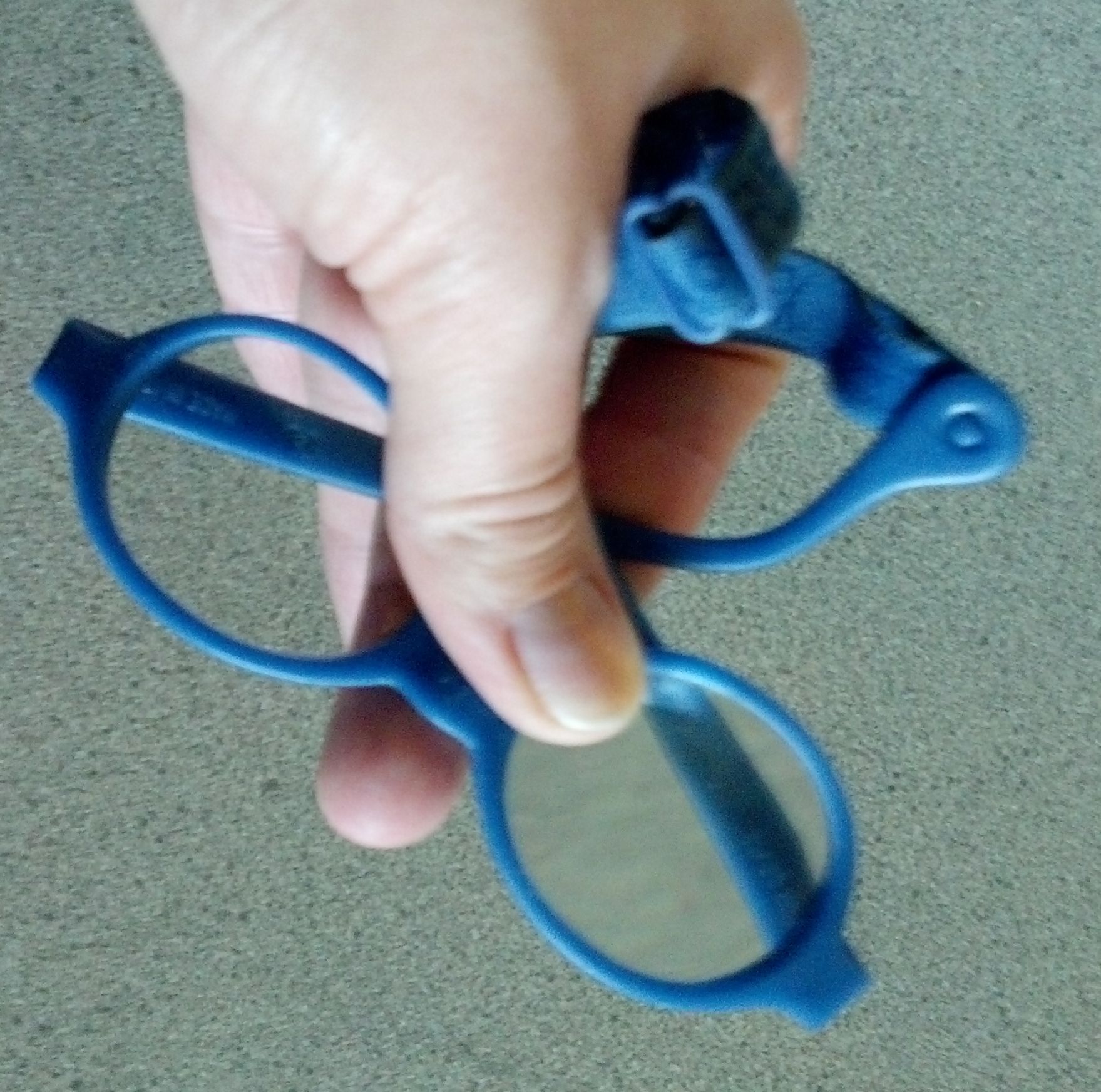
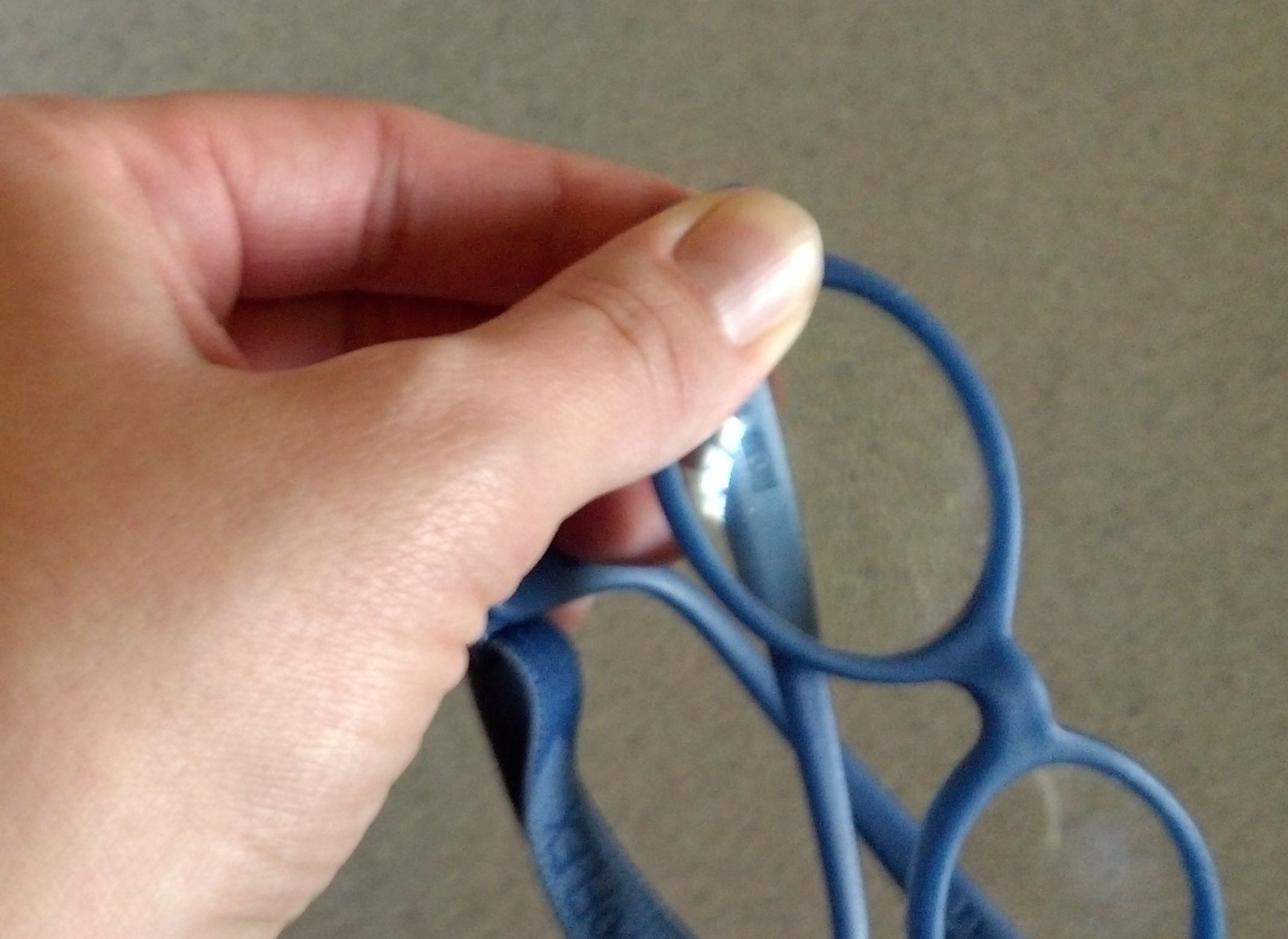
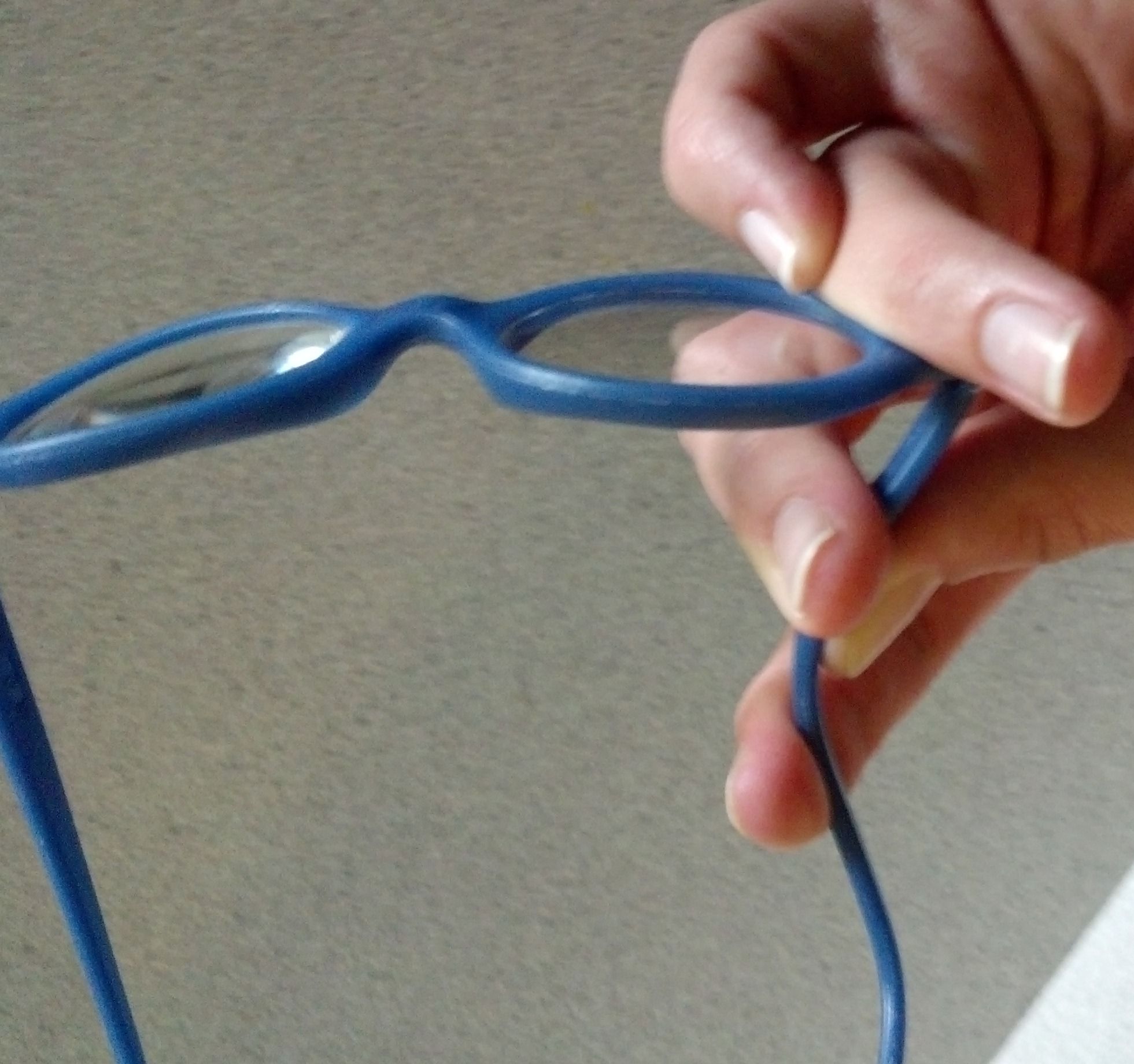
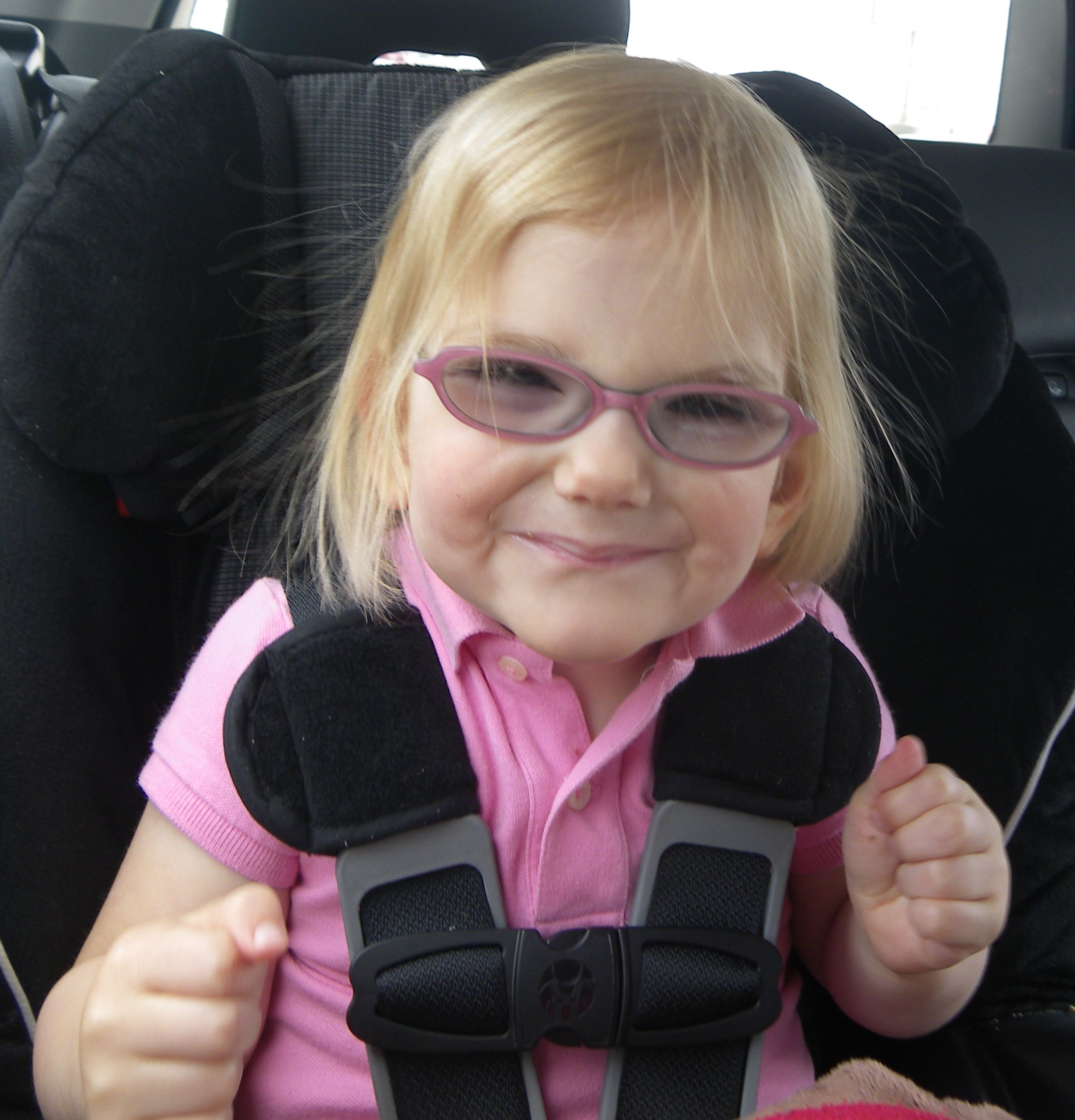
Tutorial to keep Miraflex glasses from folding down your child’s ears

Missy Adams created this tutorial of how she manipulates her son’s Miraflex glasses to keep them from folding down his ears.  She originally posted it on the Little Four Eyes facebook group, and I wanted to post it here as well, so it’s easy to find again.  And by special request, I’ve also made this in to a pdf that you can download and print.  Many thanks to Missy for sharing this! – Ann Z

  1. This is what his Miraflex frames look like before I manipulate them.
  2. I fold them first with arm pieces slightly lower than the center of the lens.
  3. I pinch the joint on each side.
  4. I bend the arm piece in at about where his ear is going to be.
  5. This is what they look like right before I put them on his head. They don’t fold his ears down this way. He leaves them alone.

.

Speaking of polls…

After reading the comments on the poll about how long it takes kids to leave their glasses on, it sounds like people were interested in whether the prescription strength makes a difference in how well a child takes to glasses.  So I’ve decided to put together a huge survey of experiences of young children in glasses.  I’m hoping to pull together information on how quickly children take to their glasses, but also why they wear their glasses, and how strong their prescription is, and what other treatments they’ve received, and other experiences.

As far as I can tell, this would be the first such survey, and I’ll publish the results on Little Four Eyes (responses will be anonymous, of course).

But I wanted to ask all of you, are there any questions or topics you’d love to have that I could ask?


Reader Request: Poll about accommodative esotropia

Updated: I’ve added Vision Therapy as a choice, but it’s not showing up yet.  It should show up shortly.  Sorry for that, I knew there was something I was forgetting when I hit publish.

One of our readers, Heather, asked if I’d do a poll about how many children with accommodative esotropia end up patching.  I’m expanding the poll just a bit to include other treatment options.

If your child has accommodative esotropia (partial or full), let us know what treatments you’ve done.

Everything I know about wearing glasses, I learned from having a young kid who wears glasses

mom and daughter, both in glasses
Zoe in her third pair of glasses (from Peeps Eyewear), and me in my second pair (from Cafe).

(Ok, not everything, that’s an exaggeration, but it sounds better than the title “Some things I know about glasses…”).  I was recently at the eye doctors for my normal eye check up.  I’d decided that I was finally going to get myself a second pair of glasses.  I could say that it’s because I want a back up just in case something happens to one pair, but I’d be lying.  I’ve found myself jealous recently of Zoe’s 3 pairs of glasses, and the fact that she gets to choose which pair she’s going each morning.  After I chose my frames, I was talking with the optician about my lens choices, when he stopped for a moment and observed that I really seemed to know a lot about glasses.  It made me chuckle, but indeed, I do know a whole lot more about glasses now.  I’ve had glasses since I was 10, but it wasn’t until we embarked on this journey with Zoe that I really learned much about glasses.

Some other things I’ve learned since Zoe got her glasses:

  1. I’d never bothered to figure out what those numbers on the prescription mean.  Now I can tell people way more about what they mean than anyone probably wants to know.  Funny thing, though.  I have Zoe’s prescription memorized, but not mine.
  2. I used to wipe my lenses with whatever cloth or tissue was nearby.  I know better now.
  3. I also used to take my glasses on and off with one hand.  That was until we took Zoe’s glasses in for adjustment because the ear pieces were bending out, and we were both told to use both hands.
  4. Speaking of adjustments, I’m no longer afraid to go in to get my glasses adjusted if they bother me.

Of course, there are a few things I still haven’t gotten through my thick skull:

  1. I still forget to take off my glasses when I’m putting on a shirt with a tight-fitting neck, leaving me to struggle helplessly with the shirt half over my face, stuck on my frames.
  2. That “on your face or in their case” rule that I posted recently?  I’m really, really bad at it.  The worst part being that if I don’t have my glasses on, my vision is bad enough that I can’t see my glasses.  Another great reason to have 2 pair!

new study on ordering glasses online

A study was published this past September that looked at the safety and accuracy of glasses ordered online – including children’s glasses:  “Safety and compliance of prescription spectacles ordered by the public via the Internet,” by Karl Citek, published in Optometry, vol. 82, iss. 9 , pgs 549-555, Sept. 2011   The full text of the article is available here.

The study found that nearly half of the glasses ordered were either the wrong prescription, the wrong lens style, or the lenses failed impact testing.

It’s important to note that this study looked only at online retailers where you can buy both the frames and prescription lenses online.  Cases where the frames are purchased online, but have the lenses filled by a local optical shop would not have the problems identified in this study.

Overall, the study found that nearly half of all glasses they ordered online had a problem, either with the prescription being wrong, the lens type (single vision vs bi-focal) being wrong, or with the lenses not passing impact resistance testing – and that problem existed regardless of the cost of those glasses online.  Probably the most disturbing finding of the study was that in 25% of the glasses for children, the lenses failed impact testing.  Given how active kids can be, it’s extremely important for our children’s glasses to not shatter on impact.  The study did find that all of the polycarbonate lenses that were ordered did pass the impact resistance testing.  Some of the children’s glasses also had incorrect prescriptions.

A couple of interesting pieces from that study include the fact that the rate of problems with prescription errors was similar to the error rate at traditional optical labs, it’s just that when you order glasses through a traditional optical shop, there are additional checkpoints, and nearly all the problems have been caught and correct before the glasses even make it to the shop. The article also mentioned that some of the researchers had difficulties placing the orders correctly with some of the vendors, this despite the fact that the researchers were quite knowledgeable about eyewear.  So if you’ve felt confused by some of those sites, you’re not alone.

So given this study, I would be much more hesitant to purchase glasses online for Zoe, and I would not recommend it for a primary pair glasses.  If you do order glasses online, you can – and should! – take the glasses in to your eye doctor.  He or she can verify that the prescription is correct.  In fact, you should do that with glasses that you purchase from a traditional optical shop, too.  Your eye doctor will not be able to test the impact resistance of the lenses, though (well, at least not without breaking the lenses). I would only order polycarbonate lenses online, since the material is extremely strong and is unlikely to shatter on impact.  Also, make sure that you understand the return policy for the glasses you purchase, so that if there is a problem, you know how to return the glasses.

Thanks to the EyeWorks facebook page, which is where I first heard of this study.

Poll: how long until your child left their glasses on reliably?

Quick poll for all you parents whose children have had their glasses long enough that you’re no longer on the edge of your seat all day long, ready to pick up flung glasses, and put them back on their faces.  So how long did it take your child to get used to their glasses, so that they’d leave them on reliably for at least a few hours at a time?

Feel free to vote more than once if you have more than one child in glasses.

Four big years of Little Four Eyes!

This month will be the four year anniversary of Little Four Eyes.  It’s been a great four years.  I was reading through some of the early stories and posts, and found it comforting to know that so many of our experiences are shared.  I started this site because I felt alone when Zoe first got her glasses.  I do not feel alone at all anymore.

Thank you all for sharing, for writing, for reading, and for being a part of this community.

I have some exciting news, changes and announcements that I’ll be sharing this month to celebrate.

Book review: Pearl and Wagner: Four Eyes

Pearl and Wagner: Four Eyes, by Kate McMullan, with wonderful watercolor pictures by R. W. Alley, tells the story of a young mouse who gets glasses, but it’s also about how friends can stand up for each other, and help each other feel better about themselves.  The Pearl and Wagner series are books targeted at 5-8 year olds about two friends, a mouse named Wagner and a rabbit named Pearl.  The books are early chapter books.  Pearl and Wagner: Four Eyes is a level 2 early reader.  It has three very short chapters, and can easily be read out loud by a parent in one sitting.

The story starts on eye test day at school, where Wagner has difficulty reading the eye chart.  He realizes he’ll need glasses, though he doesn’t want them.  His friend Pearl tries to cheer him up by talking about how great glasses are and how different styles can give someone a whole new look.  While Wagner isn’t convinced, he still ends up with glasses shortly thereafter.

At school, his friends all support him and tell him he looks great in his glasses.  My favorite is Henry, who remarks, “You look like Wagner with glasses.”  But he does get teased by two bigger boys, one of whom calls out “Hi, Four Eyes!”  This is where is friends really step up to help Wagner by making a joke of it:

“I have on a hat,” said Henry.
“I guess that makes me Two Heads.”
“I’m wearing boots,” said Bud.
“That makes me Four Feet.”
Wagner smiled.

And with that, Wagner puts his glasses back on.  The book ends with the whole class having a party to celebrate seeing.  At the back of the book, there’s tips for wearing glasses, such as, “If you sleep with your glasses on, they can get lost in your covers,” and there’s a helpful guide to the different parts of glasses.

I normally don’t like books about glasses that have scenes of the child being teased or taunted, since that hasn’t been Zoe’s experience, and so I don’t feel the need to point out to her that some kids are teased for their glasses.  But I this to be a really sweet book about friendship as much as it is about glasses, and Zoe loves it.  She particularly loves the part where Wagner’s friends make jokes about being Two Heads or Four Feet.

I’d recommend this book for older children, age 4 or 5 and up, especially those who may be worried about being teased.

Reader request: pictures of kids with a difference in prescription in each eye

Dara just posted this question in the comments, and I thought I’d pose it here:

My daughter was just diagnosed with amblyopia in her left eye. Glasses and patching for 2 hours a day is the plan… her left eye is +4.50 , her right eye just says PL.

My huge concern is that one eye is going to look magnified and one eye isn’t. That she will look funny or weird since they don’t match. Can anyone calm my fears? PICTURES would be great!! : )

If any of you have a child with a large difference in prescription between his or her eyes, would you be willing to share a picture?  You can send it to ann @ shinypebble.com.  Thanks!

Glasses rule! Glasses rules.

A special place for Zoe's glasses.

Do you have any rules for glasses at your house?  I’ve come up with a few ideas, the first one even rhymes (I can’t take credit for that one, though, I’ve heard it a lot of times):

  1. Glasses on your face, or in their case, on in the special glasses place.
  2. When putting on or taking off your glasses, use both hands.
  3. If your glasses are dirty, give them to an adult to clean.
    • As Zoe has gotten older and more responsible, she cleans her glasses herself, so the new rule is that she uses a special glasses cleaning cloth.
  4. Tell a parent if your glasses are hurting or slipping down your face.

Rules for the adults in the house:

  1. Always ask before taking Zoe’s glasses off.
  2. Use both hands to take off her glasses, or put them on.
  3. Put the glasses in their place or case when they’re off her face.  (Fun rhyme, but I’m really bad at this).

Rules for other kids

  1. The glasses are off limits for playing, stealing, hiding, etc.  No exceptions!
  2. If the glasses fall off while playing, everyone stops until they’re back on her face.

“with glasses.”

by, Rebecca of Mommy, Ever After

Something happened, recently;

In fact, many somethings.

My baby daughter became a kid;

She started to go to school;

She got recognized for her glasses.

Back in the early days, when her diagnoses, and spectacles, were so new,

my greatest fear was that she’d be judged.

I worried that she would be ridiculed

and prayed that she would not be marginalized.

I hoped that people would be able to look beyond the tiny, wire frames that sat upon her nose,

and not see a girl who was bespectacled,

but instead, a girl who was being spectacular.

I hoped. I wished. I waited.

And then, she grew up.

She started preschool.

She met children.

She made new friends.

And, by coincidence, we found out that another girl in her class had the very same name.

I wrestled with the idea of how to tackle the name situation, as I am in the role of both mother and teacher,

and with the girls being so young, I wanted to avoid as much confusion as possible.

Should I call by daughter by her full name, although she’s used to going by the abbreviation?

Should I tack on the first initial to their last name?

But, before I could come up with the right answer,

it was handed to me;

handed to me by two, tiny, sticky, toddler hands.

A little boy in the class, for whom my daughter has the utmost affection, began to ask for her on his drive to school in the morning.

His mother shared with me that as they would pull into the parking lot, he would ask for his teachers, the puppets, and my daughter.

And he would say her name, and then, to be absolutely clear, he would modify it, by saying,

“With glasses.”

His mother told me this with a smile.

Her son loved my daughter. His friend. His friend with glasses.

And when I heard this, I was overcome with great emotion.

For all those many days and weeks and months, I had felt so worried that my daughter would not be seen for who she was

for what she could do,

and here it was: The affirmation of my fears. My kid was the little girl who was known for having glasses, and even given a nickname, as such.

And as soon as her words hit me,

I felt

absolutely

nothing

but

love.

I thought it was precious.

I felt grateful.

I felt proud.

Because for me, her glasses are just one of the many things that maker her special. And they make her special to her new friend. And they have absolutely nothing to do with why he loves her.

He loves her because she shares his obsession with animals. He loves her because they do puppet shows for one another. He loves her because they sit quietly together, in the corner, and read books. And he loves her enough to have a nickname for her. And it is true. She’s with glasses,

but she’s also with so much more.


Pediatric Glaucoma

As we come to the end of January, which this year is Glaucoma Awareness Month, I wanted to post a few resources for families who are dealing with pediatric glaucoma.

Glaucoma is a leading cause of blindness, and while older people are more at risk, glaucoma can occur at any age.  Pediatric or Childhood Glaucoma may be congenital (1 in 10,000 babies in the US are born with glaucoma) or may develop later in childhood.  Glaucoma is also closely associated with cataracts, children who have cataract surgery are at higher risk of developing glaucoma, and so are often closely monitored.  Some symptoms of childhood glaucoma include light sensitivity (photophobia), corneal opacification (hazy gray cornea), enlarged eye and cornea, epiphora (overflow of tears), and vision loss. (Information is from the Pediatric Glaucoma and Cataract Family Association, and the Glaucoma Research Foundation).

You can find more information about pediatric glaucoma and support support for those dealing with it here:

  • Congenital Glaucoma Network – this is a social network for all people affected by childhood glaucoma come to share their story.  There is a forum, blogs, a place to share photos, videos, and links to more resources.
  • Pediatric Glaucoma – information on pediatric glaucoma from the Pediatric Cataracts & Glaucoma Family Association.  You may also want to check their Knowledgebase for more articles on glaucoma.
  • Children’s Glaucoma Foundation – a non-profit dedicated to supporting children with glaucoma.
  • Childhood Glaucoma – symptoms, treatment options, and stories about childhood glaucoma.  From the Glaucoma Research Foundation.
Blogs from our blog list that deal with glaucoma:

You can also read other posts on Little Four Eyes that deal with glaucoma.

If I’m missing anything, please let me know!


Your stories – Our experiences with a teacher of the visually impaired

Many thanks to Sarah who sent in her account of working with a teacher of the visually impaired. – Ann Z

My nearly four-year-old daughter Isabella has multiple ocular diagnoses: severe hyperopia (farsightedness), astigmatism, mild macular hypoplasia (“underdevelopment of the macula, a small area on the retina responsible for seeing in detail” – read more) , latent nystagmus (“involuntary rapid movement of the eyeball, occurring only when one eye is covered” – read more), and intermittent exotropia (“eyes that turn outward” –  read more).  She began seeing an ophthalmologist at six weeks old and received her first pair of glasses at 15 months. Today at nearly age four, her acuity measures about 20/70 with correction. Isabella also has bilateral sensorineural hearing loss, childhood apraxia of speech (a motor speech disorder),  hypotonia (low muscle tone), and fine and gross motor delays.

girl wearing glasses
Isabella

Continue reading “Your stories – Our experiences with a teacher of the visually impaired”

January is National Braille Literacy Month

I just learned that January is National Braille Literacy Month.  Braille is the reading and writing system for the blind and visually impaired.     In recognition of the month and the movement to improve literacy rates among the blind and visually impaired, Online Colleges has an interesting post with 15 facts about Braille, including the fact that Braille was developed by Louis Braille when he was only 15.

Other links of interest about Braille:

More

Preparing older siblings for your younger child’s glasses

A question was posted on the Little Four Eyes facebook group by Danyelle, whose 3 month old will be getting glasses this week.  She’s  looking for resources to help prepare her older children for their younger sister’s glasses.  I thought I’d post here and see if anyone had any good ideas to add.

Books

Books would be my first place to start (but I’m a librarian, so of course they’re my go to resource).  Most books on our list are written from the perspective of the child who needs glasses, but some also follow friends or family members of kids who get glasses.  One person has already recommended Magenta Gets Glasses! by Deborah Reber, a Blues Clues book.

Shows

I’ve written before about some kids’ TV shows with characters who wear glasses.  Depending on the age of the siblings, the Yo Gabba Gabba episode from season 2 called Differences tells the story of Muno getting glasses, and his friends reacting to that.  I didn’t like that at the end Muno wears contacts (because I had hoped that he’d become a character who regularly wore glasses), but I think it talked a lot about other people’s reactions to seeing someone in glasses for the first time.  Sid the Science Kid also has an episode called Grandma’s Glasses in which Sid learns about vision and why some people need glasses.

Websites

There are a whole lot of websites aimed at kids that explain how the eye works (my favorites are from the Exploratorium – warning, it contains graphic images of a cow eye dissection, and the National Eye Institute), but not nearly as many that talk about glasses. Here’s a few:

  • Whyzz – a site that helps kids explore questions, it provides not just answers, but also experiments to help learn more, and links to more information.  I’d start here.
  • Annie’s Unite for Sight website for kids – a dog named Annie, who wears glasses, explains how the eye works, amblyopia, strabismus, as well as other vision issues.
  • Kid’s Health has sections about eyes and glasses.

So what other resources are there?  Have you had to prepare an older sibling for their younger brother or sister getting glasses?  Any words of wisdom?