I love sharing stories of people who grew up with glasses, I think it helps me to hear what their childhood were life. I am so pleased that Nitie agreed to write about her experiences growing up with nystagmus. Many, many thanks, Nitie! -Ann Z
Growing Up with Congenital Nystagmus
Hello my name is Nitie Mehta and I have a 7 year old daughter. No she does not have Congenital Nystagmus but I do. I wanted to share with parents my experience of growing up with Congenital Nystagmus.
When Ann asked me to write about this I did not know where to start as there is so much I would like to share, so I am breaking this post into 3 sections
Congenital Nystagmus: the way I see
Only If I Knew This Before
Adapting to everyday things
1) Congenital Nystagmus: the way I see
Growing up I just thought I was a normal child just like any other kid. I only needed glasses to see well. To be honest I really did not know why I wore glasses because I did not see any different with or without them. Yes, unfortunately glasses do not correct too much, I improved from 20/80 to 20/70. That meant I could not read the black board in class and could not recognize someone across the playground. If the font was large (14) and there was plenty of light I could read but otherwise I would avoid reading and could never read more than 5 pages at once. Once I was in 5th grade and school work had increased I started using a magnifying glass to help me read normal print. But all along I considered myself a normal child who needed to be a little closer to read.
2) Only If I knew This Growing Up.
I grow up in India in the days prior to the internet. I really did not know much about my condition and I am not sure my parents knew too much too.
Ball sports that needed hand eye coordination or depth perception were not for me. I spent 3 years learning tennis, only to hope and pray that I could somehow hit the ball back, because I really did not see it till it was over the net. Instead swimming, running, rollerblading, cycling would have been great sports to pick up.
I hated family movie nights: our television sets was not large and there was a myth that if you sit too close to the TV it spoils your eyes. Thus sitting 6 feet away from a 28 inch TV I could barely see anything. Only if I sat closer I would have enjoyed family movie night.
Good white light would make it easy for me to read. It was not until I was in 7th grade that I discovered that a nice bight white light lamp made things so much easier to read.
People often have a visual memory; they read something and have a visual image of it that they can remember forever. Well I did not have this but I do have an audio memory that is if I heard anything I would remember it.
3) Adapting to Everyday things
Once I was a teenager I realized that there were things I could not do on my own even if I tried really hard, but what I could do was make good friends everywhere I go so they could help me.
Driving – not only do I have the GPS but also carry paper direction and if possible ask for land marks to a new place I am going, this way I do not need to read road signs or house number.
Reading menus at a fast food place or in a dimly lit restaurant: I always search for the menu online before going to a place and know what I am going to order. If for some reason I have not done this I ask the waitress for their special and just pick something from it.
Reading fine print on anything. I use my smart phone and take a picture of the thing and then enlarge it to read it.
Driving at night, I am not supposed to drive at night thus I will form a carpool group and offer to pay for gas if someone else is driving.
Finally parents of kids who may have this, I want to leave you with this, I have an MBA, I worked at KPMG Consulting a top 5 consulting firm and at Microsoft before I decided to start my own Eyewear company Taffy Eyewear . You child too will and can achieve anything they set out to do when you believe that they can.
Nitie Mehta is the founder of Taffy Eyewear: Eyeglasses specifically designed for kids
I saw this video and just had to share it (with the permission of the parents, of course!). The baby is 6 months old and has just gotten his first pair of glasses for myopia (nearsightedness / shortsightedness) and astigmatism. You can watch the moment he starts seeing everything around him – his pacifier falls right out of his mouth! It is such a stark reminder of how life-changing glasses can be for those who need them. His mother writes:
We found out that our baby needed glasses when he was 6 months old. We were seeing a pediatric ophthalmologist regularly because he was born 8 weeks premature but we had no suspicion of any vision issues. He was diagnosed with severe myopia (-12.00 in both eyes) as well as an astigmatism. On a side note, we felt so fortunate that we were forced to see the ophthalmologist and caught it so early. He developed perfectly with the glasses and I wonder what kind of delays he could have had if he was not seeing properly. By the way, the doctors believe that family genetics are to blame more than the prematurity.
As an aside, not every child takes to glasses so quickly. If your child doesn’t like their glasses at first, don’t despair, you are in good company. Zoe took 2 weeks before she’d leave hers on regularly, and that’s not uncommon. You can read our tips for helping the transition to wearing glasses.
I was thrilled to receive my copy of “I See, You See, We ALL See!” in the mail today. This is a board book written by Allison Joyce and Don McClain, inspired by Allison’s daughter Emma. Allison ran a Kickstarter this fall to raise the money to cover the production of the book, and the results are fantastic.
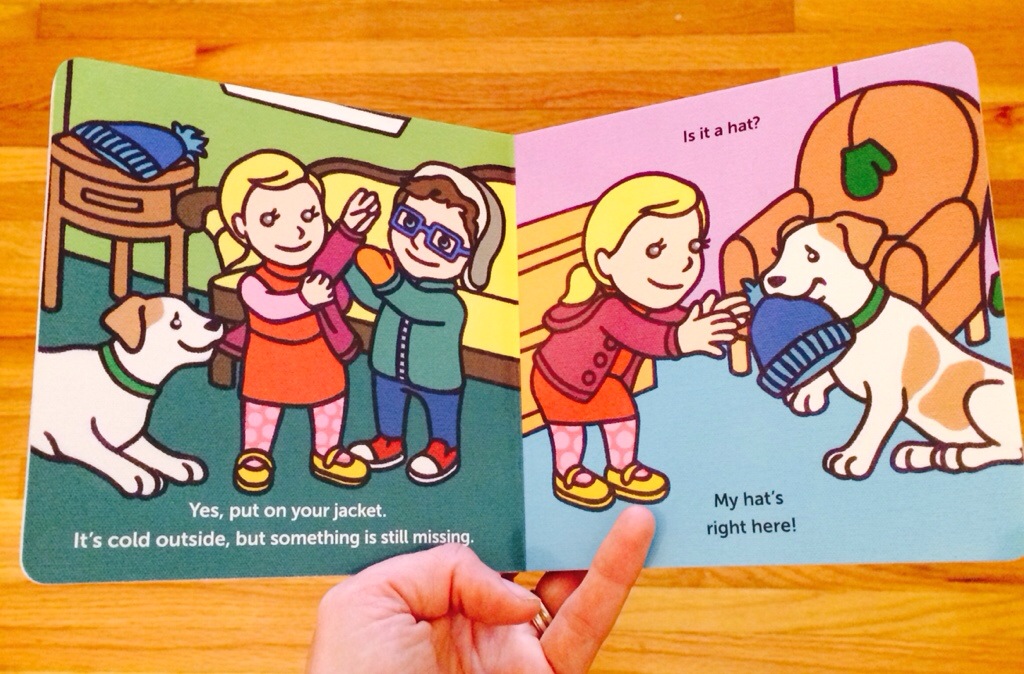
The book follows Emma and her big brother as Emma wakes up from her nap and gets ready to go play outside. Her brother helps her remember all the things she needs: shoes, jacket, hat, mittens, but most importantly, her glasses! The story line is simple, but it’s fun and engaging and very appropriate for toddlesr. My 3 year old daughter (the one that doesn’t wear glasses), has asked to read this book multiple times, and loves “helping” Emma figure out what all she needs to wear.
The illustrations by Amanda Beard are beautiful and fun and bright. We spend quite a bit of time looking through the pictures to find all of Emma’s outdoor items.
There are practically no books that are targeted at very young children in glasses. Allison’s book is a sturdy board book that’s going to stand up to the repeated readings that I’m sure will happen. The story and illustrations are right on for the age group.
Our community has backed a few Kickstarters already: Eye Power Kids Wear, I See, You See, WE ALL SEE, and of course, my book, Glasses! I think crowdfunding is a great way to encourage new products that can meet the needs of a smallish community like us. And now there’s a new Kickstarter that just launched and needs your help! Lenz Frenz are adorable plush animals that can hold your child’s glasses in two different ways. They are a great way to encourage kids to learn to always put their glasses away in a safe place. I talked to the project creator Molly to get more details on the project. – Ann Z
Question:Tell me about your son and why he needs glasses.
Molly:Lenz Frenz began with a tragic incident involving my son Liam. He was stabbed in the eye at school, by a bully, with a sharpened pencil, and a quarter inch of lead broke off and lodged in his eye. He underwent emergency surgery in order to save his eye. At that time, we weren’t sure what to expect. We didn’t know if he would lose his eye, have vision loss, or remedial pain.
Question: Where did the idea for Lenz Frenz come from?
Molly:Lenz Frenz is an idea that my son had. We had been putting play glasses on his stuffed animals, during his recovery, in hopes of easing his transition to wearing eyeglasses, in case he needed to wear them. Liam came up with the idea that his animals would eat his glasses and store them in their bellies. We looked for similar products but when we couldn’t find anything like that, we made our own, and Lenz Frenz was born!
Question:Tell us a little about Lenz Frenz – which I find super, super cute, by the way. How do they work, and what features do they have? What ages are they intended for?
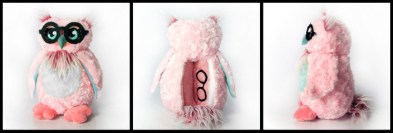
Molly:Lenz Frenz is a plush animal that securely stores and wears eyeglasses on its face and inside its protective belly case. We have 14” animals that have a full size hard eyeglass case mounted inside of the Lenz Frenz. Your child can store their eyeglasses safely inside this protective case, or place them safely on the Lenz Frenz face in the special holder for your glasses! We thought this would be a fun idea for children to have the Lenz Frenz character wear their glasses (the child’s). It can hold two pairs of eyeglasses! Our smaller size is 6.5”, and it holds a contact lens case. It can be clipped to a backpack or purse. We love the idea that our characters can safely wear glasses just like your child does!
Prototype of the Owl Lenz Frenz
Question:What was the design process like in developing the Lenz Frenz?
Molly:The design process was fun. We played with stuffed animals! For our first prototype, we went to Build-a-Bear as a family and purchased a few different stuffed animal shells. We used existing eyeglass cases and mounted them inside. From there, we did a ton of research to find the right materials and better design methods. Then we moved on to speak with character artists and began designing the Lenz Frenz animals we see today. My kids had a lot of fun selecting animals and coloring them so we could see numerous color choices. We also spoke with a few eye experts; surgeons, optometrists, and Ann Z.— founder of Little Four Eyes.com! Everyone has been so helpful and supportive.
Question:How did you choose the animals?
Molly:We asked our neighborhood children what their favorite animals were. We showed them pictures and had them vote on their favorites. I think I stopped every child I saw with glasses on and asked them questions. We wanted to make sure we had animals that were neutral, animals that girls prefer, and animals that boys tend to prefer.
Prototypes for the Lenz Frenz animals
Question:Do you think you might add more animals in the future?
Molly:Yes, I hope so! I love our animals. They’re like family. I’d love to add a few more Lenz Frenz to our line.
Question:Where should people go for more information? We have launched our campaign on Kickstarter. We’re also on Facebook (Lenz Frenz), and you can check out our website. Please visit us!
Question:What are your goals for this project?
Molly:We hope to raise $20,000 in order to bring our 14” bear and our 6.5” puppy to market! If we raise more than that, we’ll use those funds to manufacture more of our Lenz Frenz animals.
Question:You’ll be doing a Kickstarter for funding. What made you choose funding the project this way?
Molly:I think Kickstarter is an amazing forum. It’s creative, rewarding, and real. These are real people with real products who have a passion, and they’re willing to work hard to bring their ideas to market. It’s hard to ask others for help, especially to ask for anything monetary. If you’re on Kickstarter, then you’ve worked hard to create something and get it out there. You’re not giving up. You’ve got a dream and you’re asking others to help invest in your dream, and Kickstarter is how you’re going to fund that dream.
Question:Anything else you’d like to add?
Molly: We hope that Lenz Frenz will be a fun training system for children to remember to put their glasses away. It began as a comfort for a child, many children are totally comfortable wearing glasses because they always have. However, children can always use a little motivation to take care of their glasses 🙂
Thank you so much to Molly for answering our questions about Lenz Frenz!
Recently, UK retailer Tesco had some children’s shirts for sale that had a picture of an animal wearing glasses and the word “geek” or “nerd.” Quite a few parents wrote on Tesco’s wall to complain about the shirts linking glasses with a term that many people still feel is an insult. Tesco decided to remove those shirts, and you’d think that would be the end of that. But some newspapers picked up the story, and chose one mother’s post in particular and wrote articles about how that one mother had forced Tesco to remove a line of clothing. The story has taken off from there, though hardly any of the newspapers have bothered to talk with Aneliese, the mother whose post they cited, about any of it. (I’m not linking to any of the articles because the reporting was so very shoddy). Now I’m not new to the Internet, I know that people can be cruel and take things way out of context, but I’ve been horrified by the number of awful comments, tweets, and posts that Aneliese and her son have received due to this. Inside the Wendy House has a good post that talks about what happened (and actually talked with Aneliese about the incident, as have I).
Tesco is not the first retailer to have shirts that show a character in glasses with the work “geek” or “nerd”, and I’m sure they won’t be the last. The question shows up a lot in the Little Four Eyes facebook group. It’s always leads to an interesting and spirited debate, and the community seems to be pretty evenly split on the issue. On the one hand, as many parents point out, “geek” and “nerd” are no longer the insults that they used to be, in fact, they can be seen as cool and the words should be taken as compliments. Any thing that portrays glasses as being cool, those parents say, is something we should celebrate. Other parents note that “geek” and “nerd” may be cool for some, but they’re still a stereotype with specific associations that are not all positive, such as being introverted and socially awkward. For those parents, glasses are something that help or at least protect, our children’s vision, they don’t define our children’s personalities, for better or for worse.
I hope everyone can agree that insulting a mother for giving a retailer feedback about their merchandise is completely uncalled for unnecessary, and frankly, really awful.
I should note that I consider myself a nerd (I’m not cool enough to be a geek), and that I’ve been nerdy all my life. It wasn’t a label that I liked as a kid or in high school, but now 20-some years later, it’s a label that I will proudly wear. I also wear glasses, but even when I wore contacts, I was quite a nerd.
I do think there are a lot of problems, though, with associating “geek” and “nerd” with wearing glasses. I honestly cannot think of another personality stereotype (and let’s be honest, whether you see geek/nerd as good or bad, it’s a stereotype) that is associated with something that needs to be worn for medical reasons. The need to wear glasses is almost always because of structural issues with the eye – this has nothing to do with a person’s intelligence or how well they do interacting with others.
It bothers me because while I’m happy with being labeled a nerd, I know plenty of people who would not be happy with that characterization. Some of those people wear glasses. I look at Zoe, and I wonder what she’ll want to be known as when she gets a bit older. Will she want to be the nerdy girl? Or will she want to be arty, or athletic, or will she want people to not label her at all? Who she decides to be should not have anything to do with the fact that she’s hyperopic with moderate astigmatism.
On a less personal note, I have written before about the problems that can arise when children aren’t treated for vision issues. I hear from a lot of parents when they first learn their child needs glasses, and many of those parents are filled with fears (I know I was). Some of those fears have to do with general vision and glasses-related issues, but there’s also the fear that your child will be seen and treated differently once they have glasses. Glasses for your child are hard enough to deal with, even without the fears, they’re expensive and frustrating. I’d love to lessen any of the stress that comes with having a young child in glasses – that’s part of why I started this blog, and that’s part of what’s behind my dislike of the association of glasses and nerd/geekiness. Why add to the potential reasons why a parent might not follow through and make sure their child needs glasses? Not that I think this alone will solve the problem, but I don’t think it helps.
All that being said, there is a lot of evidence that the fears we have as parents of our child being treated differently or seen as less attractive because of their glasses are not always borne out. I don’t want to dismiss anyone who has actually experienced their child being bullied or teased because of their glasses, but there have been studies that have found that glasses really aren’t seen as a bad thing by other kids:
One study asked kids in glasses and their parents a series of questions about their quality of life including socially. It asked the kids questions like “are you teased because of your eyes?” And it asked parents questions like, “do people treat your child differently because of his or her vision?” The kids’ answers were the same as other kids their age without glasses. They did not report being teased because of their glasses. The parents on the other hand were very worried about their child being treated poorly.
Another study had kids look at pictures of other kids, some with glasses, some without, and asked which kids they’d rather play with, and which ones were the most honest, or smart, or better looking, or better at sports. According to that study, there was no difference in how kids saw other kids in glasses, except that they thought they looked smarter.
Essentially, what our kids experience because of their glasses is probably not as bad as we worry about.
So what do you think? Is it a good thing that glasses are associated with the newly cool nerd and geek identities? Or is it something that bothers you? (I don’t think I need to add this, but please be kind in your comments, I think this is one of those topics where people can disagree with very good reasons on all sides of the issue).
Pam shared this great idea for a glasses strap on the Little Four Eyes facebook group. I asked her for instructions, and she graciously agreed to write them up and share them! – Ann Z
How to Make a Rainbow Loom (or other rubber band loom) Miraflex Strap
Disclaimer: Both the rubber bands and the findings used to make this would be considered choking hazards for babies and small children. This is meant for older children.
Rainbow Loom rubber band bracelets are all the rage at my older son’s elementary school. I volunteered in his class, and decided to learn to make them since most of the 2nd graders didn’t know how.
My L4E quickly jumped on the bandwagon. So I decided to try to make him a strap for his Miraflex glasses.
Here is what you will need:
Rainbow Loom (or other loom)
Rubber bands
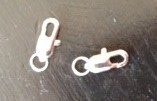
14mm Lobster Clasps
Jump Rings or Double Jump Rings
Your Child’s Miraflex Strap (for measuring)
Make the rainbow loom bracelet of your choice. I chose the simple fishtail bracelet, because it is very stretchy. You may choose any design; just keep in mind that some designs do not stretch as much as others. This will matter when deciding length. fHere is a video tutorial for the fishtail bracelet:
The rubberband strap will need to be shorter than your Miraflex strap as it stretches more than the original strap. Mine ended up being about an inch shorter. You will see from the picture at the top that it sits snugly (but not tight) against his head. I had to shorten it by removing bands until it was the right length.
When the bracelet/strap is the desired length, remove from the loom. Do NOT attach a C-clip.Instead, attach a jump ring and lobster claw to each end.
Squeeze the jump ring closed.
Next, clip the lobster claw through the hole on each end of your glasses. You are finished!
A Few Tips
You could do this with jump clips only if you do not unhook your strap when putting the glasses on or taking them off. Simply skip the lobster claw, and put the jump clip through the hole on your Miraflex glasses. You may want to choose bigger, thicker jump clips if you choose this route.
You may want to do double bands for the ends for added strength.
These clips don’t work. The opening is too small and you cannot get them hooked on to the glasses
Here are some other designs that I think would work well and plan to make!
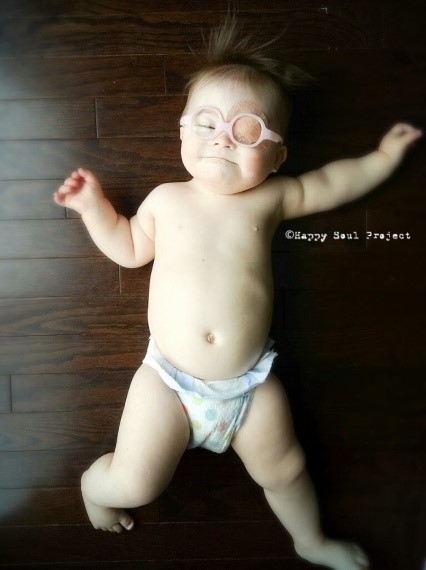
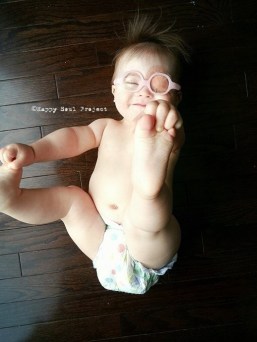
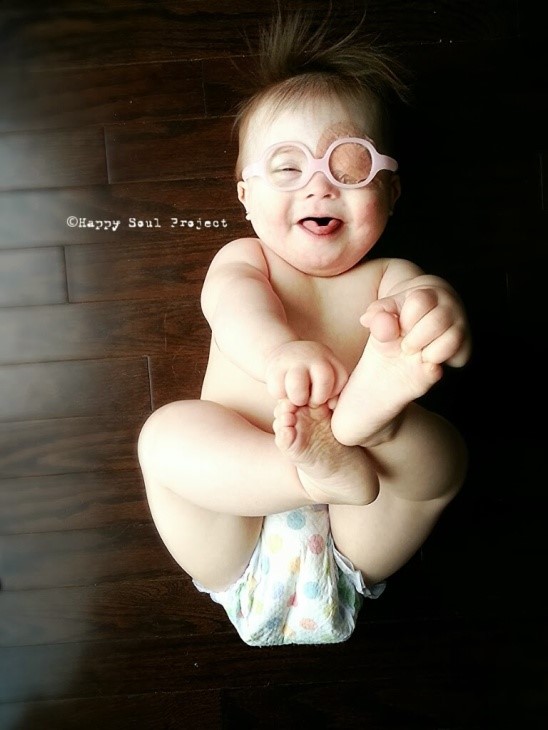
Tara from Happy Soul Project kindly sent in this post reflecting on a year since her little girl had eye surgery. She describes the fears and uncertainty that we all felt when we first learned our child or children had vision issues. This was originally posted on her blog, Happy Soul Project, and is reposted here with her permission. Oh, and if her daughter looks familiar, you may have seen her featured in the Huffington Post article about what makes you different is what makes you beautiful. – Ann Z
Her first and won’t be her last
This time last year I was on night 1 of at least 4 or 5 of absolutely no sleep…This time tomorrow I was desperately trying to look into my 5 week old baby girl’s eyes still kinda hoping for a miraculous miracle…This time the following day I was handing my tiny baby to a surgeon and literally collapsing and choking in fear…This time the day after I was learning to put in and care for a minuscule contact and instructed to patch my daughter’s “good eye” half her waking hours – Awesome to decipher for a newborn right?
This time last year was just filled with the unknown…
Would the surgery be successful? Would she survive the post surgery complications? Would the plan of care after even work? Would her other eye need surgery? Would she need glasses?
Nothing in the world prepares you for hearing the news that your child, let alone your newborn needs surgery…And no matter how many parents you seek out who have been there before, articles you read or sit down chats with the surgeons, the absolute feeling of helplessness is bound to overtake you…
I’ve been sitting here this morning reading blogs from last year, sobbing if really you must know…Remembering how very terrified I was…With each surgery she’s had since, those feelings return but the first one will be forever etched in my mind…
It was the first time I had to see her in one of those ridiculous hospital gowns, way too big to fit any 5 week old baby…It was the first time the clock absolutely dragged & I watched my husband pound donut after donut, nervously waiting for an update…And it was the first time I felt nothing but utter gratefulness, when she was finally put back into my arms…It was her first and it won’t be her last but the feelings surrounding this surgery will be with me always…
I wonder if every year around the time of her surgeries I will reflect on them as I have these last few days…I wonder if the tears will still come like they have while writing this…I wonder if the fear will still kinda get caught in my throat when I think back to how desperately I was begging God to keep her here with us…And I wonder if I will always be as awed with how far she’s come…
“So, as I learn to let go of what I can’t control- I realized that all that really matters is how I live my life & teach my babies to live theirs…I can’t control that Noal is a busy boy, has my short little legs & has my sassy personality…I can’t control that Reid was born with Down Syndrome, had a hole in her heart or needs eye surgery…I can only control how I handle what has been given to me- How I hope to raise Noal & Reid to be loving, kind, open minded, grateful & Happy Little Souls…At the end of the day this is what I truly believe to be important.”
And let’s just say it’s been one hell of a year learning to let go and realize what’s important & I truly think I have been a pretty damn good student of just that…
To read about my thoughts hours before Pip’s first surgery Click HERE and to read about Pip’s Eye Surgery/Complications & the Outcome Click HERE…
Tara is a quirky wanna-be Writer/Blogger, adoring/annoyed wife, minivan mum to 2 hooligans, one who just happens to have Down syndrome & most importantly a Happy Soul…She is the founder of Happy Soul Project {www.happysoulproject.com} & is currently working on her first book. You can reach Tara at t@happysoulproject.com
I met Kristin from Peeps Eyewear a few years ago through this site. I had no idea when I first met her that we’d come to do so many things together. She and I worked together to create the Great Glasses Play Day, and she’s going to be the publisher of the Glasses! book that I am writing (photo shoot was last weekend, it was amazing!!!)
Kristin recently wrote a great post on her blog about how as a mom, she had initially tried to keep her girls from being inundated with pink and with princesses. But hearing her youngest, who needed glasses, say in a sad voice that “princesses don’t wear glasses,” led her to see pink and princesses in a new light – as ways to empower kids and show them that they can be powerful, regardless of their favorite color, or their gender, or whether or not they wear glasses. The post is absolutely worth reading, and at the same time, she’s doing a giveaway of her customized book, a customized case to hold your child’s glasses book and a t-shirt. Take a look.
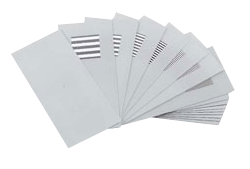
One of the questions that you run in to a lot when you have a very little one in glasses is how an eye doctor can determine the prescription of kids who can’t read letters yet — and in many cases, aren’t verbal yet. It was one of the things I wondered about when we took Zoe in at 9 months old. It turns out that eye doctors (optometrists and ophthalmologists) have a number of tools to help them do this. At Zoe’s early appointments, they used Teller Cards (grey cards with black and white lines on them) as well as dilating her eyes and using the retinoscope to look at the shape of her eye. The Teller cards are an example of a subjective measurement of her acuity – it requires some response from her, in this case, it was whether or not she looked at the black and white squares. Other examples of subjective measurements include eye charts, which can use letters or symbols. The retinoscopy was an objective refraction. That is, it looked at the shape of her eye to see how well she could focus without requiring a response from her.
The way these work is based on the idea of preferential looking: that a child will look at the most visually interesting part of an object. In the case of the cards, the square of alternating black and white lines is more interesting than the grey background. If your child can see the lines clearly enough, they’ll prefer to look at that square. However, if a child’s vision is blurry, the lines blur together at some point and the square will be the same shade of grey as the rest of the card and they won’t look at the square. The eye doctor shows the child the cards with thinner and thinner lines until the child stops looking at the square. That point at which the lines blur together too much to see a separate square tells you about the child’s visual acuity.
Retinoscopy
Much of how clearly a person can see is related to the shape of the eye and where the lens of the eye focuses the light. If you’re hyperopic (farsighted or longsighted), light focuses behind the retina. If you’re myopic (nearsighted or shortsighted), light is focused before it reaches the retina. So understanding how the eye is shaped and where light is focused tells the eye doctor what shape corrective lenses need to be to get the light focusing in the right spot. The video below gives the best description I’ve seen of how retinoscopy works.
Putting it all together
Subjective measures like the Teller cards require some cooperation and response from the patient. The retinoscopy will tell you how someone’s eye is shaped, but there are other things that go in to how clearly a person can see. So both of those methods are used by eye doctors to come up with the final corrective lens prescription.
For a more complete explanation of how it all comes together, I turned to Dr. Dominick Maino, OD, MEd, FAAO, FCOVD-A. He is a Professor of Pediatrics/Binocular Vision at the Illinois Eye Institute/IllinoisCollege of Optometry and is in private practice in Chicago, Il. He also writes about latest research in vision and vision care of children at MainosMemos.
An objective examination of refractive error (myopia, also known as nearsightedness or shortsightedness; hyperopia, also known as farsightedness or longsightedness; and astigmatism) can be completed several ways. You can use an auto-refractor (though most do not work well for little ones) where the child looks at this computerized device and it tells you the refractive error. Eye doctors can also use a retinoscope. This is a small handheld flashlight that directs a light into the eye. When it is reflected back out, depending upon the type of refractive error, it will move in a certain way. We then neutralize this movement by placing lenses in front of the eye. Once we see no movement, we know the refractive error. In terms of accuracy, they are all accurate depending upon several factors.
Retinoscopy. From National Eye Institute, National Institutes of Health Ref#: EE95
The same pretty much applies to the subjective measurement of visual acuity. Teller Cards, Snellen Chart and the Lea Symbols all measure visual acuity but slightly differently. Once again all are accurate. I am not quite as concerned about the number generated by the visual acuity test at this age. I am much more concerned with both eyes having similar numbers. You want both eyes to see equally as well. [emphasis mine – Ann Z]
Now on to prescribing for little ones: Giving glasses is still as much art as it is science (something about humans being so…well human!). For example, most people want to be fully corrected if they have myopia (nearsightedness / shortsightedneess) so they can see clearly at all distances. Hyperopia (farsightedness / longsightedness) is even more tricky. If you are farsighted and a child, you can compensate for the farsightedness by kicking in your focusing ability. Unfortunately this can lead to major problems such as accommodative esotropia: when you compensate for the high amount of hyperopia by using your focusing system, an eye turn inwards results (from MainosMemos, “What is Accomodative Esotropia?“). To complicate matters even more, ophthalmologists and optometrists have different philosophies when it comes to prescribing glasses. Ophthalmologists tend to prescribe for higher amounts of farsightedness, while Optometrists lower. The good news is that for infants and toddlers we probably prescribe in a similar way.
The important thing is to find a doctor you trust and follow his/her advice. Don’t be afraid to seek out a second opinion and don’t be surprised if that second opinion if different from what you’ve been hearing. Ask lots of questions. Ask why the doctor is recommending what they are recommending. If the doc doesn’t have the time to fully explain what he/she is doing, find a new doc. I hope this helps!!!”
— Ann here again. Many, many thanks again to Dr. Maino for the explanations.
I’ve come across some links recently that I wanted to make sure to share:
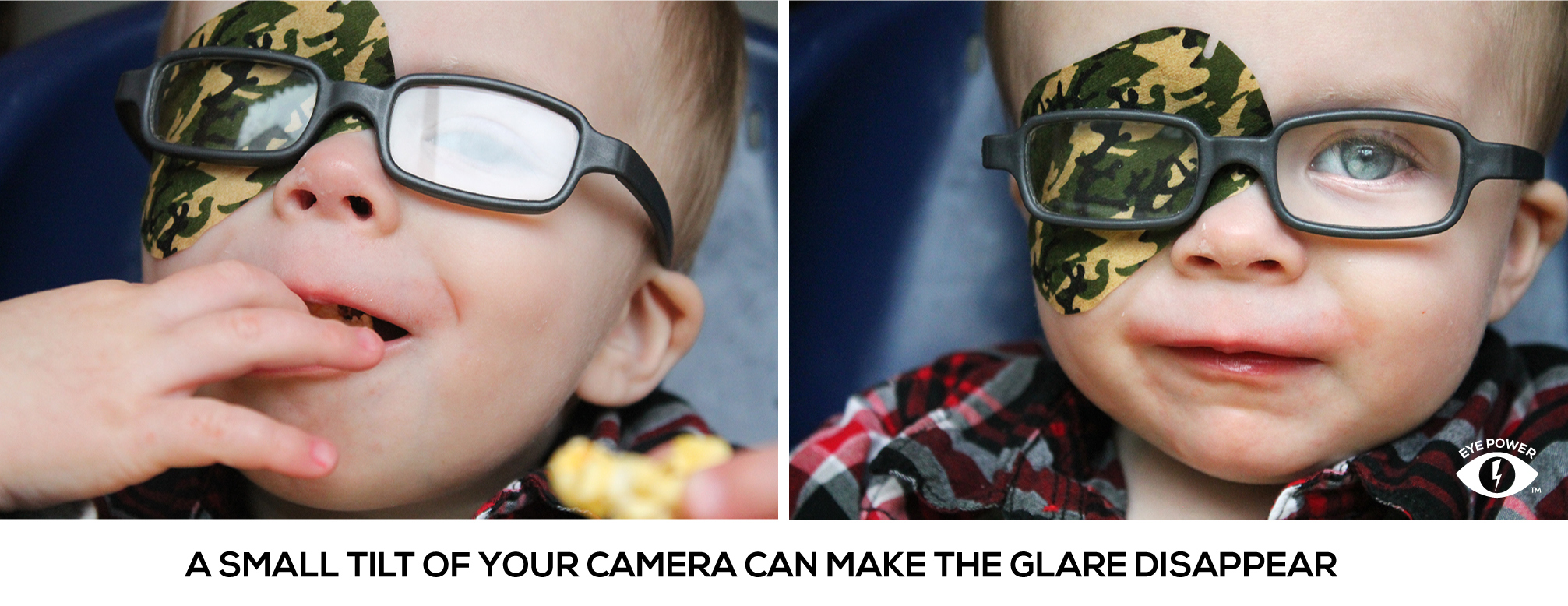
How to take photos of kids in glasses – Jessica from Eye Power Kids’ Wear has a great post with advice on getting great pictures of your kids in glasses. Take a look!
William Curran & Sons Optical is running a special for Little Four Eyes facebook members only! The special is for $100 off the purchase of Silhouette rimless frames and lenses, plus and a two-year warranty. They will work with and ship to any location. Offer ends this Saturday, January 18, 2014 (the image says it expires Dec. 31, 2013, but they extended the offer through this Saturday).
Book giveaways! And of course, don’t forget to enter the giveaways for the three books just reviewed here.
I’m excited to be reviewing three new books by Juliette Vignola, and Cynthia Davis and Baby Sue Acree. The authors of these books have all been through glasses either as a parent of a young child in glasses, or as a child who wore glasses themselves. I am giving away the copies of the books used in this review. See the bottom of the post for details.
My Bright Blue Glasses by Cynthia Davis and Baby Sue Acree
The first book, “My Bright Blue Glasses“, is written by Cynthia Davis and Baby Sue Acree. Author Davis’s son was diagnosed with amblyopia at 3 years old, and author Acree was diagnosed with amblyopia in 2nd grade. The story follows Tommy and his stuffed animal friends “Puppy” and “Little Bunny.” Tommy learns that he needs glasses, and would have to wear an eye patch and do vision therapy.
The book does a great job of introducing the idea of glasses and patches and vision therapy in an understandable, relatable and realistic way without being overly-negative. While Tommy is not happy about his glasses, his family and friends help him to see how much they help. The concepts of why a child might need glasses or patches are clearly explained. Some books fall into the trap of only showing how much a child dislikes their glasses, while other books talk only about how wonderful glasses are. I really appreciated how My Bright Blue acknowledges the difficulties with glasses and patches without dwelling on them, and balances that with humor and a celebration of good vision.
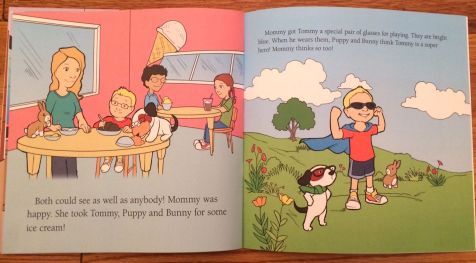
Everyone loves to get ice cream after an eye exam!
The illustrations are charming. I loved seeing what Puppy and Bunny would be doing in each scene: in one scene, Bunny is testing Puppy’s eyes, in another, they’re both enjoying ice cream in their own ways.
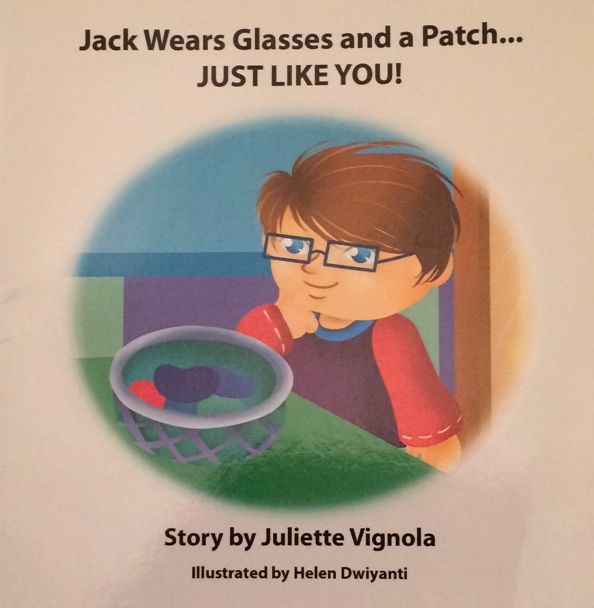
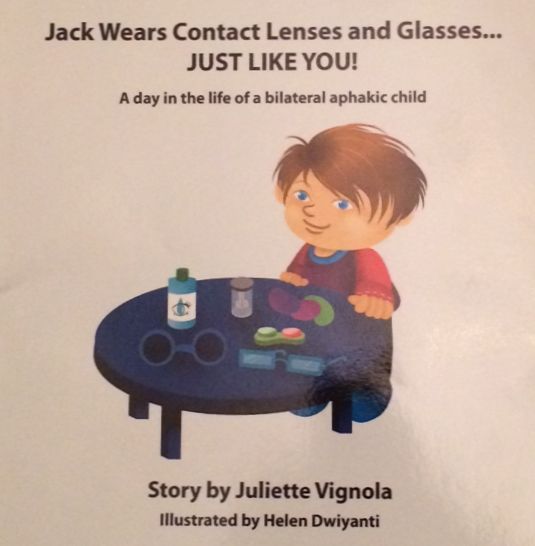
Jack Wears Contact Lenses and Glasses … JUST LIKE YOU! & Jack Wears Glasses and a Patch … JUST LIKE YOU by Juliette Vignola
I should first explain that Vignola used many of the same pages in her two Jack books. In the first, “Contact Lenses and Glasses,” Jack is a bilateral aphakic child who needs to wear contacts and sometimes wears a patch or glasses. In the second book, Jack needs glasses and a patch, so the contact lens pages are left out. The result are two different books addressing two different reasons for wearing glasses (bilateral aphakia, and amblyopia). This means that the “JUST LIKE YOU” series now has a book for:
unilateral aphakic kids
bilateral aphakic kids
amblyopic kids
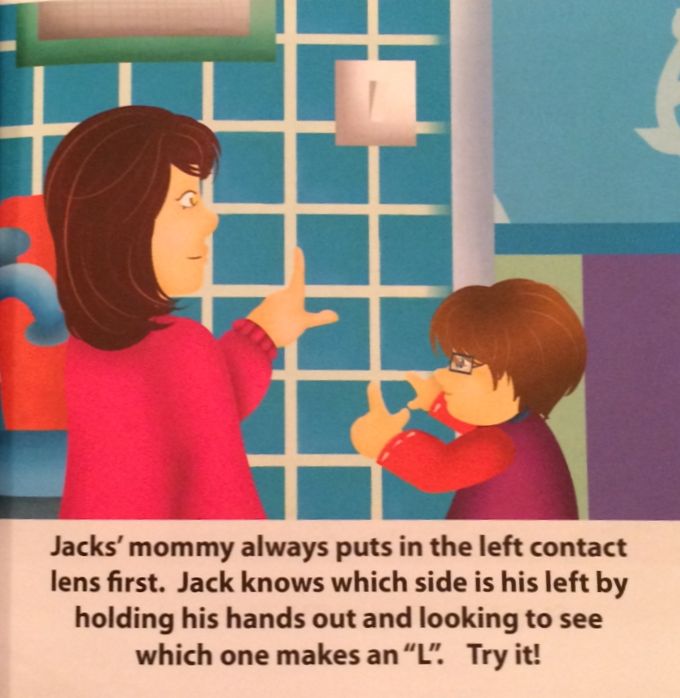
I think it’s great that these books address very specific situations. Each book emphasizes the routineness of glasses (in this case bifocals) and contacts and patches — as an example, in the “Contact lenses and glasses” book, the contact lenses always go in the left eye first. This focus on these things being routine can be wonderfully comforting to kids as that is their experience once they’re past the initial adjustment period. The books do not talk at all about learning you have a vision problem or starting out with contacts or glasses, which makes them perfect for kids who have been doing this for a while, but still want a book character who wearing glasses or contacts like them. The books do give brief explanations of what the glasses, contacts, and patches are for. The books also direct questions at the child reading the book, helping them to think about their own experiences.
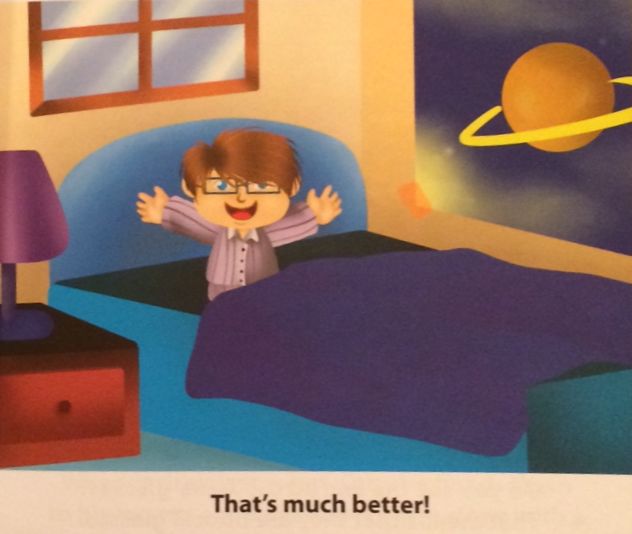
Page from “Jack needs glasses and a patch…”Page from “Jack needs contact lenses and glasses…”
The illustrations are simple, cheerful, and upbeat. At the end of each book, Vignola has included a page of notes of helpful tips and advice from her own experiences.
Books Giveaways
I have one copy of each book to give away. Leave me a comment with the title of the book you’d like to be entered to win — you can list more than one title, but winners are limited to one book each (so if you win in the first drawing for My Bright Blue Glasses, you won’t be eligible for either of the JUST LIKE YOU books.
If you want to add something to your comment, leave your best piece of advice for parents who are just starting out with a child in glasses, patches, or contacts. Or, if you’re just starting out, what’s your biggest question?
After a few discussions on the Little Four Eyes facebook group about whether to be concerned about a glow in a child’s eye in photos (see “Know the Glow” for more information), Kristen shared a little of her son, Jayden’s story. I asked if she would like to share more of his story, as I agree with her on how important it is to increase awareness of retinoblastoma. Many, many thanks to Kristen for sharing Jayden’s story, and many good thoughts and prayers to Jayden and his family as they finish what they hope is his last round of chemo. – Ann Z
Super Hero Jayden
On Thursday night, I noticed both of Jayden’s eyes were puffy so I gave him some Benadryl. Friday morning Jayden stopped eating and drinking and only wanted to be held and slept while someone held him. Very unlike Jayden, a vibrant and silly toddler who eats everything in sight and hates naps. That day I called the nurse line and emailed his pediatrician and they thought it was just a virus and to keep an eye on him. Saturday I made an appointment and the doctor on call didn’t look at his eye because she didn’t want to irritate him. She told me not to give him any pain reliever to see if he broke a fever, telling us it was a virus. Sunday morning, his eye was swollen shut and 3 times the normal size. I rushed him to the ER and we were there all day and they finally told me he had a “calcium deposit”. I didn’t know that meant a tumor that was cancerous. We were admitted to the hospital that night. The next day they did an exam under anesthesia, Monday, July 15th of 2013 I was told he had Retinoblastoma.
At 6 months, a difference in reflections is noticeable in pictures.
Retinoblastoma or Rb is caused by an abnormality in chromosome 13 which controls retinal cell division. It affects 1 in every 15,000 to 30,000 babies born in the US. Retinoblastoma is a fast growing eye cancer affecting babies and young children. Tumors may form in one eye or both and can spread outside of the eye. This cancer typically develops before 3 years of age.
There are two types, hereditary or spontaneous. In October of 2012, I started noticing a different reflection in Jayden’s right eye in pictures that I took. When I brought up my concerns to his pediatrician, he felt it was just the flash from the camera. Later I would learn that this white glow in his affected eye is called “leukorcoria” and was a definite sign of the tumor. A couple of months after, I noticed that one of his eyes was lazy so I asked again about his eyes to his pediatrician and he told me to go to an ophthalmologist if I was concerned. A week later, he got sick.
From everyone thinking it was pink eye to all of a sudden the cancer word? WHAT? That week in the hospital was a blur, I didn’t sleep, tried to digest everything the doctors, nurses, and social workers were telling me, learning new medical terms and trying to keep all of his 13 meds straight… I was running on adrenaline. Jayden got diagnosed at 15 months old. The surgeon told me that the size of the tumor was so big that Jayden was already blind in his right eye 8 or 9 months earlier. I never suspected anything, he met all of his large and small skills at target or even earlier. I felt like the worst mother ever. The day after the exam, he had another MRI and CT scan, surgery for his port and a spinal tap. Since there was controversy if the cancer had spread beyond the eye orbit and onto the optic nerve, they decided to chemo first and then remove they eye. On the Thursday after his diagnosis, he started a high dose of chemo treatment. The plan was to do 2 days of the high dose chemo for 2 rounds (28 day cycles). Then after his eye calmed down with the steroids and other meds, he would have his eye enucleated (removed). Then they would decide to do more chemo or if we were done.
For 2 months, Jayden was a different kid until his eye came out. He stopped talking, eating and being social. He would lay and scream on the floor in pain, nights we wouldn’t sleep just try to rock him or watch “Mighty Machines” to keep his mind off the pain. Finally we got him on pain meds a month after his diagnosis and he was a little better. He was on Oxycodone every 4 hours, just to give you an idea of the pain he was in. OH, and let me tell you that “roid rage” is very real. A toddler on steroids is a disaster! One minute he would be content playing with his truck or tractor and the next minute he would throw “Corey Combine” across the room and start hitting the air! He would fall asleep with his snack cup and wake up at night and want a snack. It took me many nights of no sleep to realize that a blueberry waffle or cereal bar would make him happier. His beautiful brown curls were also falling out and always in his face. He would rip it out himself and hand me clumps of curls. We buzzed it and it was an emotional haircut for both of us.
The superhero shortly after his enucleation.
Jayden was getting daily Neupogen shots to help bring his counts up faster, but they also hurt his body. We did 4 cycles and then during the 4th round of shots, he had a huge allergic reaction. He also had an allergic reaction to one of his chemo meds, the Etoposide. Now he gets Benadryl before chemo treatments. Jayden is my super hero, he wears Super Man shirts and capes to his big days at the clinic (EUAs, chemo, transfusions). He has fear and anxiety of nurses and doctors. All of the port accesses, bloodwork, eye exams, and chemo treatments are traumatic for him. September 16th was his enucleation and the surgery went well and 2 days later, my happy boy came back to me. He was back to being Jayden, he started laughing, talking, eating, and playing again. My heart was so happy. Those 2 months of pain were the hardest, nothing I could do could make him happy. Who knew I would be so happy to have my son’s eye removed? After surgery, they placed a clear plastic lens in it called a conformer.
After surgery, his MRI results were sent to COG (Children’s Oncology Group) RB Commitee, the US experts to decide if he should continue chemo or if he was done. After some waiting, the Rb experts saw some “suspicious cell areas” on Jayden’s MRI scan. One of the experts examined the atypical cells and they may or may not be residual Rb tissues. The tissues were behind the eye globe close to the optic nerve. 4 more rounds of chemo was decided.
We were getting treated at Duke Children’s Hospital in North Carolina and then moved to Wisconsin, so Jayden is currently being treated at UW-Madison Children’s Hospital. Moving half-way through treatment is not ideal but I needed help and support from family. We are blessed to have these institutions helping us.
After enucleation, I patched his eye when we went out. He hated it and it ripped off his skin. He has glasses that he needs to wear now but hates them and we are trying to master this battle. He needs them to protect his good eye from harm. We received his first prosthetic eye right before Christmas, the best Christmas present ever! I cried after seeing how real it looked, now people wouldn’t stare at my child like he was an alien. His latest MRI looked good and he has another EUA in January to examine his eyes and another round of chemo the second week in January (hopefully his last one). We are also still waiting to hear back on his pathology, to see if it’s hereditary or spontaneous. Praying it’s the sporadic/spontaneous kind.
We are hoping we are seeing the light at the end of the tunnel. He is doing well and is a fighter. He inspires me to be strong and brave. He has been through so much and yet is happy and cheers others up. This morning we were waiting to get bloodwork and he was smiling and waving to everyone going by. For a couple weeks after chemo, his ANC (infection fighting) counts get really low and is neutropenic so we basically stay at home and can’t really go anywhere or be by groups of people. If he would get a fever when he is “neutropenic” (counts 500 or lower) he would be hospitalized for 3 days with antibiotics. Cancer doesn’t slow this boy down! His depth perception is off since he only has one eye, so we are trying to work on that. Every night we say our prayers and he holds my hand and we pray for all the other brave children who are battling cancer. Spread the awareness! If you would like updates, you can go to Jayden Hebberth for his facebook community. Thanks for listening. Shine on.
Update February 9, 2014: Kristen shared some fantastic news! Jayden’s MRI came back clear, with no signs of cancer growth. No more chemo for Jayden, his port will be removed soon!
It’s Ann again. Please do help spread the word about the importance paying attention to those photos and knowing the glow. A white or golden glow in the eye in a photo is one of the early signs of retinoblastoma, but it is not always an indicator of retinoblastoma: it may be nothing at all, or it can also be a sign of many other vision disorders, including amblyopia, astigmatism, cataracts, and more. If you are seeing a glow in your child’s eye in pictures, please make sure to get it checked out! – Ann Z
The Little Four Eyes facebook group gets quite a few parents who have just learned that their child will need glasses. Many come to the group with the same question: “How on earth am I ever going to convince my wonderful, but strong-willed child to keep glasses on her face?” For many of us, the only experience we’ve had with getting our child to keep something on their face is with sunglasses or maybe trying on frames at the optical shop. If we’re asking the question, chances are those experiences didn’t end well.
So for those who are asking that question right now, I have a couple of thoughts which may or may not be comforting. First, sunglasses and display frames at an optical shop don’t actually help a child see. Kids are more likely to leave on glasses with prescription lenses because those glasses will help them to see better. That’s the good news. The less good news is that it can take a while for a child to get to that point.
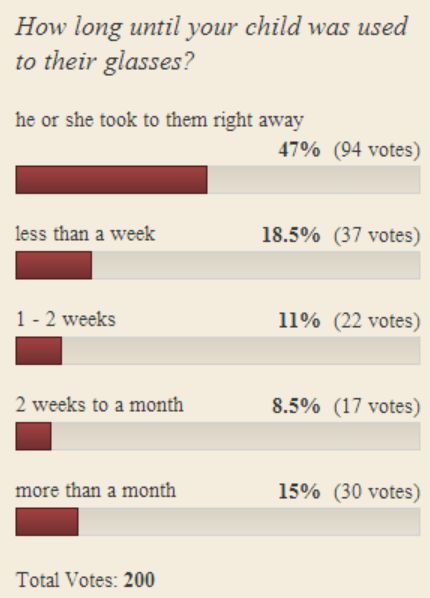
I ran a poll last year asking parents how long it took their child to get used to their glasses. Nearly half of the parents said their child took to their glasses right away. So you very well may be one of the lucky ones. Almost a third (29.5%) said their child took to their glasses in 2 weeks or less. And then the last 23.5% said it took more than 2 weeks. What that says to me is that you’re not alone going through this, and the amount of time it takes your child to wear their glasses well will depend a lot of the child and probably a whole lot of other factors. Chances are that your child will wear their glasses well pretty quickly, but if they don’t you still have a lot of good company. (For what it’s worth, it took Zoe 2 weeks to wear her glasses well).
General themes for keeping the glasses on
Every child is different, so not all of these will work for everyone, but in reading the stories of so many parents, there are some common themes:
Stay consistent
Make the glasses part of your routine from the beginning. Put them on your child first thing in the morning. Every time your child takes them off, put them back on. If you have to take them off for something (to wash their face or nap time), tell them that you’re just taking the glasses off for a little bit. And then put the glasses right back on when it’s time.This means that you may find yourself putting your child’s glasses back on hundreds of times a day (or at least it may feel that way). Just keep at it and know that it will get better.
Stay neutral/positive
Your child will pick up on your cues about this. So if you’re really upset about their glasses, that’s not going to help them want to wear their glasses. Instead, even if you’re frustrated that it’s the 101st time you put the glasses on, have a smile on your face when you put them on. But you don’t need to make a big deal out of the glasses, certainly not day to day. Just set them back on your child’s face with a smile every time they come off.If your child throws a fit or gets really upset. Set the glasses aside for a few minutes until they calm down. Then put the glasses back on calmly with a smile.(And yes, I know how frustrating it gets. But putting the glasses on your child’s face and trying to hold the glasses there with one hand, while fending off your childs hand with the other doesn’t work. I tried.)
Find ways to distract your child
You know your child and what your child loves. Use that to your advantage and as soon as the glasses go on their face, find that special something to distract your child. Book, TV, game, toy, walk outside, zoo, whatever it is, use it! You want your child to get used to looking at the world through their glasses – it will help them realize how much better they see with their glasses, which will encourage them to keep them on.
Some specific tricks
These are tricks that I’ve heard and collected over the years. Again, because all kids are different, some may not be appropriate for your child at all.
Get a stuffed animal or doll with glasses. Have your child put the glasses on the animal.
Put your child’s glasses on while they are sleeping. For some kids, they won’t notice when they wake up, and will wear their glasses better after that.
Throw a new glasses party. That can include having #1 and 2 or even cake or other festivities. Yes, this goes against the advice to not make a big deal about it, but that advice is more for the day to day stuff, for the first day, if your child is the type to celebrate those milestones, then go for it.
Explain why your child needs the glasses. This obviously works better for older children.
Show your child the photo gallery so he or she doesn’t feel so alone with their glasses.
Sticker charts! Your child gets a sticker for each day he or she wears their glasses well, with some reward after a week.
Let your child choose which glasses to put on. If you have a back-up pair, consider letting your child choose which they want to wear. That gives them a choice in the matter, they still have to wear glasses, but they can choose which to wear. You could also use something like Ficklets to decorate the glasses if they want variety a different way.
Take the glasses off in the car. If your child gets bored in the car, they are likely to take off their glasses and play with them in their carseat. For the first few months, you may want to just take them off ahead of time.
If your child had a terrible day of not wearing glasses at all, know that it does usually get better. Just take a break and start again first thing the next morning.
If your child is absolutely refusing to wear their glasses after a couple of weeks, make sure that the frames are adjusted well and get the prescription checked. If your child is farsighted or wears bifocals, you can ask your child’s eye doctor for atropine drops. The drops will relax your child’s focusing muscles and keep them from being able to see clearly without glasses. (Farsighted children can focus through their farsightedness, which can make it harder for them to accept glasses because they don’t always see the benefit to their glasses, and they have to learn to relax their focusing muscle and let the glasses focus for them.)
I don’t write about colorblindness in children much, largely because it is not something that can be corrected with glasses or contacts or patches. But it is certainly a component of vision, and a very important one for children (and adults).
Recently, a friend contacted me because his son was recently diagnosed as having moderate-to-severe colorblindness with greens. As he said “he literally couldn’t see the numbers hidden in the Ishahara plates, for many of them. It was both scary and eerily fascinating.” While I don’t have any first-hand experience with color blindness, I certainly can relate to how hard it is to watch your child struggle to see something in a vision test.
Child taking a color vision test. Image credit: National Eye Institute, National Institutes of Health Ref#: EE56
What is color blindness or color vision deficiency?
“Color blindness” is actually a misleading term, the more accurate term is “color vision deficiency.” Nearly everyone can distinguish some colors, but people with color vision deficiency have trouble seeing differences between certain shades of colors. The most common types of color vision deficiencies are with shades of reds and greens. People with normal color vision can distinguish more than 100 different colors. Those with strong color vision deficiencies may only be able to distinguish 20 colors.
Color vision deficiency is usually hereditary, though it is sometimes caused by injury. Color vision is encoded on the X chromosome, which means that men are far more likely to have color vision deficiencies than women. About 8% of men and about 0.5% of women have a color vision deficiency. Some people truly are “color blind” in that they cannot see any colors at all. This is called “achromotopsia” and is very rare: it affects around 1 in 30,000 people. Achromotopsia is also associated with poor visual acuity and nystagmus.
What is it like to have color vision deficiency?
This is a short documentary that was put together to explain color vision deficiency to children. It is based on the longer documentary, “No such thing as color.”
What does it mean for my child to have color vision deficiency?
Colblindor has a pretty sweet interview with two boys with color vision deficiency asking about what they see in terms of color. One question was whether they see rainbows, both boys answered yes. As the author states,
even if they really have some problems with colors their life is still very colorful.
Unfortunately, children with color vision deficiencies will often have trouble at school. Many worksheets and exercises are color coded (“color the circle red” or “how many green dots are there?”), and later, charts and graphs used in assignments often have a color component. These can be very difficult and frustrating for children with color vision deficiency. That’s why, if you know that your child has color vision deficiency, it is important that you talk with his or her teachers so they all know about it and can adjust those accordingly. Color deficiency is common enough that statistically, there will be one student with color vision deficiency in each classroom. However, you may still need to advocate for your child and make sure he or she receives the adaptations they need in school. There’s a nice post at ColorVisionTesting that talks about ways teachers can help their students with color vision deficiency.
Should I test my child’s color vision?
Children normally develop full color vision by 6 months, but as most parents will tell you, they won’t know their colors by name until well past that age. At age 2, they should be starting to match colors, around age 3 beginning to name colors, and between 4 and 6, have good color naming skills. Parents of children with strong color vision deficiency often start to notice problems between the ages of 3 and 10. If you’re noticing that your child is consistently confusing colors or naming colors incorrectly, they should be tested before starting Kindergarten.
There are online color vision tests, but you will need to see an eye doctor to diagnose color vision deficiencies accurately.
More Reading
I relied very heavily on the excellent Colblindor website for this post. Some good articles to start with:
Colorblindness is a part of a web exhibit on color. It has a really good overview of the types of colorblindness, causes, and tests. There’s also a very nice vision simulator that lets you choose different pictures and different types of color blindness.
Is my son colorblind? (this is also applicable to daughters, just boys are much more likely to have color vision deficiencies).
5 online color blindness tests links and explanations of some of the different types of tests. Note: make an appointment with an eye doctor if you suspect your child has a color vision deficiency.
Color Blind Home Page is a site written by publishers of a color vision test. The site has a lot of good information about color vision deficiency. This site offers a free online test for color vision deficiency, but make sure you see an eye doctor for a final diagnosis.
Books!!
There are a few books that I found for kids about color vision deficiency. I have not read these books, I welcome any reviews or other recommendations:
Seeing Color: It’s my rainbow, too – written by Arlene Evans, a school nurse who worked with many kids with color vision deficiency. For ages 9-12 (though one review I read said it would be appropriate for kids as young as 5 or 6). Includes a glossary of key terms.
All about color blindness: A guide to color vision deficiency for kids – written by Karen Rae Levine, the mother of a boy with color vision deficiency. The book follows the story of Cory, a 4th grader who learns he has color vision deficiency and learns to deal with situations that come about because of it. This one has been awarded the Mom’s Choice Award, Next Generation Indie Book Award, and National Indie Excellence Book Award.
Erik the Red sees green: A story about color blindness – by Julie Anderson. Erik has troubles in school and at soccer until he discovers that he has color vision deficiency. He and his friends and teachers figure out ways for him to overcome the difficulties. For ages 4-7.
First, a quick note to say that I have updated the photo galleries with some wonderful new photos of kiddos in glasses and in patches. Thank you to everyone who has shared their photos! They really go a long way to helping other families and young kids in glasses and patches to feel less alone.
‘Tis the season for all sorts of giveaways and contests, it seems. And there’s some really good ones going on right now. Here’s a quick rundown of the ones I know of:
Share your opinions – be entered to win $50 Amazon card: There is a survey that is looking at ways to improve the glasses-buying experience for parents with young children who need glasses. They are looking for opinions of US parents whose children needed glasses before the age of 8. At the end of the survey, they will do a drawing and one participant will receive a $50 Amazon card. US only. UPDATE: Survey is still open. Survey closes Dec. 1, 2013. Take the survey here.
Yes, that is celery wearing glasses.
Make a funny face with fruits and vegetables and glasses – win 1 of 12 pairs of Zoobug frames: Zoobug glasses has a super-cute funny face contest, with 12 winners, each receiving a pair of Zoobug frames! Just dress up a fruit or vegetable like a face wearing glasses and send the photo in to their facebook page, or tweet it to @Zoobuglondon. Contest is open worldwide, and ends December 9, 2013. More details here.
Closed. Facebook giveaway with a whole lot of prizes: Eye Candy by Gwen is hosting a huge holiday giveaway on her facebook page. The prizes include books, accessories, patches, and even eye glasses frames. Giveaway ends November 25, 2013. Contest is open worldwide, but shipping may be required for international winners in some cases. More details here.
Enter your child’s school library to win a copy of Jacob’s Eye Patch: Patch Pals and author Beth Kobliner Shaw are working together to give away 100 copies to elementary school libraries. US only. The last 25 copies will be given away on November 26, 2013. More details here.
Of course, there’s the patching giveaway going on here, with patches, books and a bear wearing an eye patch. The giveaway is open world wide and ends November 25. Take a look!
And please, if you haven’t looked at the Glasses board book Kickstarter, take a look. We are getting very close to our goal, but still need a bit more to be fully funded. The Kickstarter ends November 26.
 Hello my name is Nitie Mehta and I have a 7 year old daughter. No she does not have Congenital Nystagmus but I do. I wanted to share with parents my experience of growing up with Congenital Nystagmus.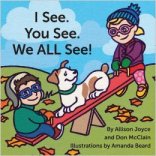

















 For Little Eyes