Preparing for a Newborn’s Cataract Surgery

Hi again, For Little Eye’s readers!

In case you missed my first post, I’m Kyla from Homemade Hometown— mom to Arthur, who was born with unilateral PHPV/PFV microphthalmia.

Headshot of Kyla Charles, Author and Mom

After discovering Arthur’s condition and existing cataract, the next step was to schedule his lensectomy to remove his cataract. We discussed the surgery process and possible unknowns before going in, which involved a lengthy appointment and dilated examination.

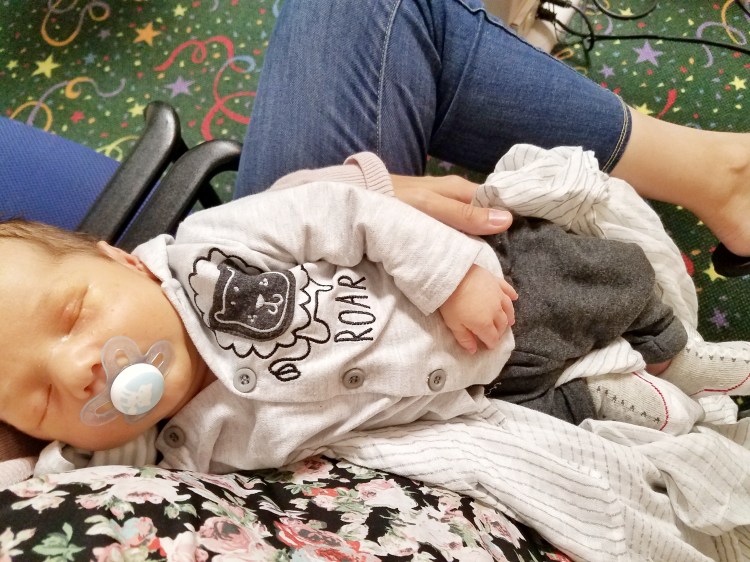
I’ve never had a dilated exam to compare, but doing one with a small month-old infant was probably easier than examining a toddler. The ophthalmologist had an exam table and swaddles to keep him contained. It still wasn’t easy and I ended up having to leave the room while tearing up and my husband stayed with Arthur. I took it pretty hard with the loud baby cries—he wasn’t in pain—but the combination of postpartum hormones and hearing my little newborn cry just did me in. In fact, 6 months later, I still leave the room at each examination. Don’t be embarrassed if you need to, too.
IMG_20170807_203031_123_1

We never had previous experience with surgery scheduling, and the whole process struck us by surprise. I ended up calling the office to check on any movement on a weekly basis. The month of waiting for surgery took me back to my time during late-pregnancy—pacing around and nesting, making sure every little detail was as prepared as possible. Once we finally had a date confirmed (it took long to coordinate between our ophthalmologist and retina specialist) we found out that it’s standard with surgery scheduling to not know the operating time until the day before surgery. The youngest babies usually are operated on first in the morning. We didn’t get in until mid-day.
After the examination we discussed the surgery details and met the retina specialist that our ophthalmologist wanted to keep on call through the duration of the surgery. With such a large and dense cataract, the doctor couldn’t get any look at the retina. Since she didn’t know exactly what she was dealing with until she could get inside the eye, she made sure to explain the chance of pulling in the retina specialist to tend to any abnormalities such as a detached retina. We also discussed the common conditions of PHPV/PFV in that the stalk in the eye may still be fully formed and need to be removed.

There was a lot of unknown, but the one thing we did know was that surgery was imperative between 6 and 8 weeks of age in order to create the brain connection to the eye to establish vision. We trusted our ophthalmologist, did extensive research, and planned for tentative surgery.

time-calendar-saturday-weekend-60032

Surgery preparation involved bathing the night before and hours of fasting—which is tough for a little baby trying to pack on the pounds and earn his Michelin Man rolls. The scheduler asked us to arrive two hours earlier than the scheduled operation time and we were dreading the idea of waking and fussing with a fasting newborn. It was only a small fraction of what we weren’t looking forward to, though.

Despite all of the preparations, conversations, and appointments, nothing makes you feel ready to send your child off to surgery. There was a long debate over if it was worth doing anything at all—we didn’t want to put him under anesthesia and cause him any pain. After a few long-winded, late-night conversations, we made the individual choice that we felt we needed to give Arthur every chance we could to establish his vision. We were going to fight for his sight.

Discovering PHPV/PFV in our Newborn

Hi For Little Eyes readers!

I’m so happy to introduce myself to such a supportive and helpful group. I’m Kyla, and I run a crafting lifestyle blog at Homemade Hometown as well as write for a few other blogs, magazines, and publications. You can read more about me here if you’d like– I plan to stick around the For Little Eyes community for the long haul!
DSC_5935
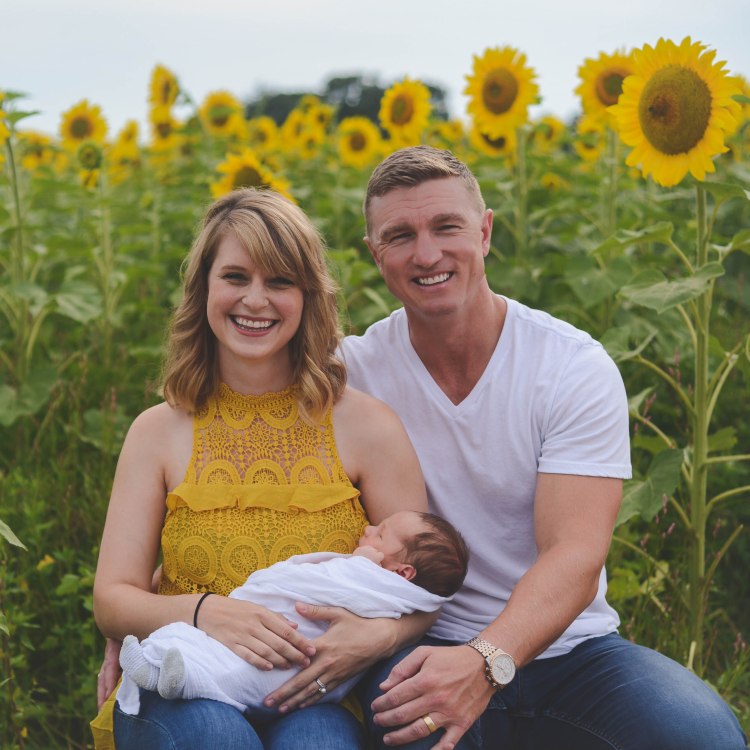
[photo image of author with husband and newborn son, Arthur]
You may have seen this post originally on Homemade Hometown, but I have teamed up with For Little Eyes to help spread awareness and advocate for other families faced with a similar story to ours. I’ll be sharing our journey with our youngest son, Arthur, and his condition of unilateral PHPV/PFV and microphthalmia.


[photo image of stock photo child looking off in the distance]


When Arthur was born, we noticed almost immediately that one of his eyes seemed a little swollen shut. He would open one eye and not the other. We asked the doctors about it while we were still in the hospital after his delivery. Our resident doctor assured us that it’s common for babies to have some swelling or similar symptoms, especially when they deliver “sunny-side-up”.

The next day during the rounds, we continued to voice our concern over the disproportion and favoritism opening one eye and not the other. The overseeing physician repeated the advice we received already, and to be honest, it’s easy to listen to what you want to hear.
Arthur passed all of his tests. I stayed in the room for each one. He aced his APGAR with a 10—crying before even being fully born. Chaos ensued at home, and we enjoyed our time together before making our way home.
At his follow-up clinic appointment, we voiced our concerns again—nothing was improving, and we were able to look closer at his eye and see different coloring and a jagged-shaped pupil. His eyes were checked, they felt his head, and gave him the all clear again. I gladly listened. Luckily, Alan wasn’t so easily swayed.
The photo we captured of Arthur’s eye before seeing the Ophthalmologist, when we were told things were normal

[photo image of newborn Arthur with one healthy eye with a blue iris and normal size on the right and one eye with a green and cloudy iris and smaller eye on the left]

At two weeks old, my husband was still sticking to his gut that something wasn’t normal with Arthur. I knew that he looked different, but I wanted to believe otherwise. I finally took to Dr. Google (which is SO unlike me to wait an entire two weeks… it usually takes me 5 seconds to web MD a problem and conclude impending death).
Google came up with some scary results:
  • Congenital Glaucoma
  • Horner’s Syndrome
  • Cataracts
  • Pete’s Anomoly
  • Anopthalmia/Microphthalmia
  • And more
After reading about how serious many of these conditions are, we called the Pediatric Ophthalmologist on our own and requested an appointment without a referral. They fit us in the next Monday, and immediately knew something was not right in plain sight. After sending stern warning letters to all of our doctors, our provider’s Ophthalmologist admitted that they have no tools or specialists able to work on babies this small, and we were sent on to a specialist at the University of Wisconsin.
We still didn’t have any answers when we came to the UW. We met our doctor and after a long, long day of examinations and deductions, we knew what we were dealing with:


Arthur had a Persistent Fetal Vasculature (PHPV/PFV)
Congenital Cataract and Microphthalmia in his left eye.


Persistent hyperplastic primary vitreous or persistent fetal vasculature is a rare anomaly of the eye where it doesn’t fully form in the womb. When an eye is formed in utero, a stalk connects the back of the eye to the pupil, and once the eye develops further, the stalk then regresses and the eye is left clear to allow light in for vision. With PHPV, that stalk sometimes doesn’t regress—and the eye remains cloudy. A PHPV cataract is the worst type of cataract for vision prognosis, and needs to be removed between 6 and 8 weeks of age for a chance for the brain to make the right connections to the eye in order to establish vision. Microphthalmia can pair with PHPV, but can also exist alone. That condition is the medical term for having a smaller eye. It can vary in severity and in how it affects vision. All together, these conditions lead to increased risk of glaucoma, poor vision prognosis, and a long journey of maintenance and related surgeries.

Easy DIY Valentines

Jessica Green posted these super cute valentines that she made with her 5 year old daughter.  She graciously gave us permission to share the photos and instructions.  You can see her original post on Instagram.

IMG_0998

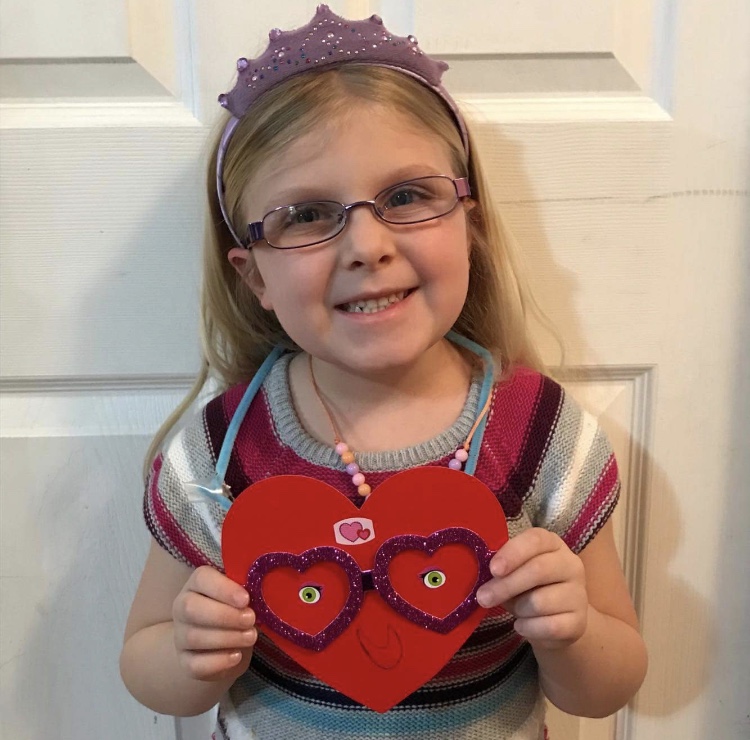
[photo description: 5 year old girl in a tiara and glasses, holding a red heart-shaped valentine with sparkly purple glasses.]

Materials (from Hobby Lobby and Michael’s):

  • die-cut hearts
  • paper glitter glasses (about the same size as the hearts)
  • valentines stickers
  • silly eye stickers

1. Put the glasses on the heart and tape the arms to the back of the heart

[photo description: left photo of red paper hearts with glittery heart glasses. right photo shows the back of the paper heart with the temples of the glasses taped down.]

2. Put eye stickers inside the glasses frames (centered for the best fit!)

IMG_1004

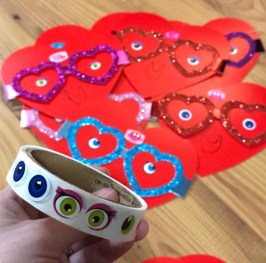
[photo image: roll of eye stickers in front of the heart valentines with glasses and eyes.]

3. Add a mouth and Valentines stickers to decorate!

IMG_1006

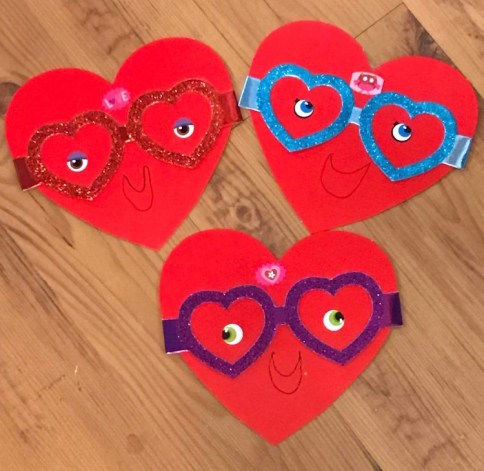
[photo image: Three finished valentines: Red heart shapes with glittery heart-shaped glasses, eye stickers and hand-drawn smiles and other valentines stickers.]

New Year – New Name: Little Four Eyes is now For Little Eyes

It’s the start of the new year, and a time to reflect and make changes. In that spirit, I have decided to change the name of this site (and the related fb group and page) from “Little Four Eyes” to “For Little Eyes.” There’s a few reasons that led to this decision, and I wanted to share my thinking on this.

First, some history:

This site started out back in 2008 as the blog “Toddler Glasses,” so named because, well, my toddler wore glasses, and I wasn’t feeling terribly creative. Very shortly after I started writing, it became clear to me that while a lot of my readers had toddlers in glasses, even more had children of other ages, ranging from 0 to well into elementary school and beyond, and so I needed a different name. The name “Little Four Eyes” popped into my head pretty quickly, though I’m not entirely sure where it came from. It was meant to be sweet and fun and a little whimsical. It never occurred to me that the name might bring up painful memories for people who had been taunted as a child with the phrase “four eyes,” but I’ve heard from enough to know that unfortunately, that is the case for more than a few readers. For those of you who did feel that way, please accept my sincere apologies. I never, ever intended the name to be hurtful.

This site has grown a lot since then and reached far more people than I had ever imagined. It has been a huge positive part of my life, and I hope for many others as well. However, the question of the name has nagged at me ever since I first heard that it bothered someone. After thinking this over a long time, and listening to many discussions of the name, both through personal emails and on the facebook group, I’ve decided to change the to “For Little Eyes.”

I like that the name still makes reference to the previous name of the site, as well as broadening the scope to include children who wear eye patches, contact lenses, prosthetic eyes, or who have had other vision treatments. While this site has featured information on those topics for years, until now, the name only referred to wearing glasses.

A couple of other notes on this decision:

  • I struggled over this decision for a long time, it was not made lightly, nor was it made in response to any single conversation or person.
  • The thing that finally pushed me to make the change was a conversation I had with friends who are not part of the group – as I was looking for an outside opinion. One particularly wise friend asked me who I was trying to reach. I’m trying to reach any parent who has learned their child needs glasses, but especially those who are feeling upset or worried about it. I don’t want the name of this site to add any pain on top of the stress of a parent who is already feeling overwhelmed.
  • The term “little four eyes” or “L4E” gets used a whole lot in the facebook group as well as on the site as shorthand for a child who needs glasses. I am totally fine with that term being used in that way. It’s kind of a pain to type out “child who needs glasses” and I know that no one using that term in that context is being mean-spirited.

I own both the domains “LittleFourEyes.com” and “ForLittleEyes.com” and they both will bring you to this site.  I will continue to maintain both of them, so any bookmarks and links to the site will continue to work. I know that it’s going to take me a while to update the site as well as all the associated social media accounts, so please forgive me if both names still show up for a while.

One final note, I’m keeping comments open, but I would not like to have a debate over whether or not the name is hurtful. I’ve seen that debate happen enough times to  know that no one is going to change anyone’s mind on what is or is not personally hurtful to them.  The name was hurtful to some and that’s reason enough for me to change it.

Cyber Monday, Little Four Eyes style — and a giveaway!

Hello! For readers in the U.S., I hope you had a wonderful Thanksgiving, and a happy weekend to all! I am so thankful for this community and for all the people who have helped Zoe to see better.

Tomorrow is known as Cyber Monday, a day when online retailers often offer deals to kick off the holiday season.  There are so many wonderful online retailers out there that provide products that help our kids in glasses to see better, look better, or like their glasses better.  Below is a list of sites offering deals or specials this Monday (Nov. 27, 2017).  I’ll also be giving away three copies of my book.

Happy Thanksgiving!

[image description: drawing of a turkey wearing glasses. Text reads: “Thankful for vision! Cyber Monday deals…and a book giveaway!”]

Disclosure: I am not receiving any money or compensation from these companies, nor am I endorsing them. I am listing them because I think it helps our community to have companies that offering products for our kids.

2017 Cyber Monday Deals for the Little Four Eyes Community

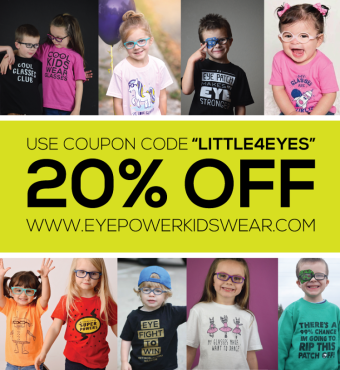
  • Eye Power Kids Wear is offering 20% off items on their website with the code LITTLE4EYESCheck out their store
    EyePower
    [image description: photos of children in glasses wearing t-shirts about glasses and vision.  Text reads: “use coupon code ‘LITTLE4EYES’ 20% OFF. http://www.eyepowerkidswear.com “]
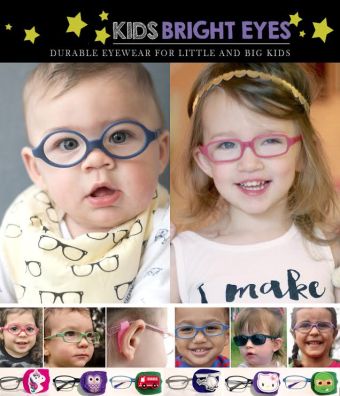
  • Kids Bright Eyes is having their largest sale of the year.  Coupon code: glasses2017   will save you 25% off Frames (Free 1 year warranty on the frame), Prescription Services, and Accessories. Take a look at their shopKBE[image description: photos of young children in glasses and frames with patches.  Text reads: “Kids Bright Eyes, durable eyewear for little and big kids”]
  • Spectacular Sprouts is having a 25% off sale of all their items from Nov. 23 through to Nov 27th. No coupon code needed.  Check out their storespectacularsprouts
    [image description: photos of children’s t-shirts featuring animals in glasses.  Text reads: “Spectacular Sprouts 25% off storewide.  Black Friday through to Cyber Monday http://www.spectacularsprouts.com “]
  • Presbeau Publishing is offering the three Patchland Adventures books about patching by Carmen Swick and a sweet plush bear with (or without) an eye patch.  Free shipping in the US. (Read our review of the first book.)  Take a look at their shop
    patchland
    [image description: cover images of three Patch Land Adventures books and a photo of a stuffed animal bear wearing an eye patch.  Text reads: “the Adventures continue! New! Book Three. Collect the Series! http://www.patchlandadventures.com “]
  • i2i Optique is offering 20% off their website with the code 20%.  Browse their collection

(If you are a vendor and would like to add your special to this list, please let me know – ann@shinypebble.com)

Glasses Book Giveaway

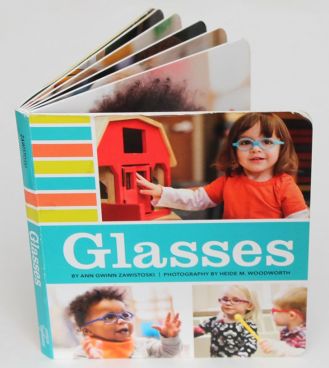
In honor of the season, I am giving away three copies of my board book, Glasses (you can read a review of the book at Children’s Books Heal).  Just comment below with your child’s favorite thing to see during this season to be entered.  I’ll use a random number generator to choose three winners on the evening of Wednesday, Nov. 29.

standingbook

[image description: photo of the board book “Glasses” which has photos of young children in glasses on the cover.]

Children in glasses and the eclipse

Eclipse_20160901_Composition
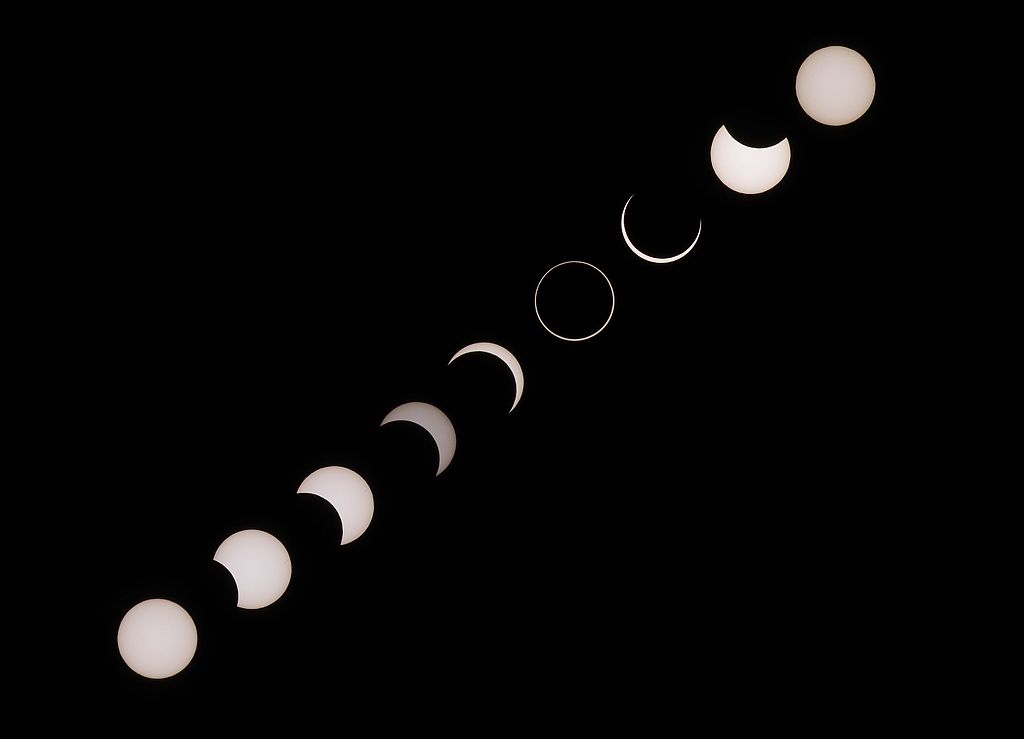
Time lapse photos of a total solar eclipse. By Scoolasse (Own work). Used under a CC BY-SA 4.0 license (http://creativecommons.org/licenses/by-sa/4.0) via Wikimedia Commons
For those of us in North America, Monday, August 21, 2017 will offer a rare chance to see a solar eclipse across the continent.  While there’s only a small portion that will see a total eclipse, if the weather cooperates, everyone on the continent will see at least a partial eclipse.  Eclipses are relatively rare and fascinating events.  I still remember vividly seeing a partial eclipse in 1984 when I was 9. It made me think about the world and the universe a little differently.

This brings us to the question of how to best view an eclipse, or more specifically how to help our children observe the eclipse.  Looking directly at the sun without protection, even during an eclipse (maybe especially during an eclipse) is dangerous and will damage your vision.   Given how important we all know vision is, and how much we’ve invested in our children’s vision, I’ve seen a lot of questions about what to do for safety.

I talked with Dr. Nate Bonilla-Warford, a pediatric optometrist in Tampa, FL about his thoughts on children viewing the eclipse.  He said:

“An eclipse is an exciting event for the entire family. As long as you and your children are prepared ahead of time with proper viewing equipment, practice, and instruction to never look directly at the sun, there is very low risk of eye problems. If you are concerned about vision problems after the eclipse, vision your eye doctor.”

You can hear more from Dr. Nate on his recent podcast, about eclipse safety.

There are safe and not-safe ways to observe the eclipse

As mentioned before, looking at the sun without protection will damage your child’s eyes (and your eyes).  Usually, the brightness of the sun keeps you from looking directly at it, however, during the eclipse, the sun will be less bright and it may feel more comfortable to look at the sun.  The backs of our eyes do not have pain sensors, so there’s not any feedback telling you to look away.  And unfortunately, looking directly at the sun can cause permanent damage known as solar retinopathy.

For any eclipse viewing, make sure that you supervise your child and that you emphasize to them how important it is that they not look directly at the sun. You know your child best, if they are likely to try to stare at the sun, maybe directly observing the eclipse outside isn’t the right activity for them (there are other ways to observe it though).

Observing the eclipse without looking at the sun

Some of the best ways of observing the eclipse don’t involve looking directly at the sun at all.

Pinhole projectors
Making a pinhole projector is easy and it lets you see the changes in the sun during the eclipse safely as you are looking at a projection of the sun.

NASA has a page with instructions and printable pdfs to use to make different pinhole projectors at home.

3d_team_pic_2_hand_zoom
One of the pinhole projector projects from NASA http://eclipse2017.nasa.gov/2d3d-printable-pinhole-projectors
The Jet Propulsion Laboratory also has step by step instructions.

University of Illinois has instructions to make a couple of different types of viewers, from cereal box or a cardboard tube.

Looking at shadows cast by leaves
This is my favorite!  The sun shining through leaves on the trees makes a natural pinhole projector – you can see the shape of the eclipse in the shadows.  This made a huge impression on me as a child and I still think of it every time I look at shadows of leaves.

The science blog, Last Word on Nothing has a great explanation of this.

7243724172_79e3dc45c2_z
Tree shadows as a natural pinhole viewer during the eclipse in San Francisco in 2012.  Photo credit: torbakhopper, https://www.flickr.com/photos/gazeronly/7243724172. Used under a CC BY-2.0 license.
Visit your local observatory.
If you live near an observatory, many will have public events (though they’ll probably be very crowded) and many will have other solar viewers that let you view the eclipse safely, often in much greater detail than you’d be able to see on your own.  Plus, there will be astronomers and teachers there to give you more information during the event.

Using Eclipse Glasses

I’ve saved this section for the last, since I think this is potentially the most likely viewing method to lead to problems.

First, it is critical to make sure that the glasses you have are compliant with the ISO 12312-2 international safety standard (read more about this on the NASA site).  If they are the right kind of glasses, you will not be able to see through them at all when you aren’t looking at the sun.

For kids who wear glasses, the eclipse glasses should go over their regular glasses.  It may be easiest for them to just hold the glasses up to their eyes rather than try to wear them over their glasses. Try this out before the eclipse.

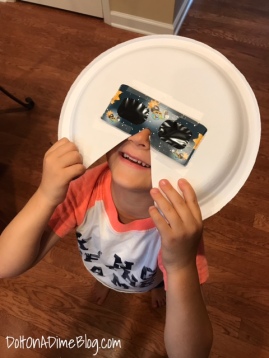
You can cut out a paper plate around the glasses to make them easier for your child to hold up to their eyes and make it less likely that they’ll peek around at the sun.  The blog, Do it on a Dime with Kathryn, has detailed instructions.

image4
Eclipse glasses with paper plate holder.  From http://www.doitonadimeblog.com/2017/08/2017-solar-eclipse-for-kids/
When looking at the eclipse with the glasses, have your child put the glasses on while looking away from the sun.  Have them turn and glance at the eclipse and then turn away again.  Then remove the glasses.  Take time to practice this with your child before the eclipse (without looking at the uneclipsed sun) so that your child understands the process and also knows that they won’t be able to see through the glasses until they are looking at the eclipse.

Again, make sure you are supervising your child while they use the glasses and make sure that they are not looking at the sun without them.

Watch online or on tv

If the weather doesn’t cooperate or you feel that this isn’t something your child can do safely, the eclipse will – of course – be broadcast through a lot of different channels live, both on tv and online.

Have a wonderful and safe eclipse!  

Eclipse information and safety links:

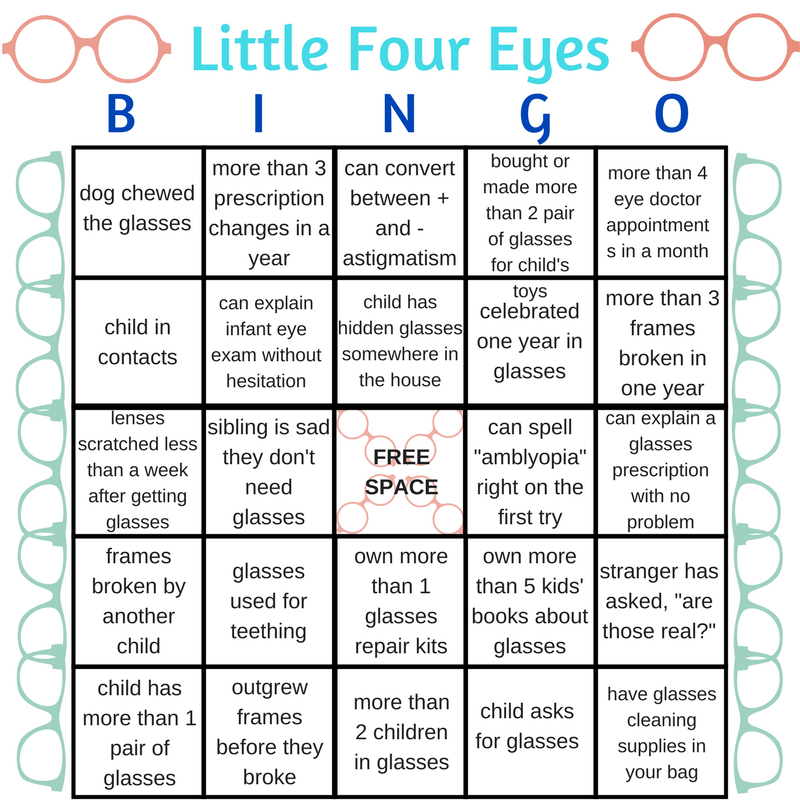
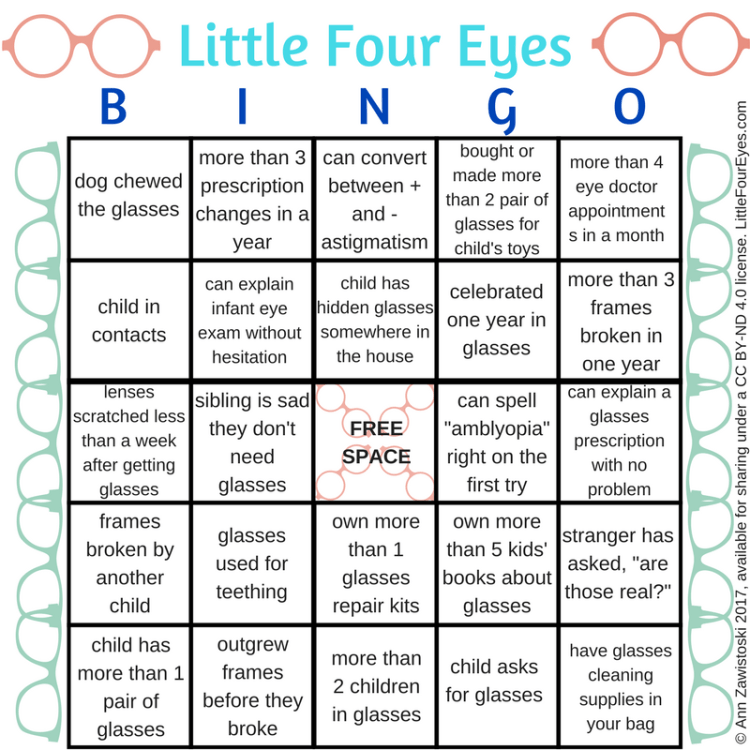
Little Four Eyes BINGO

Just for fun…I made up a BINGO card, with each square being a common experience for parents of young children in glasses.  Do you have a bingo (5 in a row, up and down, across, diagonal, or all four corners)?  What other experiences should I have added?

Little Four Eyes Bingo! (1)


Megan’s story

I loved this idea that was shared by Lisa – it combines some of my favorite things: books, libraries, and kids telling their own story. Lisa’s daughter, Megan, is in first grade and recently asked to wear her patch to school.  Megan brought “Jacob’s Eye Patch” to school as well as her own story of her vision challenges read them to her class.  Her teacher reported that the class was entranced.

Megan and her mom then donated that copy of the book to the school library.  Inside the book, they included Megan’s story:

19029504_10209205241395629_2084122578913346724_n

Hello! My name is Megan.  I want to share the story of my vision challenge with you so it can help other kids understand why some people, big and little, might wear glasses or eye patches or have a lazy eye.

I have patched since I was 3 months old and no one has ever made fun of me for it and I hope no one ever does. I also hope no other kids get made fun of either. I have had a lot of kids ask me what my patch is for and then I tell them and they usually say “oh cool!” That makes me feel happy.

I was born with a cataract that covered the lens in my eye so it couldn’t see very well. Do you see the reddish-yellow glow in my eye? That was my cataract. Dr. Karr removed it when I was just 11 weeks old. After my surgery they put a protective shield on my eye while it healed. My mom got to pick out a quilt for me and they also gave me a fuzzy elk. I love my special quilt. After my eye healed I got a contact lens so I could see clearly. My parent had to take it out to clean it and as I got older I HATED it. I got glasses when I was about 1 1/2 year old. They were so cute!

I started patching for 5 hours every day. I had patches with cool designs. The patch helped my eye get stronger so I could see better. My eye also was lazy because of the cataract and it pointed out to the left. When my patch was on it looked straight! When I was 5 I had surgery again to help straighted my eye. Then I had another surgery to put a special kind of lens inside my eye so I didn’t have to wear the contact anymore. I still patch for 5 hours a day. I have patched over 10,000 hours!! Can you imagine that? Want to know a secret? I still don’t like patching and still struggle to do it when I am supposed to but I am glad my Mom has tried to get me to patch every day because it has helped my eye learn to see much better. I still go see Dr. Karr every few months to check my eye and someday I may need another surgery because it’s getting a little lazy again. Maybe because sometimes I take my patch off or maybe it just wants to be lazy. I do love my glasses though!

Thank you for hearing my story and I hope you enjoy this book.

Gifted to Ladd Acres Elementary by Megan Sanchez June 2017.

19060082_10209205149233325_6741370189873097837_n

[visual description: a picture of the book “Jacob’s Eye Patch”; Megan’s story; and photos of Megan as a baby and a young girl wearing an eye patch.]

Great Glasses Play Day Book Contest Results

Last weekend was the Great Glasses Play Day and the week leading up to it was Children’s Book Week.  So in honor of both celebrations, I held a contest on Facebook, asking people to submit their child’s favorite book about glasses and write a little about why they loved the book.

Children's book contest

So first, congratulations to Chau, Mummy T, Sarah, Aleece, and Michele!  You were chosen in a random drawing of submissions.  I’ll get in touch so you can get your prizes.

And now, here are books that were submitted as favorites:

Note, links to books through Amazon.com are affiliate links.  By purchasing through those links, I receive a small commission, which goes towards upkeep of this site:

Little Bear Needs Glasses, by Christine Faust and Bernd Penners

This new book from Usborne was mentioned 4 times, making it the book with the most mentions in the contest.  The book comes with 5 reusable stickers.  Parents had this to say:

My 2 year old loves being able to stick the glasses on the animals and he loves that they are “like me”.  – Parker’s Mom

It has five sticker eyeglasses that my son loves to put on the different characters. It’s a great motivator for him to put on his glasses! – Heather Hargadon-DeCesare

There are 5 reusable/repositionable stickers of 5 different glasses. Each animal in the book has their own distinct pair. Little Bear learns he needs glasses and his friends offer theirs for him to try on one by one as he searches for the right pair for him. My child loves placing the glasses on each of the characters of the book and matching them to their owners at the end of the book. – Lindsey S

Simple to understand. Five pairs of reusable glasses sticker for all of the animals. – Aleece

Arthur’s Eyes by Marc Brown

Arthur’s Eyes is a classic book about Arthur the Aardvark getting glasses.  Kristin Mackintosh said this about it:

Story about Arthur needing glasses but doesn’t want to wear them because his friends will make fun of him. Talks to his principles and realizes he wears glasses too. Arthur starts wearing his glasses and then Francine brings a pair of glasses to school with no lens because she wants to be cool and wear glasses like Arthur does.

Glasses for D. W.  by Marc Brown

Another Arthur the Aardvark story, but this time about his little sister, D. W.  UmmKatherine said this about the book:

Hugo loves the silliness this book contains, it’s just right for preschool-age. D.W. wants glasses, even though she doesn’t need them, and she even wants “rainglasses” with built-in wipers! It also takes about why Arthur needed glasses.

Glasses: a board book by Ann Gwinn Zawistoski

Full disclosure, this is my book, but I promise I did not ask for the submission and the submission had no bearing on who won the contest.  Esther recommended the book:

My son rarely gets to meet other children his age with glasses, so this book makes him feel understood.

I Really Absolutely Must Have Glasses  by Lauren Child

This is a Charlie and Lola story, in which Lola really, really wants glasses.  Mummy T explains:

My daughter loves Charlie and Lola already so it’s less about another child who needs glasses and more about wearing glasses being seen as desirable.

You can watch the Youtube video of the episode, too.

My Travelin’ Eye by Jenny Sue Kostecki-Shaw

A beautiful story about a girl with strabismus.  Author Kostecki-Shaw had strabismus as a child and writes this book from that experience.  You can read more about it on her website.   Chau submitted this book and writes:

The book helps me understand my daughter’s condition and see the world through her lens. It also serves as an extra support for my daughter to continue with her patching, since she is very uncomfortable about it.

Princess Peepers by Pam Calvert

A book about a princess who needs glasses, J. Douglas submitted this book, saying that her daughter loves the different glasses in the book.

Red’s Big Day by ClearVision

“Red’s Big Day”” is a story of a bird that finds out he needs glasses.  As Michele from Southern California writes:

The bird can’t complete his race because he can’t see the hoops. He keeps hitting his head. Once he gets glasses, he flies so perfectly, he not only wins the race, but becomes team captain.

You can watch the movie here

Rupert the Rhinoceros by Carl Memling

A Little Golden Book from 1960 that follows the story of rhinoceros.  Michele from Southern California explains:

The rhino charges everyone because they look blurry to him, once he sees clearly with glasses, he makes many friends and gets roses for his tail.

The Pirate of Kindergarten by George Ella Lyon

Another lovely story written by an author based on her own experience.  Sarah writes about why her daughter loves the book:

She loves Ginny the main character and my sons vision problems were also discovered in a school screening so it related to our family.

Thanks to everyone for submitting their favorite books.  Please add your own favorite books in the comments.


Bohring-Opitz Syndrome Awareness Day

Today, April 6, is Bohring-Opitz Syndrome Awareness Day.  Bohring-Opitz Syndrome is a rare genetic syndrome, with myopia being one of the common features of the syndrome.  You can read more here.

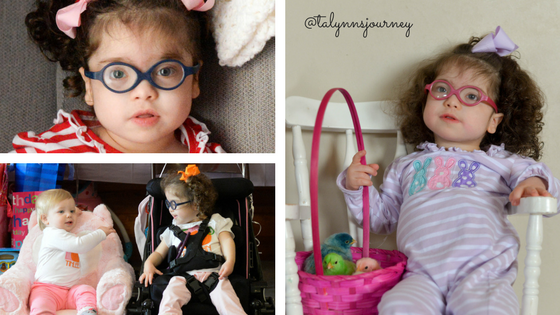
Two years ago, Chad and Taylor shared the story of their daughter Talynn who has Bohring-Opitz Syndrome.  They’ve sent an update and some photos of how Talynn is doing and in particular, her vision and how she’s been doing with her glasses. Many thanks, again to Chad and Taylor.  – Ann Z

@talynnsjourney

A couple years ago, Talynn Gurganus was featured on Little Four Eyes Blog. At that time she was a little over a year old. We had just gone through the unknown of not having a diagnosis but yet knowing something wasn’t right. She was in the hospital every month.
At 10 months old, Talynn was clinically diagnosed with Bohring-Opitz Syndrome (BOS). We researched symptoms and found that one was myopia. Talynn got her first pair of glasses. Since then, she has changed prescriptions 3 times! Each time her eye sight has improved! She is now 3 years old with a pair of Navy and Fuchsia glasses. She actually likes wearing them and hardly ever pulls them off. Talynn’s overall health has improved and we continue to push her to be the best she can be.
Follow her journey at Talynn’s Journey, or on Facebook, Twitter, and Instagram.

Guest post: patching

Many, many thanks to Reena for sharing this story about her son’s year of patching. — Ann Z

Noah on his first day in glasses. [image: baby boy wearing a patch]
On April 5th, 2016, I touched my first patch. I picked my favorite pattern, camouflage. I took it out of the package, took a deep breath, and covered my 3 month old son’s left eye. Noah hated it instantly; so did I. I didn’t cry. I smiled, took a picture, and repeatedly told Noah how cool he looked, how much I loved him, and how it’s all going to be okay. I nursed him, I rocked him, I sang, I danced around the apartment. I did anything I could think of, except cry. I waited until 4 hours went by. I gently took off the patch. And then, I cried.

Noah was diagnosed with bilateral congenital cataracts at two and a half months old. Since then, he’s been under anesthesia 5 times: 2 cataract surgeries, 2 exams under anesthesia, and 1 strabismus surgery. His left eye is much stronger than his right eye, so in order to make his right eye stronger, for the past year we’ve patched (nearly) every day. We’ve cried, hugged, and distracted, distracted, distracted. However many hundreds of patches Noah pulled off, we put on just one more. Noah’s had good days and bad days. There were days when Noah’s eye crossed into his nose, he kept pulling off his patch, and I hated patches so much I almost screamed. There were days when, miraculously, he kept his patch on and I put him to sleep knowing we had done our part to fight the weaker eye.

Noah today. [Image: toddler boy in a swing wearing glasses and a patch.]
It’s been quite a year. Somehow though, looking back, today there’s no hate. Today, it’s replaced by a heart full of gratitude, and an eye that gets stronger every day. I’m grateful for doctors who both treated and loved Noah. I’m grateful for family, for the times that (I convince myself?) Noah looks straight into my eyes. Most of all, I’m grateful to God, for bestowing endless blessings upon myself and my family.

Today? I’m grateful for patches.

Rare Disease Day: With research possibilities are endless!

Today, February 28 is Rare Disease Day.  This is a day to raise awareness around rare diseases and the need for research.  With only 5% of rare diseases having a cure, this means many patients are left with unanswered questions and doctors who are equally as puzzled as them! Research leads to new treatments, or in some cases even a cure, and most importantly hope.

“With research, possibilities are limitless!”

rare-disease-day-2017
Graphic from the Mesothelioma Cancer Alliance, http://www.meothelioma.com.  [visual description: graphic about Rare Disease Day with statistics: 95% of rare diseases do not have a single FDA approved drug treatment; 7,000 types of rare diseases in the world; 300 million people have a rare disease worldwide; 1 in 10 Americans life with a rare disease; 50% of people affected by rare diseases are children].  
Rare Disease Day has special meaning here at Little Four Eyes, as many rare diseases impact children’s vision.   Some examples include:

…and many, many more.  And as a librarian, the theme of research leading to new treatments really speaks to me.  If you have a child with a rare disease, please share your story and help us raise awareness.


Isolated Ectopia Lentis: Drew and Marin’s rare disease story

(shared by Jessica)

Both of my children (Drew who is 5.5 and Marin who just turned 3) have Isolated Ectopia Lentis. Drew also has misplaced pupils.

Ectopia Lentis can often be associated with syndromes that affect connective tissue such as Marfran’s, but for it to be isolated because of a mutation of AdamTSL4 is extremely rare – there are less than 100 documented cases.

We struggled to find the right correction for Drew until he could do an acuity test at 3.5. Everyone agreed he would be looking through his glasses, but he was choosing to look below them (he went from a prescription of -9.00 and -10.00 to an prescription of +13.50 and +14.75.

17016371_1328550800535862_1045150140_o
[visual description: a boy and girl in glasses on a bus, both wearing jackets, rain boots and big smiles]
Since we got the prescription correct, Drew hasn’t looked back. He went from 20/200 and 20/300 to 20/40 in both eyes and he’s a normal, awesome kindergartner.

Marin has been in glasses since 8 months and has had no issues wearing them.


Many thanks to Jessica for sharing her children’s story, and thank you to Emily at Mesothelioma Cancer Alliance for the graphic and information about Rare Disease Day.

Smile of the day: Superheroes wear glasses!

Yep, even superheroes wear glasses!

superheroes

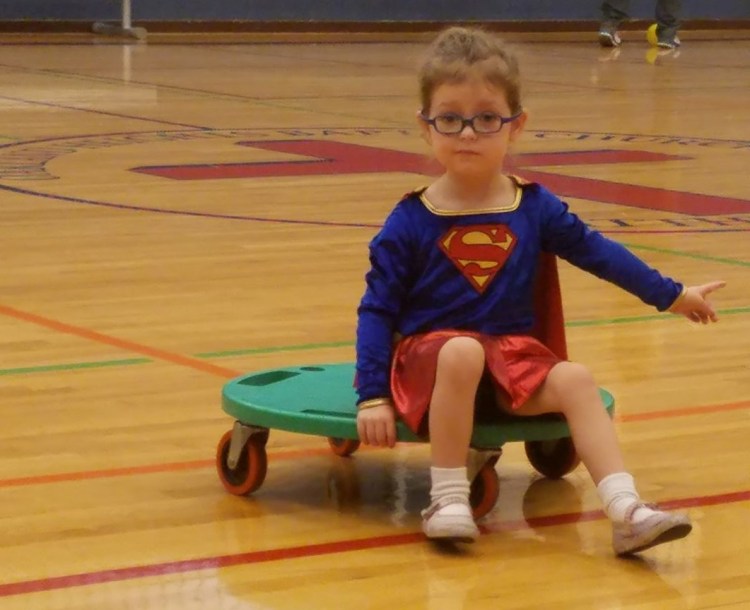
[visual description: young girl in a Supergirl outfit with blue glasses riding a scooting in a gym]

Resolution for the new year: get your child’s vision checked

As I was reflecting on Zoe’s 9 years in glasses recently, I was thinking about how the importance of early vision exams is still not well known for parents, so I thought I’d offer this suggestion for a New Year’s resolution: if you haven’t had your child’s vision tested, make an appointment to get it tested.

phoropter (very dilated eye)
Zoe at the eye doctor

[visual description: young girl with face painting and glasses in the eye doctor’s exam chair]

If you have a young child and you’re wondering if they may have a vision issue — go, get them checked out now. Vision issues are notoriously hard for parents or pediatricians to catch in young kids without a full vision exam. As it turns out, a pediatric vision exam is a pretty easy, non-invasive way to either get peace of mind or, if your child does have a vision problem, get moving on treatment.  The American Optometric Association recommends that a child’s first vision exam be between 6 and 12 months.

If you live the the US, there’s a program called InfantSEE that offers free vision exams for babies aged 6 – 12 months, done by optometrists who have undergone extra training to do pediatric vision exams. Even if you’re outside of that age group, pediatric eye care is required to be covered under the Affordable Care Act.

Why is it important to treat vision issues early?

  • Early treatment of vision issues can reduce the risk of developing amblyopia (sometimes called “lazy eye”), and amblyopia that is caught early is more likely to be treated successfully (2016 study on treatment of amblyopia and amblyopia risk factors).
  • Preschoolers with uncorrected vision issues have lower early literacy scores (2016 Vision in Preschoolers study), and school-aged children with uncorrected vision issues often struggle to keep up academically (e.
  • Kids with serious vision issues, those that cannot be fully corrected with glasses, can get in to early intervention programs that can help develop their vision to its greatest potential and equip them with skills to thrive with less than perfect vision.

How prevalent are vision issues in children?

According to the 2009 Baltimore Pediatric Eye Disease study, about 1 in 20 preschoolers meet the criteria for needing glasses (and only about 1 or 2 out of 100 actually have glasses).

What are some signs that my young child might have a vision problem?

Many kids show no signs that they aren’t seeing well, or if they do show signs, those signs are subtle. Kids are extremely adaptable, and if they’ve never seen clearly, they likely don’t know that they could be seeing things more clearly.
Some signs (again, these can be very subtle, and there may not be any signs at all):

  • Eyes are not always aligned (they’re crossing or pointing outwards).
  • Unequal reflections in the eyes when you look at pictures taken from straight on with flash (if you’re seeing a white or gold glow in one or both eyes, please get your child’s vision checked right away).
  • Tilting their head frequently, especially when focusing on something.
  • Eyes that make rapid, seemingly uncontrolled movements.
  • Not making eye contact or not following toys with their eyes.
  • Closing or squinting one eye.
  • Sensitivity to light.
  • You can read through the comments on an open thread where parents talk about the signs they noticed that their child needed glasses.

9 years in glasses & why you should get your child’s eyes checked

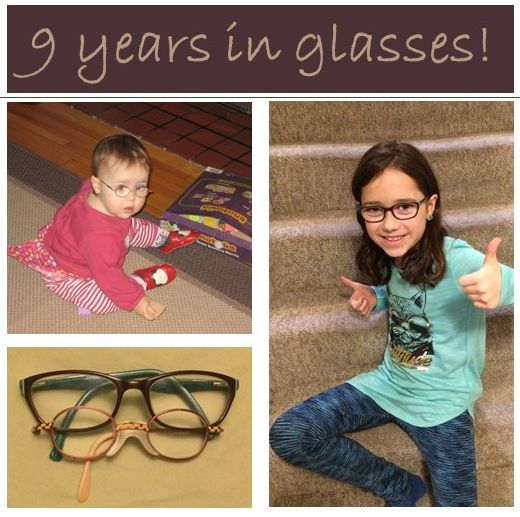
Zoe’s 9 year anniversary of getting her first glasses was at the end of December.  Her Glassesversary, as I like to call it.  At this point, she’s had glasses for 90% of her life — her glasses are so much a normal part of her that it didn’t warrant more than a passing mention, and me asking her for a photo for comparison.
9-years
[visual description: Header says “9 years in glasses” with a photo of a 14 month old Zoe on her first day in glasses, another photo of her at 10 years old, and a photo of her first pair of glasses next to her current frames.]
I was recently reminded of how little awareness there still is about how important it is to catch and treat vision issues early.  I am very certain that one of the reasons Zoe is doing so well now is because we got her eyes checked and got her in to glasses when it became clear that she needed them.  I’ll be publishing a series of resolution posts in the next couple of days that talk more about ways to increase awareness.