The first photo I posted, which is fitting, as it’s of Zoe’s first day in glasses.
Today is the 7 year birthday of the Little Four Eyes blog. I started it about 3 1/2 months into Zoe’s journey with glasses. By that point, we’d already gotten through convincing her to wear them semi-reliably, and she’d already had her first prescription change. I thought maybe I could help others by sharing what we’d learned, but mostly I just had a whole lot of questions — like, how on earth do you deal with a toddler throwing a tantrum when she’s wearing breakable equipment on her face? (She was 17 months then, and we were just learning the joys of tantrums.) And how do you deal with other toddlers who are curious about your child’s glasses?
I’m a bit in awe of what this site has become in the past 7 years: over 670 posts, nearly 6,000 comments, over 200 photos in the galleries, plus a really active facebook group. I have learned so much from all of you, including ideas for dealing with tantrums, and I want to thank you for sharing and reading and being part of this.
Top 7 Posts
(based on number of thumbs up votes and number of shares) One of my favorite things about this list is that more than half of the posts are by people other than me. I am proud that this site has given a voice to so many different people with different stories and experiences:
Update: Congratulations to the winners of the giveaway: Kenner82, Kogden97, Kelly K, Sarah Jane Mastenbrook, Leslie McMordie, Christine, and Erin! You should receive an email from me, let me know (ann@shinypebble.com) if you don’t.
And in celebration, I’m giving away 7 copies of my Glasses book, which was inspired by feedback I got for the photo galleries on this site. Comment with one thing you’d tell a parent who’s just learned their child needs glasses. I’ll choose 7 winners at random on March 22nd!
The 2015 Great Glasses Play Day is the first weekend in May — that’s coming up soon! We have over two dozen locations already, but we’d love to have more. The event is a great way to meet other families near you who have kids with vision issues, and a way to spread awareness in your community about the importance of early detection and treatment of vision problems. It’s easy to sign up, and we’ll help you with the organizing. Check it out!
Eye Power Kid’s Wear is sponsoring a fantastically huge giveaway. There are 20 different prize packages that you can enter to win. Everything from a pair of glasses, to books (including my book, Glasses), to patches, to t-shirts, and more! The giveaway ends Feb. 18. Take a look and enter — and good luck!
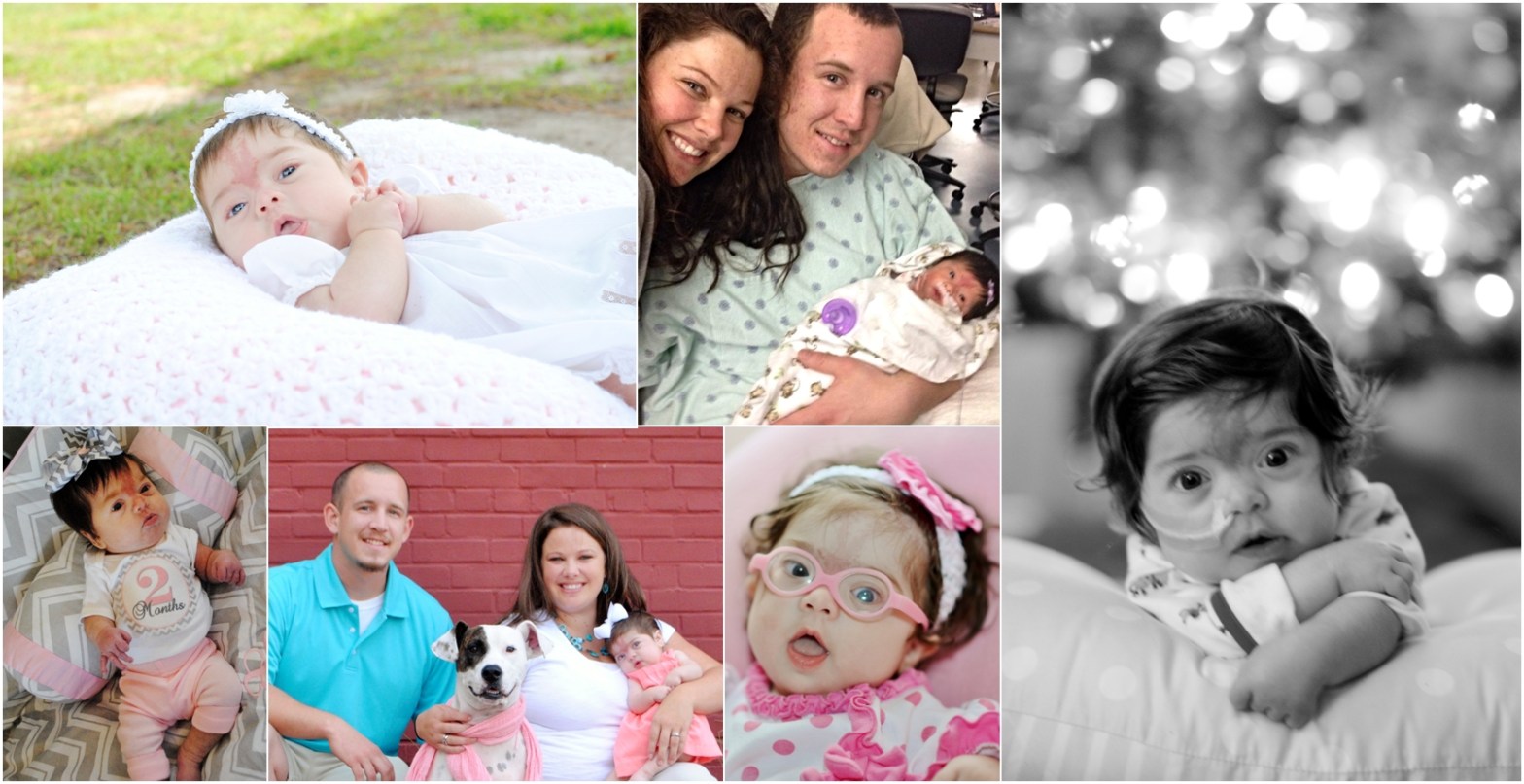
A very big thank you to Chad and Taylor for sharing their daughter, Talynn’s, story of her journey through her first year of life, and her diagnosis of Bohring-Opitz Syndrome. You can read more about Talynn’s journey at her blog, Open Eyes, or follow them on facebook or twitter. – Ann Z
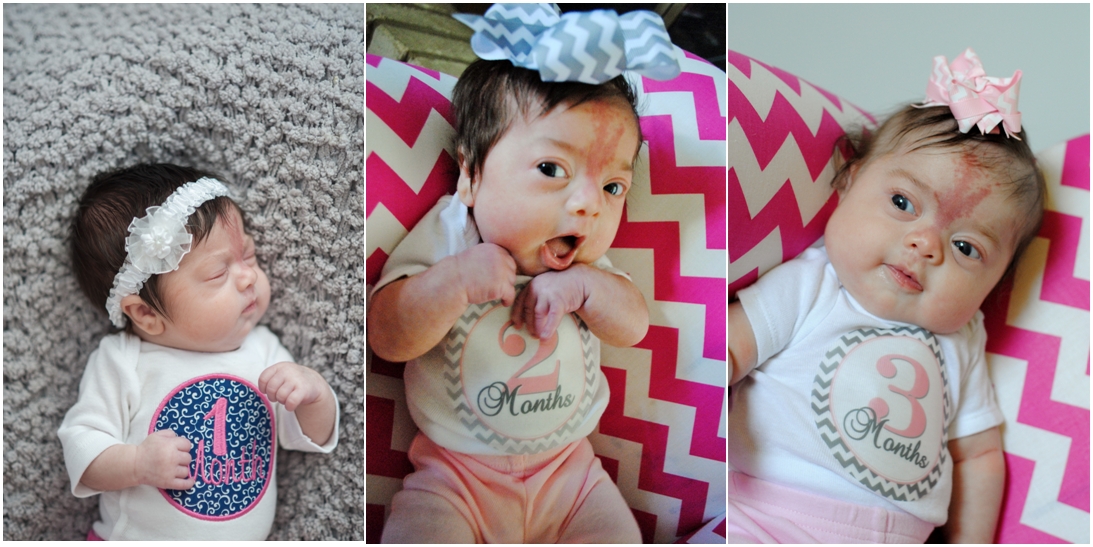
Talynn Gurganus was born on 1/27/14. She came into the world at 35 weeks. She had to spend 3 1/2 weeks in the NICU due to respiratory and feeding issues. During this time, we found out Talynn had Partial Agenisis of the Corpus Collosum. She had other genetic tests done because all doctors suspected something was wrong. She had a simian crease on both hands, three port wine stains (heart shaped- forehead, round-back of neck, and round-above her bottom), tons of hair (all over her body), flat nasal bridge, bigger eyes, lip and tongue tie, mild hip dysplasia in her left hip, and inward turn wrists. The microarray testing (chromosome test) came back negative. The geneticist seemed shocked but at that point they wanted to watch her development and we would follow up 6 months later.
This winter, we hit Zoe’s 7 year glassesversary. In some ways, it seems like only yesterday I was trying desperately to get my young toddler to leave her glasses on, in other ways, all those struggles seem so far away. Here’s a few ways that things have changed since then:
There are no more struggles to get her to wear her glasses. She picks out her pair (we get two pair so that she always has a back-up, and has a choice) first thing in the morning, and puts them away right before going to sleep. I know that some kids her age are resistant to glasses, but I think because she can’t remember a time without them, there’s no resistance.
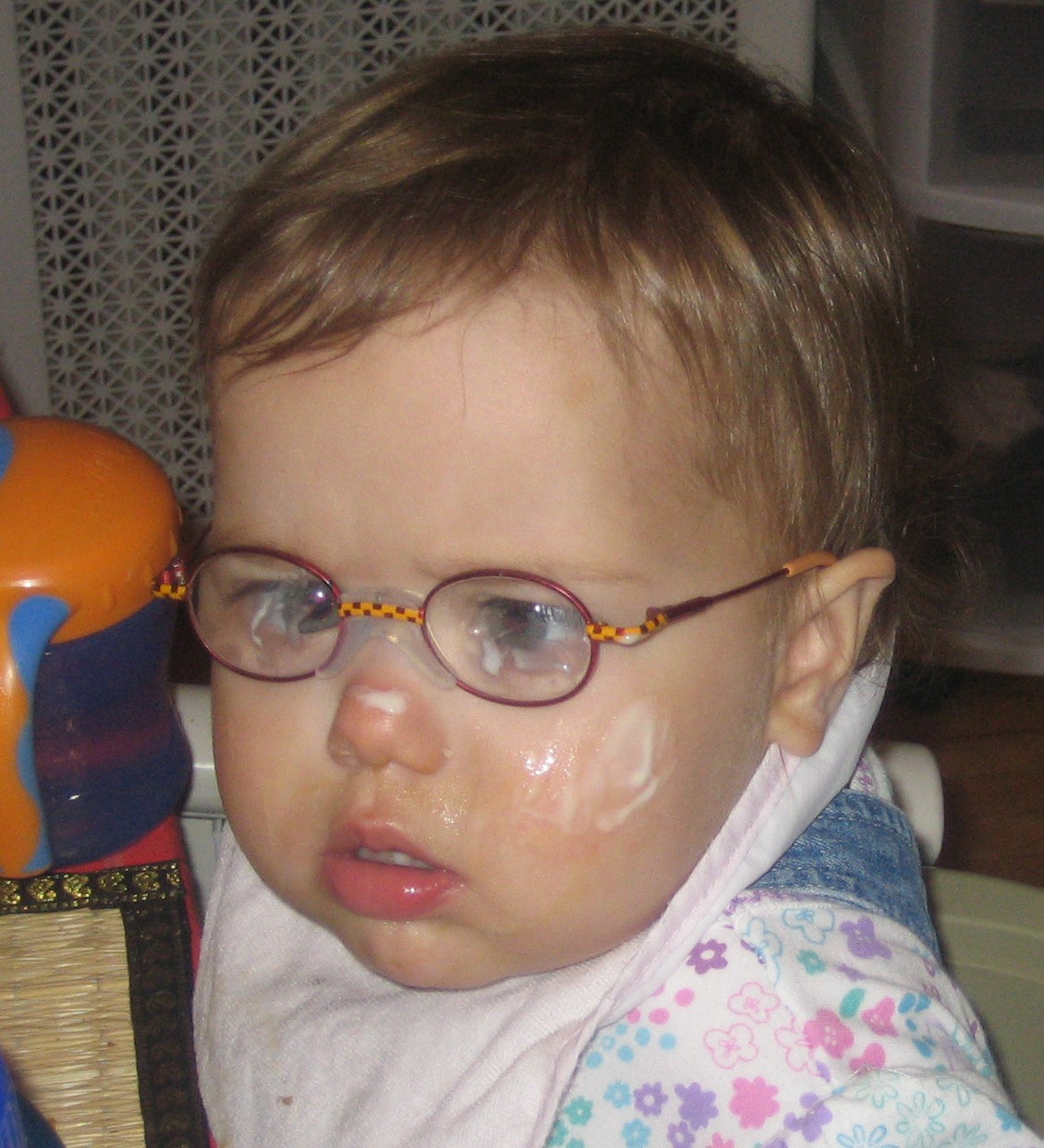
Even now, this photo makes me want to run and get a glasses cleaning cloth.
The glasses stay so much cleaner! Now that she has learned to eat without getting food all over her body, her glasses don’t get nearly as dirty. And she is old enough to know how to clean her glasses herself.
Choosing glasses is both easier and harder. No more crying and struggling to get frames on a wiggly toddler at the optical shop, and there’s so many more options for an 8 year old than a 1 year old. But now she has Opinions. I like that she has opinions, and so far, I’ve loved the frames she’s chosen, but the more opinions there are, the more complicated selection can get.
Most of the anxiety around glasses is gone now. I feared that we’d lose her glasses, and now seeing how she loves to wear them, I’m less worried about that. I worried that she would beteased, but so far, that’s not the case. I was afraid she’d always be known as the kid in glasses, and while that was a little bit the case when she was younger, it’s much less of an issue now. I was scared about the problems she might have due to her vision, but that fear has been replaced by wonder as I watch her become an independent, awesome 2nd grader.
Need a pick me up? Videos of babies and young kids getting glasses — and seeing — for the first time always make my day. So here’s four great videos of those first moments in glasses. I hope they brighten your day, too!
Love this guy’s smile as he checks out his vision through the lenses from all angles:
This guy is so taken by what he can see that he loses his pacifier:
This one has been making the rounds on social media lately, and for good reason. Watch this sweetie see her mother for the first time:
This guy objects to his glasses for about 1 second, and then he just can’t stop looking around:
And a bonus video, a baby playing peek-a-boo with his glasses:
Click to get to video on Jack’s blog
Kristen just shared this fantastic video comparing her son before and after getting glasses:
Click to see the video on Facebook
Another new video with an amazing smile brought on by his new glasses:
This last one has gotten a whole lot of views and shares on facebook: Click the photo to see the video
A huge thanks to Dr. Kanevsky for writing this post about children and contact lenses. She addresses both when it’s important for babies and toddlers to have contacts, and information about older children transitioning from glasses to contacts. If you’re looking for a parent’s perspective on babies or toddlers in contacts, check out the Contacts 101 post on Eye Power Kid’s Wear – Ann Z
Can My Child Wear Contact Lenses?
There are many reasons for children to wear contact lenses. Sometimes they are medically necessary, more often they are needed for cosmetic reasons or for activities which require freedom of movement and good peripheral vision. In all cases, the parent or caretaker must be willing and able to share the burden of responsibility with their teenager, or be wholly responsible for a baby or toddler. Although common wisdom states that most children should wait till age 12, there is no hard and fast rule about when a child can begin using contacts. Always ask your eye doctor for guidance and unless the contacts are medically necessary, let your child’s maturity and motivation be your guide.
When Are Contact Lenses Medically Necessary?
A child is not born being able to see. Vision develops as an image is formed in the eye and is transmitted to the brain. If the brain is denied an image (due to a congenital cataract or unfocused image), pathways are not formed which will allow the brain to process the picture. This is called amblyopia and is often referred to as a “lazy eye.” If the brain is denied vision in both eyes from birth, the eyes may develop a jumpy, searching movement. This is called nystagmus. If the eyes have very different prescriptions (for instance if one is very nearsighted and one very farsighted) this is called anisommetropia and the brain has a difficult time reconcilling and fusing the two images. Sometimes, a weak muscle or high refractive error causes one eye to turn in or out. This is
called strabismus.
There is a critical period in a child’s life during which these pathways can be formed. The first year of life is crucial. After the first year it becomes increasingly difficult to improve vision, but with proper correction, patching, surgery and or vision excersizes, improvement can be made up to about 7 years of age. After this time it becomes difficult to impossible to improve sight.
Let’s look at one example when contact lenses can aid in this process. Cataracts diagnosed at birth must be removed immediately if they are hindering vision development. However, without a lens inside the eye, incoming light will not focus to form an image on the retina. Spectacles or a contact lens must be fitted quickly so the visual pathway to the brain can start to form. The high power spectacles necessary to replace the 30-40 diopter natural lens that was removed, can cause distortion. This effect can be minimized by using contact lenses. A contact lens acts as if it were part of the eye; wherever a child looks, he will be looking through the lens center. Spectacles are not possible in cases of unilateral aphakia because of the image size difference induced (aniseikonia).
This guy had a cataract in his right eye and now wears a contact in that eye. (Photo credit: Jessica Butler)
Why not place an implant into the eye after cataract surgery? Unlike an adult aphake (person without a natural crystalline lens), a child’s eye continues to grow. As the eye length increases, the power needed to correct the child’s vision will decrease. This causes frequent changes in power and size. Contact lenses can be readily changed while an implant is permanent. It is very important to follow the baby with frequent examinations to monitor the lens fit and the child’s visual development.
There are many other reasons a toddler or tween may do better with contacts than glasses. It is always best to ask the opinion of a doctor experienced in fitting pediatric contact lenses.
What Does the Fitting Process Entail?
Depending on the age of your son or daughter, the process will vary widely. Babies are seen every month or even more often because initially the lens is worn overnight and the fitting is quite complex. Parents will eventually be taught to remove the lens nightly and replace it daily at home. Although it seems an impossible and frightening task at first, with the right guidance, all parents become experts in this process more quickly than you can imagine.
In the more common circumstance, when your tween or teen asks about contacts, your child should have a thorough eye examination first, and if you and the doctor both feel that he or she is ready for the responsibility, a fitting can be scheduled. Usually, the doctor will select and place a pair of lenses in the eyes and check the initial fit, comfort and vision. Then, you or your child (or both) will be taught how to insert, remove and disinfect the lenses.
Most doctors prefer to fit children in daily disposable lenses. This is safer, cleaner and easier in the long run, but not always possible with all prescriptions or all budgets. Sometimes children are given prescriptions for more than one type of lens, depending on their specific visual and lifestyle demands. If your child
demonstrates good facility during this first training session, he or she might go home with their first pair of contacts! Often, this process requires more than one visit. Don’t be discouraged if the doctor asks you to return several times until proficiency is gained.
We want your child to be safe and happy with their lenses for years to come. Once the wearing process begins, you will return to the clinic in a week or two for a progress check. It is very important to listen carefully and follow all of your doctor’s instructions. There will be many details so please ask questions about anything that is confusing or unclear. Try not to assume that if you yourself are a contact lens wearer, your child can use
your cleaning solutions or wear the same type of lenses on the same wearing schedule. Patience and perseverance yields success!
At the first follow-up, your doctor will check the fit, corneal health, comfort and vision. Sometimes the fit will need to be altered or adjusted. Often a second or third visit may be needed. Remember, the goal is a perfectly healthy eye, a comfortable lens and clear vision. There is no rush to get there. Once everyone is
satisfied, a final prescription will be written and a contact lens supply can be ordered. Most doctors will ask to see your child again in 3-6 months but this will vary widely and depends on many factors. Whatever the schedule, please don’t miss these visits as many problems can be identified early and corrected before they turn into something more serious. And ALWAYS, your doctor will want to see or hear from you WHENEVER problems arise.
Good luck and enjoy this new experience with your little one!
Dr. Kanevsky is an optometrist specializing in pediatric and custom contact lenses. She practices on the Upper West Side of Manhattan in New York City.
In the For Little Eyes facebook group, the question of whether glasses fit a child well comes up often, and Melony has become known as one of our experts, based in large part on her own experiences finding glasses that fit on a variety of ages of kids. Melony was gracious enough to write up a fantastic guide on finding glasses that fit your child well. – Ann Z
Download our new printable guide to finding glasses that fit your child, based on the information in this post, so you can print it and take it with you when you shop for glasses!
Finding glasses that fit your child
You may have just got some startling information about your child’s vision or you may have had one or more children in glasses for some time, but have never had a clear understanding about how to choose frames so have had to rely on the knowledge of optical staff. Either way, a good understanding of how glasses should fit is something every parent of a child in glasses should have. Sadly, it can be hard to find an optical shop with staff trained especially in regards to fitting children.
I was blessed to have an amazing first optician and much of what I know about glasses he taught me. I was so sad when he left our ophthalmologist’s office for the mission field. The rest of the information comes from lots of in the trenches experience because I am blessed with not only one or even two children in glasses, but FIVE. This means countless frame try-ons and lots of frame purchases. I hope to give you some good basic tips for Do’s and Don’t when shopping for frames.
Note: if you ordered frames today after a long stressful vision appointment and are not feeling comfortable with your purchase please call and place a hold on the order until you can do a bit of research and make an educated decision. I know you are incredibly anxious to get your sweet child the glasses they need but please don’t rush. Children are amazingly adaptable and yours has been managing all of this time. A few more weeks to make sure you get frames that will be perfect are worth the wait.
I use three criteria when shopping for frames FIT, FUNCTION, and FASHION in that order.
FIT
Fit is crucial. Glasses that fit well stay put, encouraging your child to look through the appropriate part of the lens. They are more comfortable, which encourages compliance, and frankly they look more attractive. Glasses need to fit your child today so we never want to size up for growth. Bigger is definitely not better when it comes to frames. They slip and slide out of place drawing attention from your child and begging to be ripped off and chucked on the floor. Bigger frames mean bigger lenses. Big lenses are heavy and cause the frames to slide down their nose. Frames that fit don’t move even while laying down or rough play.
When trying on samples, this is how I help our children choose great frames and it has served us well: First, find the measurement of a frame that fits well. Frames have three measurements, usually marked inside of the frame and typically appear in the format: XX-XX-XXX. These number are in millimeters and represent the lens width, bridge width, and temple(arm) length.
The size of a frame is often listed on the inside of the temple as XX-XX-XXX. That represents the lens width, the bridge width, and the temple length, in millimeters.
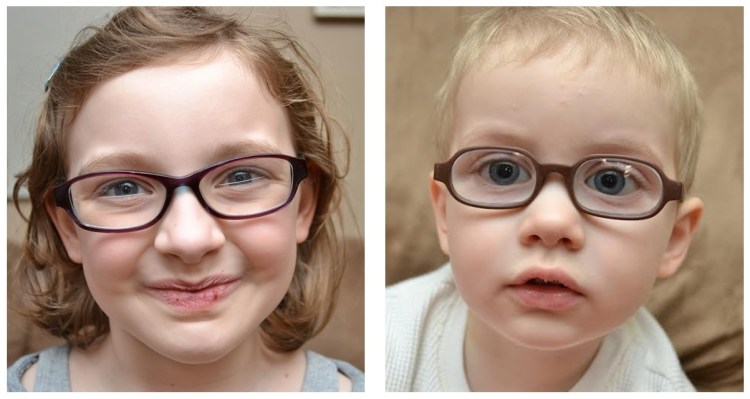
The lens width is the first measurement and describes the width of one lens in millimeters. The first step we use when trying to find if frames fit is to check lens widths. When you place a frame on your child, bend down to look directly into their face to get the best idea of fit. You are trying to center their eye both horizontally and vertically.
Your child’s eyes should be centered vertically and horizontally in the lenses
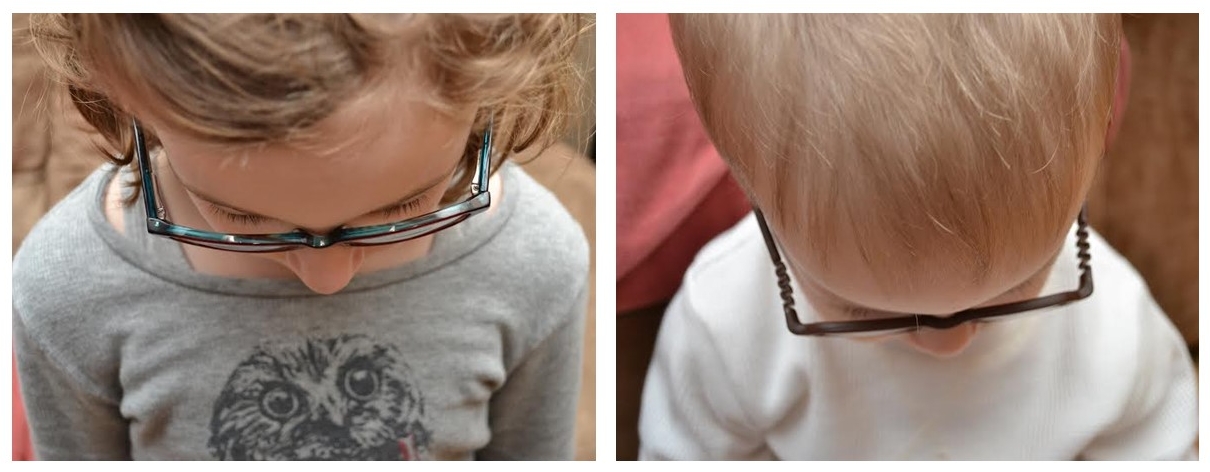
Looking at your child’s frame width the sides of the glasses should not be touching their face until they reach the ear or have a large gap between the frame and the side of the face. There should be no taper in or out on their path to the ear. From the hinge to the earpiece the temples should travel a straight parallel path along the side of their head. If the temples are angling into the ear go down in lens width, bowing out go up. Off the shelf frames are scaled so they are designed that if the lens width fits the other measurements should be appropriate too. This is not always the case but it gives you a starting point.
For reference, infants and small children may only grow one or two millimeters in lens width over a year and it can be less for older children. Once you find a frame that fits in lens width take a note of that measurement and find other frames that are the same size with a 1mm difference in either direction. It is important to understand that lens width translates differently in different frame mediums particularly for flexible frames like Miraflexand chunkier plastic frames.
The bridge is the portion of the frame that spans between the lenses over the nose. Frames are designed to be proportioned but faces vary and so the shape of the lens impacts the bridge width. More rectangular frames tend to have a narrower bridge to accommodate for the width of the lens. This means that children with wider nose bridges and infants may not be able to get a good fit with a rectangle. Nose pads should fit snugly but comfortably against the nose with no pinching or gaps. Frames with nose pads offer some adjustability, but solid plastic or flexible frames do not so they should fit the nose perfectly.
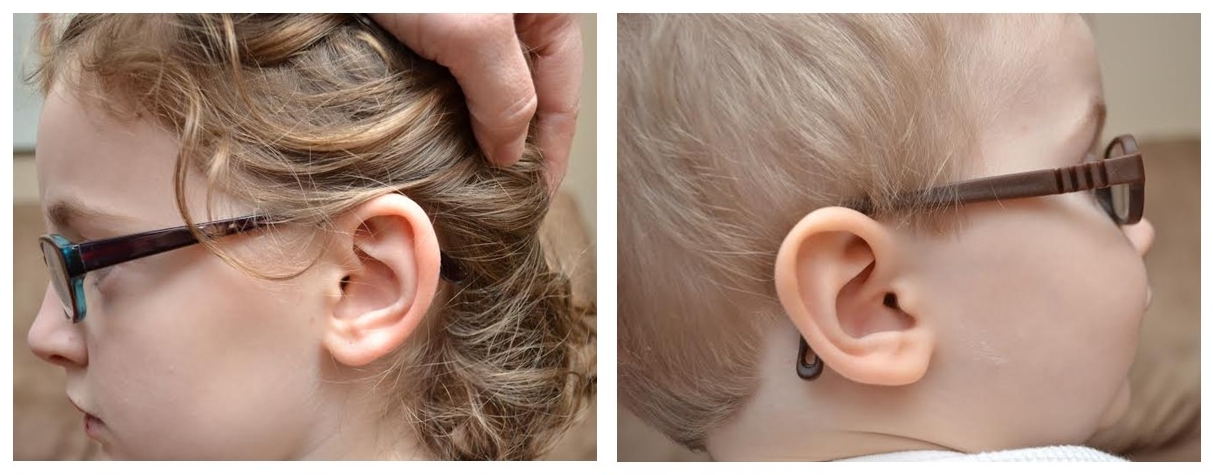
Last you want to look at the temples. The length of the temple is also important. If the temples extend too far past the ear it is a good indicator that the frames are too large. Your child should be able to sit and lie back without the earpiece bumping the surface and shifting the frames. Bent ear pieces should not extend past the bottom of the ear.
FUNCTION
That brings us to function. There are a variety of frame types but the three basic types are wire, flexible, and plastic. Fit is a huge factor in function because glasses that fit well function well. But there are other considerations. If you have a tiny squishy baby (been there) or an active young child that needs glasses, you will likely want something flexible and as close to indestructible as you can get, like Miraflex or Solo Bambini. An older child active in sports may need a second pair of glasses that are sports goggles like RecSpecs. A child who requires an exact bifocal line may do much better wearing a wire frame with nose pads because it gives you the best adjustability.
FASHION
Last on my list is fashion. Glasses that fit and function well for your child are the most important thing. That doesn’t mean they won’t be adorable. They will! And glasses that fit well will look much better on your child than a pair that does not fit. There are not nearly as many frame choices for children as there are for adults. Depending on your child’s size, your geographical location, and your budget the selection may be even more restricted. This can make finding great frames a challenge but not impossible. In fact there is an increasing number of online retailers that offer tryon kits for home. Having concerns about your child’s appearance is expected. Wearing glasses will change their appearance, in my humble opinion they will be even more adorable. Be sure not to get caught up in the fashion of the frames if it is to the detriment of fit and function. You will have many more opportunities to shop for frames and as your child gets older the selection will expand.
As a fellow parent of children in glasses and consumer I implore you to insist on good service from your optical shop. You are paying for a product and service. They have a professional responsibility to provide your child with functional frames that fit. If you have been misguided and encouraged to buy ill-fitted frames please insist on accountability from the shop and a replacement at their cost. Shopping for frames is challenging whether it is your first or 50th time but it does get easier.
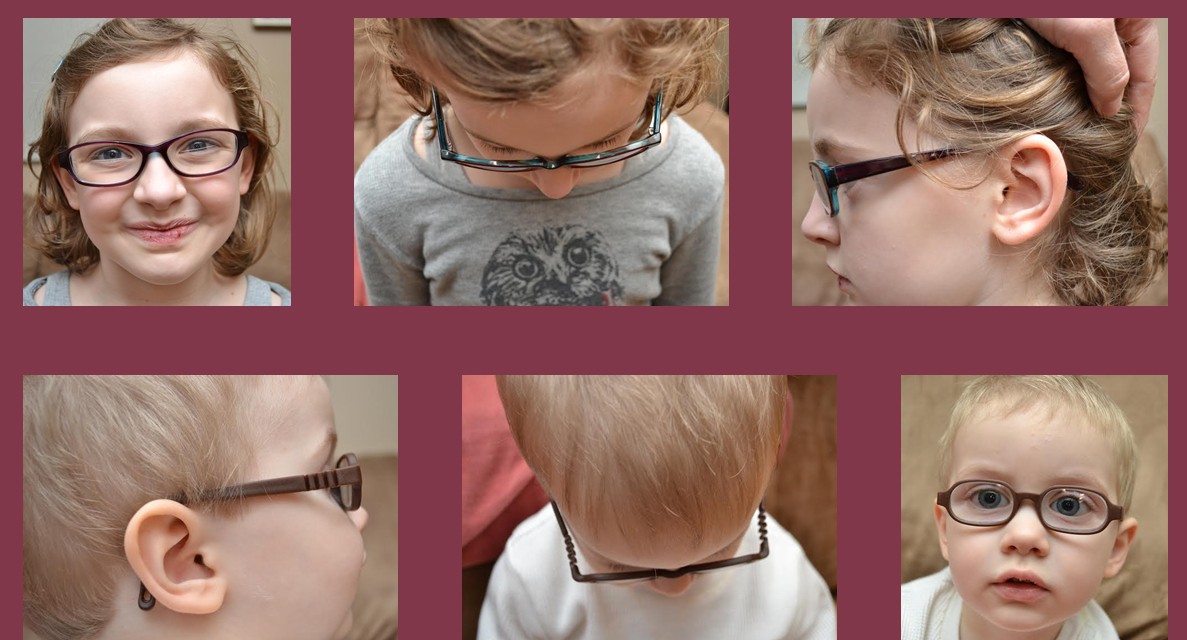
Below you will find a collection of photos generously provided by members of the Little Four Eye Facebook group. These are all actual frames that were dispensed by various optical shops with comments as to how well they fit.
This slideshow requires JavaScript.
Melony Dever lives in Maryland with her husband and their five bespectacled children.
Ever since my book project was funded on Kickstarter (almost exactly a year ago now), I try to keep an eye out (pun intended) for other crowdfunded projects that would be of interest to our community. There are two projects that are currently running that I wanted to let you all know about:
The Best Day Ever — a book about friendship and glasses by Anna Rafailov on Kickstarter
“The Best Day Ever” is a children’s book about two good friends, a little cyclops named Ben, and his snail buddy, Sid. When Ben starts having strange things happen, his friend Sid decides to do some detective work to figure it out, and realizes his friend needs glasses. Author and illustrator, Anna Rafailov, “Annie,” got the idea for the book when her son needed glasses and she found that herself drawing a story for him to explain what was going on. The book focuses on friendship between two characters that are very different, showing that a true friends don’t care how do you look, as long as you have great time together and help each other when in trouble. The illustrations for the book are amazing! Anna’s Kickstarter campaign for her book ends on Friday, Dec. 19.
GeoBee – Tablet-based game designed to improve visual and motor skills on Indiegogo
GeoBee is a game designed by Dr. Charles Boulet, BSc, BEd, OD, a developmental optometrist, author, and educator. The game is based on principles of vision science and rehabilitation to reinforce spatial awareness, motor targeting, visual memory, letter awareness, response time, and mental focus. The game is scheduled to release in February, and backers of the project can receive substantial discounts to the annual subscription costs. The Indiegogo campaign for GeoBee ends on February 1, 2015.
Current understanding of what infants see. An article written by Lea Hyvarinen and others that reviews the current literature to give a great overview of how infants see and how vision develops in the first year of life. Lea Hyvarinen is known, among other things, for developing the Lea symbols (circle, heart, square, house) used to test visual acuity in young children. The article is open access, which means it is freely available.
Light, Spike, and Sight: the Neuroscience of Vision. This is an online edX course that runs for 4 weeks, starting November 18, 2014. “In this course, we take you from the physics of focusing light onto the retina, to the processing of colors, form, and motion, and finally to the interpretation of visual information in the cortex.” The course can be audited for free. I’ve already registered, and if you’re planning to take the class, please let me know.
In honor of Wobbly Wednesday, I am very pleased that Laura has offered to share her and her son Samuel’s story of congenital nystagmus. – Ann
From Samuel’s very first check up at the doctors at 8 weeks I knew something wasn’t right. Even though he said everything was fine I couldn’t settle. I asked for a second opinion and was referred to the local screening clinic. It took around 6 months from then to finally get a diagnosis.
Samuel never tracked objects, he never acknowledged you when I entered the room, never made eye contact while feeding and those precious first smiles took a long long time to come. He still couldn’t sit up very well at 12 months and has only just started to properly crawl at around 20 months. We cannot wait for him to start walking. But when he does it will be such a special and emotional time.
After attending every baby group I was left wondering why Samuel was so behind all the other babies and felt I always had to make excuses for him. I am sad to say it affected the bond between us I spent all my time worrying about him worrying what was wrong. Looking back I regret this and I wish I cherished every moment.
After many appointments Samuel was finally diagnosed with Nystagmus. Nystagmus is a eye condition which means the eyes constantly and involuntary move. After reading the little information online it took me a while to come to terms with the fact my beautiful little boy is likely to grow up partially sighted. It did explain why things happened a lot later as his vision has taken a lot longer to develop.
Now I realised just how amazing Samuel is he went through a lot of his short life with not seeing very much. His vision is improving and he is developing into such a cheeky chappy. What I would like to tell people is to not get to hung up on the milestones. Don’t worry what other babies are doing and try not to compare. Don’t be afraid to ask for a second opinion if you are not happy with what your doctor has to say. You are the parent and going off your instinct is so important.
We have seen eye specialists, neurologists, paediatricians, ears nose and throat specialists, physiotherapists, visual team and probably some that I have forgotten and that is all before he is even 2 years old. The services we have received have been fantastic and Samuel is even more amazing then I can put into words and everything he has over come just proves what a trooper he is.
We attend the eye hospital every 3 months and they have been so good with him. They can’t tell us much at the moment we won’t know what his vision will be like until he is 6 years old. I am ready to face any hurdles as they come. I will do all that I can to help Samuel develop into a happy and confident child and young man. I’ve promised myself that I won’t project my fears and concerns on him instead guide and encourage him the best I can!
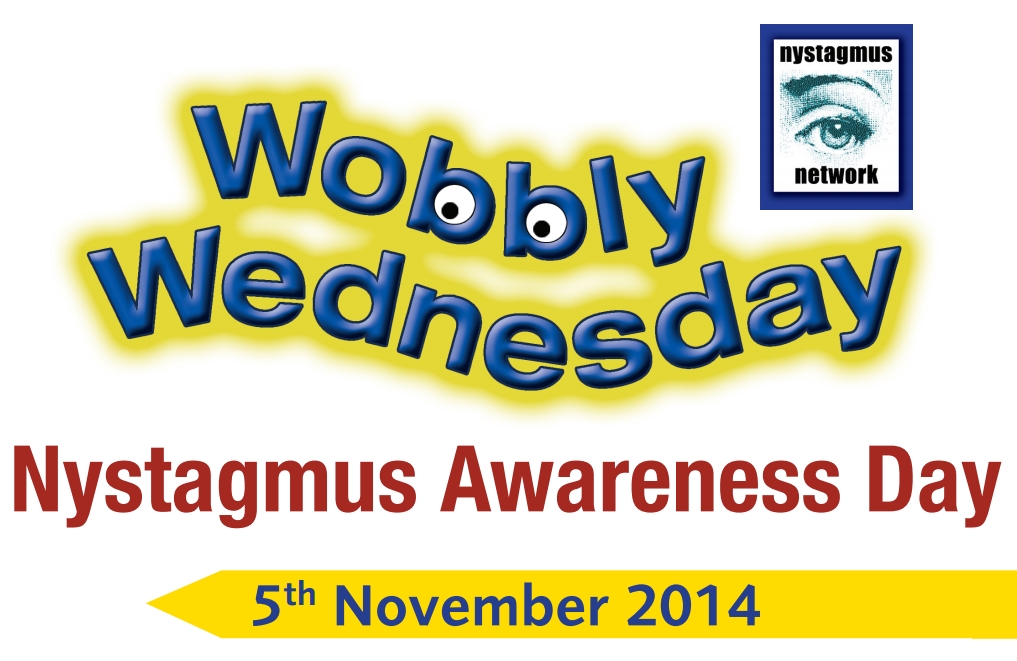
Today, Wednesday, November 5 is the second annual “Wobbly Wednesday“, the international Nystagmus Awareness Day.
What is nystagmus?
Nystagmus is an eye condition that is characterized by rapid, involuntary eye movements. Those movements can be side-to-side, up and down, or rotary. Those eye movements may reduce a person’s vision, and are often associated with other vision conditions. Usually, a person with congenital nystagmus has a “null point”, that is, an angle of gaze, at which the movements are minimized.
Read our guest post by mum, Laura, whose son has nystagmus.
What causes nystagmus?
Nystagmus can be inherited, or can result from other sensory or neurologic problems. It often occurs with childhood cataracts, albinism, optic nerve atropy, and coloboma, though in some cases, there is no known cause for the nystagmus. Accidents, strokes, and other illnesses can also lead to nystagmus later in life (called “aquired nystagmus”).
What are the visual impacts of nystagmus?
Nystagmus is associated with poor visual acuity. It also can take a person longer and more effort to see, than normally-sighted people. Crowded and cluttered scenes can be especially hard to focus on. It can be harder to track moving objects, particularly those that are moving quickly.
How is nystagmus treated?
Sometimes treating the cause of the nystagmus will resolve the nystagmus, but more often it is a permanent condition. While glasses or contact lenses will not correct nystagmus, they sometimes improve vision, and are often worn to treat other associated vision problems.
Where can I get more information?
The Nystagmus Network and American Nystagmus Network have fantastic information for individuals and families that deal with Nystagmus.
I recently ran across The Smile Challenge: Smile for Glaucomafacebook page. It aims to bring awareness to glaucoma and raise money for the Glaucoma Research Foundation by encouraging people to share photos of their smiles and stories about their experiences with glaucoma. The page is only a few months old, but has already reached hundreds of people around the world. It’s a wonderful, upbeat, and very informative page that is definitely worth checking out.
I’ve gotten to know the founders of the page, Sydney and Shweta, who are as lovely and wonderful as their page. I asked them a few questions about the project, but first I wanted to give their stories:
Shweta
Shweta was diagnosed with glaucoma when she was 21 and working on her masters degree. She dropped out briefly, while not telling any friends why. She underwent multiple surgeries and was able to go back to school and finish her law degree.
Sydney
Sydney was diagnosed with congenital cataracts when she was two weeks old. At two months old after a lens removal surgery she was diagnosed with aphakic glaucoma. As an infant she had six surgeries on her eyes. For the first 18 years, her pressures were controlled with drop. But at age 18 her pressure went up to 45 in the left eye and she had an ahmed shunt put into her left eye, and the same procedure on her right eye when the pressure went up to 35. The ahmed shunt in her left eye failed and she had a baerveldt shunt put into that eye. Her pressures have been stable since, however she developed uveitis recently in her left eye. After treatment with drops it thankfully seems to be fading away.
The page has been really inspiring to read and look at, I’m wondering where you got the idea to start the page?
Sydney: A friend in the glaucoma support group saw a post of mine in which I stated I was uncomfortable smiling in pictures. She posted a picture of herself smiling and challenged me to do the same. I challenge others in the group to do it as well and eventually it grew into The Smile Challenge. Shweta saw how big it was getting and created the page.
Shweta:I got this idea from Sydney, she was the one who started a challenge in our Glaucoma Support Group which she named The Smile Challenge. I created a page named Smile for Glaucoma to raise awareness about glaucoma and to raise funds for its research. Glaucoma is not known to many people in India, the lack of knowledge about this disease inspired me to create this page so that others could get to know whats it like to be affected by glaucoma and to let everyone know that there are many disease which do not have a cure and that they are serious in nature. Later Sydney and I teamed up and renamed the page The Smile Challenge: Smile for Glaucoma.
What is your main goal for the page?
Shweta: The first main goal is to create and spread awareness and information about Glaucoma, and we don’t want to do that by just telling people what glaucoma is or what happens after people are diagnosed with glaucoma and such but we want the world to know how glaucoma affects the lives of those suffering from it and inspite of all that, they manage to put up a big smile on their faces. The second main goal is to raise funds for the Glaucoma Research Foundation to help them in bringing the research a little closer to a cure for glaucoma.
Sydney: My main goal for this page is to raise awareness and support for glaucoma. I want people to understand not only what glaucoma is but what it’s like to live with it. My secondary goal is to raise money for an AMAZING organization dedicated to making life easier for glaucoma patients and to funding research for a cure. The Glaucoma Research Foundation is a wonderful foundation that I fully support.
What plans do you have for the page?
Shweta:The page focuses on the lives of people living with glaucoma and their stories about the fight against it, so we just want to keep spreading smiles and stories about the battles of visually impaired and blind community. We are also looking into turning this venture into a non for profit organization someday and hopefully work on raising awareness and funds on a higher level and will continue to share smiles and inspiring stories through the page.
How did the two of you meet?
Shweta: We have been a part of glaucoma support group but never really came across each other. When Sydney started this smile challenge in the support group, I thought of taking that idea to the next level and created this page, Sydney asked me if she could be a part of this and our partnership went on to become an amazing friendship
What would you tell a parent whose child had been diagnosed with glaucoma?
Shweta:Firstly, do not panic, get to know what the disease is all about and how its going to affect the child, ask as many questions to the doctor as you’d like. Be regular on medicines and check ups. And my personal advise to a parent is to be very careful in not letting a child feel that he/she has a disability. I believe no one should put a limit on ones ability, especially a child’s.
Sydney: What I want them to know is low vision or no vision your child can have a bright and independent future. There are many different organizations dedicated to helping those affected by this disease. We are always here to support parents with children diagnosed with glaucoma and they are more than welcome to message our page with any questions they have. If we don’t know the answer we will work hard to help them find it.
What do you want the world to know about glaucoma?
Shweta:Glaucoma is a serious condition in which you start losing your eye sight which once lost can never be regained. Glaucoma is incurable but if someone has glaucoma, their life doesnt stop, it only changes. I urge everyone to be proactive towards their eyes, if you do visit an eye doctor for whatever reasons, get your eye pressures checked as that is one key factor in diagnosis of glaucoma. For precaution, make it a priority to get your eyes examined at least twice a year.
Sydney:I want them to know that we are fighters. We hope for a cure but in the meantime we love and support one another in this journey.
Many thanks again to Shweta and Sydney for their time and their energy and their smiles! If you haven’t already, take a look at their page for a great smile or follow them on Twitter.
World Sight Day is a day of global awareness of vision issues, the call to action for this year is one that’s near to my heart: No More Avoidable Blindness.
I’ve written before about how important it is for children to have their vision checked, and if they have an issue, to have it treated. Untreated vision issues in children can lead to a lifetime of vision difficulties and even blindness. It can affect their academics and their achievement and their quality of life.
I know I’ve shared this infographic before (which has since gotten a face-lift for the Great Glasses Play Day), but I’m sharing it again with some of my thoughts, because it is so relevant to preventing avoidable blindness.
There’s a lot of reasons for this, but they’re all equally upsetting to me:
The vision problems aren’t caught. Either because the child’s vision hasn’t been checked, or because a vision problem was missed during a screening.
Even when a vision problem is found, a lot of parents don’t take their child for a follow up appointment with an eye care provider, either because they cannot do so financially, they don’t understand the importance, or they don’t believe their child needs glasses.
Even when a child is given glasses, many are not wearing them a year later, usually because the glasses have been lost or broken.
I know that I can’t solve all these problems, and thankfully, there are a lot of great groups out there already that are working on these issues. But I do think that we as parents here in the amazing Little Four Eyes community are in a unique position to help.
We’re doing some things already:
The community here at Little Four Eyes has helped many parents feel better about their child needing glasses, and I hope has inspired at least a few to go ahead and follow up with an eye appointment and getting glasses if they’re needed.
The annual Great Glasses Play Day each year in May is not just a day to get together to celebrate our kids in glasses, but it’s also a chance to raise awareness of just how important it is to catch and treat vision issues early.
But I know there is more that we can do. I’d love to connect other parents who are interested in spreading awareness with childrens’ librarians and early childhood educators to help get the word out to parents before they take their child to a screening or exam. And I know a lot of you probably have great ideas and connections, and I’d love to hear about them!
More reading:
Prevalence of Refractive Error among Preschool Children in an Urban Population: The Baltimore Pediatric Eye Disease Study, 2009, Ophthalmology 116(4): 739–746.e4. http://www.ncbi.nlm.nih.gov/pmc/articles/PMC2680482/
Huge thanks to Melissa for sending in this post, which covers one of my favorite topics: self-portraits of kids in glasses. It ran originally on her blog, A Boy, His Brother, the Mischief they Find. – Ann Z
The kid in the green glasses.
Just as it always does, the artwork hanging outside the classroom caught my eye. I began scanning the pictures looking for his name, not noticing the details of the pictures at first. Upon closer reflections, I realized there was a jumbled mess of “the same”-eyes, peachy circles, blobs of hair.
“Maybe he didn’t do one,” I thought. “It must have been a project on a day he wasn’t here.”
And, then…this.
My heart skipped a bit at this face.
So many emotions.
That is my kid; The kid in the green glasses is mine.
Every single other picture could be any kid in the class-2 dot eyes, a line of hair, routine kid faces.
But, there is no mistaking those green circles.
“He did a great job, didn’t he?” asked the teacher. “He really captured himself.”
Did she feel what I did?
HE DOESN’T HAVE A PATCH ON IN HIS SELF PORTRAIT.
And, he is very proud to be rocking some awesome green glasses.
This will be framed, in my house, for the rest of my life.
I am so crazily torn up about this picture because I had no inking that we would ever be at the point* where we are now.
*The point=patching vacation, “guaranteed success”, amazing because my kid doesn’t even see the patch as a part of who he is.
Please remember that the first PO we saw flat out said, “He will never be normal” in reference to my baby son. “He will never see well out of his left eye, he will probably not drive & he will always wear incredibly thick lensed glasses that make him look like a bug.” (She did no say the bug part, but she might as well have said it because that is what everyone was thinking) I still shudder at this woman who very clearly was not a mother because WHO SAYS THAT TO SOMEONE??
My fear (beyond the whole blindness thing) was that he would be made fun of, that he would be “the kid in the glasses.”
It turns out I was right.
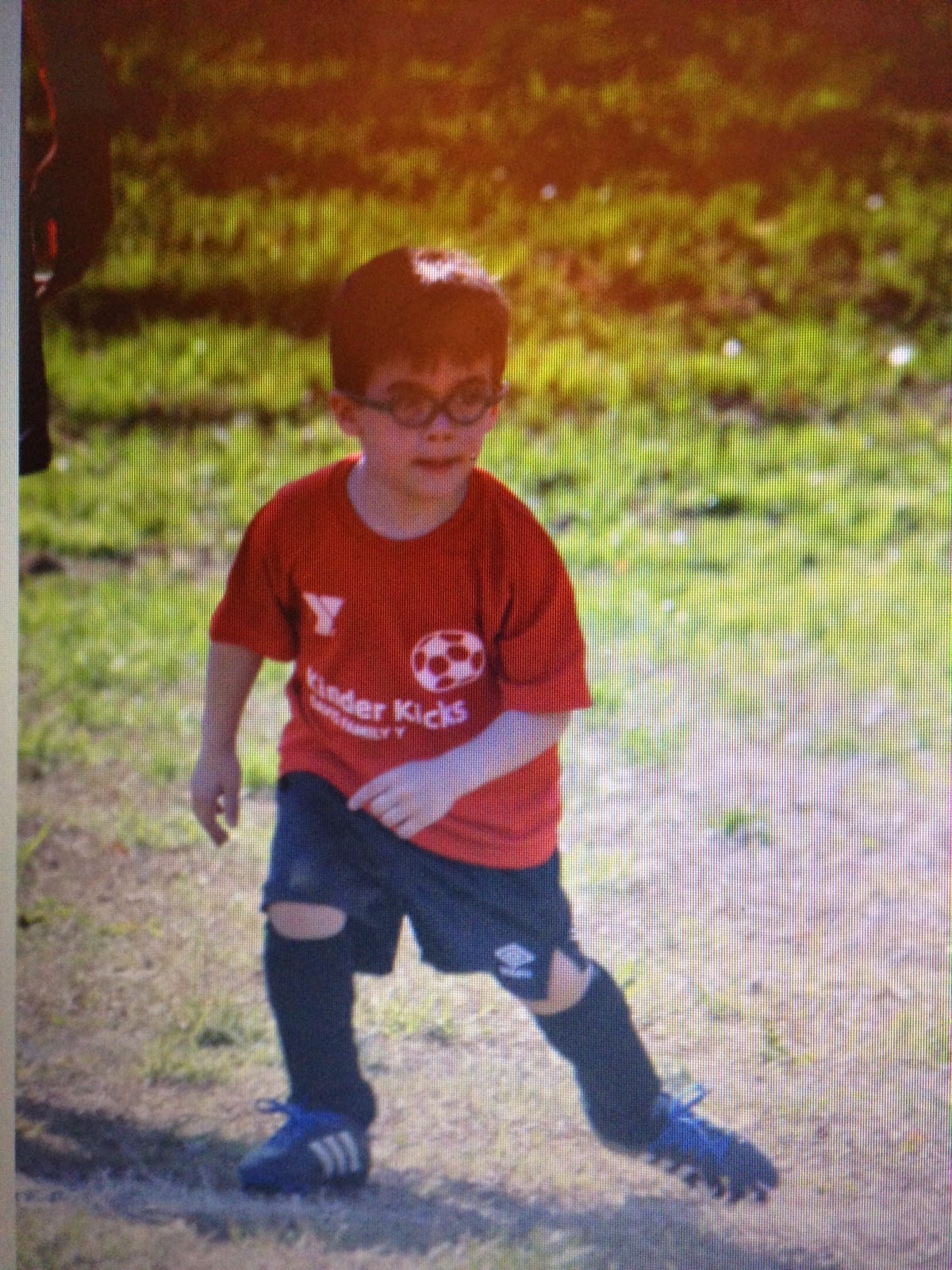
“That kid in the green glasses is fearless! He would run through a brick wall if he needed to!” was a comment I overheard at a soccer game.
Followed by, “Watch how fast that kid in the green glasses is when he runs.”
And, then there were the comments at t ball.
“You have to be quick when that kid in the glasses is around if you want to get the ball.”
“I think that kid in the glasses is going to get the ball every time.”
Hmmm.
I didn’t quite (ever in my wildest dreams) imagine that these would be the “glasses” comments I would hear.
Clearly my kid’s ability to occasionally get the ball at a “game” is not any indicator of his later success as an athlete or scholar or non-nose picker, but it is an indicator that he is beyond amazing for overcoming a significant vision problem, access to only one eye for the majority of his life and, let’s be honest, a neurotic mother.






 Download our new printable guide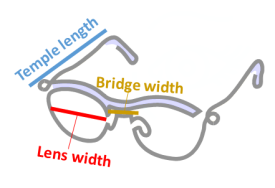









 For Little Eyes