For kids in glasses who love princesses, there’s a new princess book to check out. Princess Liana is the heroine of the book The Princess Who Wore Glasses written by Laura Hertzfeld Katz and lavishly illustrated by Jacob Duncan.
The story follows Liana as she explores the natural wonders of her kingdom with her parents. But it’s soon apparent that while she loves to look at the world, she isn’t seeing all that she can see.
Mommy,” asked Liana, ‘why are the trees singing?”
“Don’t you see the beautiful red, yellow and blue birds singing their happy songs up in the trees, Liana?: asked Queen Victoria.
“No, Mommy. Where? I want to see them!” the princess exclaimed.
She has a similar experience when her father takes her out one evening to see the moon and stars, but all she sees is a blur. Her parents quickly take her to the court magician, who produces a magic pair of the most beautiful pair of glasses Liana can imagine. And then, even more wonderfully, she is able to see all the details of the birds, gardens, and night sky. When she wears her glasses to school, she’s amazed at all the new things she sees about her friends, and her friends demand to hear how she describes them.
This is a very positive book about glasses. I’m always happy to find books that don’t dwell on negative reactions or experiences with glasses (there are plenty of books that talk about dealing with the negatives of glasses, but books that are fully positive are much rarer). Laura Hertzfeld Katz really captures the magic of seeing clearly for the first time that some of us have observed when our children get their first pair of glasses. Jacob Duncan’s illustrations are very detailed and lush, which fits well with a story that focuses on seeing details in our world. The end of the book has discussion questions for kids who wear glasses, hints for parents, and a certificate for a “Princess who wears glasses.”
The nature-loving Princess Liana joins adventurous Princess Annie and stylish Princess Peepers in the royal court of bespectacled princesses, giving our kids who love reading about royalty a growing selection of books to choose from!
Updated, June 2, 2013: I’ve added photos at the bottom of this post that have been submitted from this community. Because of the way the photos are organized and displayed, there is no way for me to link directly to the page that a photo is currently on. You’ll need to page through to find the photo you like best. Please consider voting for one of these! You can vote for one photo each day.
If I’ve missed your photo, please leave a comment or email me (ann@shinypebble.com).
~~~
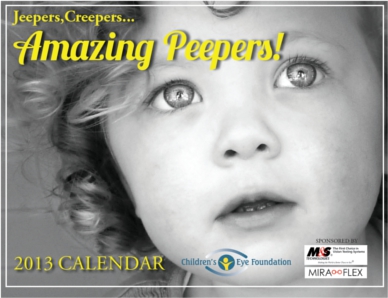
It’s time once again for the Children’s Eye Foundation‘s annual photo contest for their Eyecare for Kids calendar. I really believe that our kids can be great advocates for children’s visual health and that they’re also undoubtedly good-looking enough to win photo contests, so I would really, really like to get some of our Little Four Eyes in this calendar, and I encourage you all to vote for entries with kids wearing glasses or dealing with vision issues.
If you enter a photo of your child, leave a comment with a link to the page with photo, and the title of the photo. I’ll add the links to this page so others can find it easily and vote for it if they wish.
Contest is for: Photos to be used in the annual fundraising “Eyecare for Kids” calendar
Who can enter: Anyone
Prizes: Top 10 vote-getting photos receive a digital camera; A panel of judges then choose 12 photos to be featured in the 2014 calendar.
Theme: The theme for the calendar this year is “Sights of the Seasons.” With this in mind, entries for this contest should be “photographs involving children, eye care, and/or the beautiful things that clearly show different seasons throughout the year.”
Jessica Butler’s son, Scott, was born with a cataract. He had his cataract removed at 4 weeks. Since then, he’s been rocking a contact and glasses and eye patch.
Jessica is also a freelance graphic designer and has decided to put her talents to great use in designing fantastic, fun, creative, and stylish shirts (and a superhero cape) for kids in glasses. She has started Eye Power Kid’s Wear, and is running a Kickstarter to get the project off the ground. Take a look at the project. I hope you’ll consider backing it to help get this off the ground!
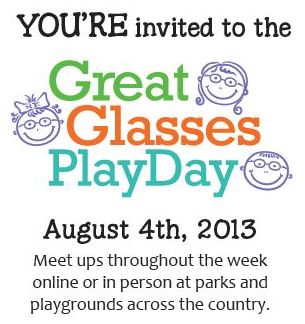
It’s that time of year again… it’s the start of the Great Glasses Play Day planning season. Last year, we had our first annual Great Glasses Play Day on the first Sunday in August, and it was so much fun that of course we had to do it again. The Great Glasses Play Day is co-founded by me and Kristin Ellsworth from Peeps Eyewear. It’s a day when families with kids in glasses, patches, or contacts across the world get together to celebrate better vision for our children and to raise awareness of the importance of early detection and treatment of vision issues in children. But really, mostly we get together to play and to connect. Sound like fun? Check out the Great Glasses Play Day website for information on how you can participate. We’re especially looking for people to help us get the word out, and to plan local get togethers. (If you’ve already signed up to help, you should hear from me shortly!).
Most of the books on our children’s book list are about getting glasses. But once kids are used to having their glasses, they may not be so interested in those story lines. Here are some children’s book series in which a main character wears glasses, even if the plot in most of the books doesn’t center around wearing glasses (in some of these books, glasses aren’t even mentioned). These are roughly in reading level order with the books for younger kids at the top, though some of the series have a range of reading levels, and even the longer chapter books can be fun to read out loud with preschoolers. We’ve read books from all of these series out loud with Zoe.
Is there a book about the character getting glasses? No
About the books: Despite being quite different, Gerald the elephant and Piggie are good friends, and these fun picture books follow their adventures together. Most of the books have simple story lines that center around friendship and having fun. They’re great to read aloud, and are quite short, which makes them good for younger kids with shorter attention spans.
Website: (also check out the Teachers and the Fun sections for some Elephant & Piggie related activities)
Is there a book about the character getting glasses? Yes, Arthur’s Eyes follows Arthur’s trip to the eye doctor, and his reluctance to wear glasses.
About the books: Arthur books are probably the first books people think of when they think of a book series with a character in glasses. The books follow the day to day adventures of Arthur and his family and his friends. They can be quite funny. There are a lot of Arthur books and they span a range of reading levels, from short stories to longer chapter books.
Website (this is for the Arthur books), you can also check out the website the PBS kids TV show about Arthur.
Is there a book about the character getting glasses? No
About the books: Gilbert is an opossum with spiky hair and glasses. Most of the books follow the adventures of Gilbert and his friends at school in first grade. The books range in difficulty, but all of them have lovely, colorful illustrations throughout.
Is there a book about the character getting glasses? No, but Who Needs Glasses? is about Katie’s friend Pedro who needs glasses and does not like them at first. Katie helps her friend see why they’re important.
About the books: Katie is fun-loving, curious, and outgoing girl. The books center around her and her friends, Pedro and JoJo, and her family. These are early chapter books, each with three short chapters, and bright illustrations on each page. The books also have discussion and writing prompts at the end.
Is there a book about the character getting glasses? Yes, in Junie B. Jones, First Grader at Last, Junie starts first grade, and learns that she needs glasses.
About the books: The Junie B. Jones books start out with Junie in kindergarten. When she gets to first grade, the series is name Junie B, First Grader, and the “B” in the logo is actually her pair of purple glasses. Junie is funny and loud and always says what she’s thinking, often to the embarrassment of her parents or teachers. The books are longer chapter books with fewer illustrations.
Is there a book about the character getting glasses? No
About the books: The Magic Tree House books about about siblings Jack and Annie. They discover a magic tree house filled with books. By reading the books in the tree house, they are transported to the times and locations in that book. These are longer chapter books with fewer illustrations.
A couple things turned up today that I wanted to mention briefly:
Using Tetris to treat amblyopia – This study has gotten quite a bit of press recently, my favorite write-up comes from Dr. Nate at Bright Eyes News. His explanation of amblyopis is excellent. A couple of quick thoughts on the study: 1) it was looking specifically at adults with amblyopia, and contrary to what was previously believed, many of the adults were able to improve their vision with treatment. The authors do not say whether this would be applicable to children. 2) As Dr. Nate points out, the Tetris part is not the most interesting part, what is interesting about the research was that it was looking at how encouraging the eyes to work together was very helpful in the treatment of amblyopia. 3) This was a small study (18 adults), hopefully it will lead to further study.
A 5-Year old has YouTube tutorials for decorating patches – Addie is 5 and patches for amblyopia. She’s started decorating her patches with stickers, and has short YouTube videos with ideas for eye patch decoration. If your child is feeling very alone about wearing an eye patch, they might enjoy watching some of her videos. In this one, she also talks about what she would like other people to say if they see a child wearing an eye patch:
“It would be nice to say ‘Cool! Where did you get that? I want one!’ And it’s not nice to say, ‘why do you have that thing on your eye?'”
A friend just posted this chart to their facebook wall, and it reminded me that I meant to finish a follow up to a previous post on what to say to kids wearing glasses. As one person pointed out in that post, comments are even harder on kids if your child is wearing a patch.
Normally, I love pie chart gags, but I don’t actually find this one funny.
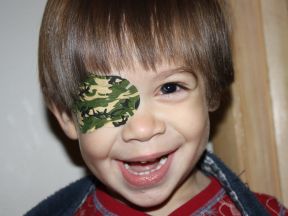
Easton is 2 years old and has been patching his entire life. He was born with PHPV and had a cataract removed at birth. He wears a contact lens to see and patches 8 hours a day.
There are a few reasons why a child might be wearing an eye patch. They may have injured their eye, or they may be recovering from surgery (for instance, cataract surgery). I suppose it’s possible that they may just be wearing one for fun, like at halloween or a dress up party. But the vast majority of kids wearing an eye patch are doing so as treatment for amblyopia (also known as “lazy eye”) or to prevent amblyopia.
With amblyopia, the visual pathways between an eye and the brain are not functioning correctly, so even with glasses or contacts, the vision in that eye is not as good as it should be. It can be caused by a number of reasons, misaligned eyes (strabismic amblyopia), one eye having a much stronger prescription than the other (anisometropic amblyopia), or even because one eye was not seeing well for other reasons like a cataract (deprivation amblyopia). No matter what the cause, once that underlying cause is treated, there is often still a need to encourage those visual pathways between the brain and that eye to start working.
The most common way to do that is through patching. By patching the good eye, the brain is forced to use the amblyopic eye. Kids who patch generally need to patch for a few hours a day, and they may need to continue the treatment for months or even years.
So what does that mean for me saying something to a child wearing a patch?
Isabella, 3.5 years old. Patching for nine months (so far).
First of all, wearing a patch is HARD. Kids who are patching for amblyopia aren’t only having to adjust to using one eye, they are also having to deal with using an eye that does not see well. Most kids really, really struggle with patching, especially in the beginning.
Add to that the fact that eye patches are very noticeable and people seem to want to comment on them or ask about them all the time. It can make the most easy-going child very sensitive and unhappy. Most parents try to distract kids who are patching by letting them do favorite activities. Commenting on a child’s patch just reminds them that they’re patching, and that they look different while doing it, and it can throw off that days patching treatment completely.
Things not to say to a child who is patching
What’s wrong with your eye? / How did you hurt your eye?
Chances are, the child is patching for amblyopia or strabismus, and there’s actually nothing wrong with the eye that’s being patched. It’s the unpatched eye that is being treated. This is one of the most common questions and not only does it get to be tiring to answer, it also focuses on there being something wrong with the child.
Are you trying to be a pirate?
Yes, pirates are often portrayed as wearing patches, and some kids like the association with pirates. But a lot of kids aren’t in to pirates, and some of them actively dislike them because of the association with patches. Exception: If they’re wearing a pirate-themed patch or pirate clothes, you’re probably safe bringing up pirates.
OK, so what should I say to a child who is patching?
He is 4 years old now but started wearing glasses and patching since he was 3 years old.
Whatever you want, as long as it’s not about the patch! Seriously, ask the child about their day, tell them you like their shirt or their toy, or comment on the airplane flying by. If you know them, please be sure talk to them and see how they’re doing. One of Zoe’s biggest fears when she was patching was that friends wouldn’t recognize her with her patch on.
Also, no matter what you say, make sure you are making eye contact with their non-patched eye, not focusing on the patch.
But what if I really must say something about the patch?
Did you wear a patch, or know someone who has patched?
Share that story. A lot of kids feel very alone when they’re patching. I know that Zoe really appreciated when her teacher told her about another little boy she taught who had to wear a patch.
I hesitate to recommend these next two because some kids are sensitive enough that they don’t want any reminder of their patch at all. If you must say something, you might try to discreetly ask the child’s parents if bringing up the patch will cause problems.
Comment on how cool the patch looks.
A lot of patches have fun pictures or patterns on them. You might say that you really like the patch that they picked out.
Tell them they’re doing a great job with patching.
Let them know that they’re doing a great job wearing that patch and working on seeing better.
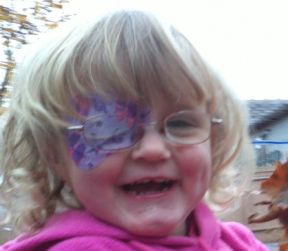
Lila 2 1/2 years old, she has been patching since March 2012 doing amazing with the patch, thankfully.
Back in September, I wrote about a study out of the Netherlands that found that children were much more likely to comply with patching if they were given a cartoon that explained amblyopia and the need for patching using simple pictures. I did some searching online, but was unable to find a copy of the cartoon. But our intrepid contributor GeorgeB did some investigating of his own, and contacted the researchers to find out more.
They graciously gave us permission to share a few more details of their project, including some pictures of the cartoon in question. They also said that they’re exploring ways to distribute an English version of the cartoon and leaflet for parents. If George or I learn more, we’ll definitely share it.
Until then, click the image below to read more about the materials that they made available for the kids and their parents to help with patching. I love that the cartoon is intentionally black and white, so that kids can color it however they choose.
Click to read more about the cartoon, the sticker calendar and the leaflet for parents used in the study.
Many, many thanks to GeorgeB for his work on tracking this down, and to Louise Hoppel for getting the permissions of the researchers artist, and for sending us the information!
Finding the right shop for glasses for your young child can make a huge difference in your child’s experiences with glasses. An good optical shop is far more than just a place to choose frames and lenses. A good shop will have experienced opticians who can help you find frames that fit your child well, and can adjust them appropriately. They can also give great advice on types of frames and lenses for your child, as well as suggestions on helping to make the transition to glasses easier. They’ll also be your place to go when glasses get bent, or scratched, or when you need to update their prescription. So it is absolutely worth it to find a great shop.
Hooray for great optical shops!
Start by getting recommendations for optical shops. You can ask your child’s eye doctor for recommendations for optical shops, though if they also sell glasses in the office, they may not have a recommendation beyond their own shop. Know that you do not need to purchase glasses at the same place where your child’s eye exam was. You should be given their prescription (it is part of their medical records, so make sure to get a copy).
If you know anyone with a young child in glasses, ask them about their experiences with optical shops. You can even stop someone on the street if you see they have a young child in glasses and ask for their recommendation. Chances are that they will have some opinions on the matter. You can also ask other friends who wear glasses if they have an optical shop they’d recommend, though a shop that is great for adults may not have the experience or selection you need for kids’ eyewear.
Below are some questions you may want to ask of any optical shops to help you choose one. You can go in person to a shop and ask about the following, but it may be easier to call before visiting, especially if you’re bringing a small child with you. Now, depending on where you live, you may not have a lot of shops to choose from, but it is still worth asking these questions, no matter where you go, to help you plan for choosing and purchasing glasses.
Selection of frames
Because young children are a small percentage of the customer base for optical shops, many shops don’t have a huge selection of the smallest frames. But don’t rely on what the shop has out on display. Some shops keep their children’s and baby’s frames in back.
Questions to ask:
Tell them the age of your child and ask whether they carry frames in that size, and how many frames you’ll have to choose from.
Ask about whether they would be willing to order some sample frames for you to try on in the store.
Ask if they are willing to fill a prescription in frames that you bring in. If you cannot find frames in a shop, you can order frames online and have them filled by a shop, that will then help you with adjustments and fitting.
Experience with Children
Fitting glasses to small children is different than fitting them to adults. It requires a few different techniques and a certain understanding of how to work with young kids.
Questions to ask:
Do you have an optician on staff that is trained or experienced with children?
When do they work?
Warranties
Few things in life are certain, but prescription changes and broken or scratched glasses on young kids are nearly a sure thing. Different shops have very different warranties for their frames and lenses. It is important to know what is covered and what is not going in. Young kids will outgrow their frames in a year or maybe two, so it is not worth it to get a warranty past that point.
Questions to ask:
Do you have a warranty for the frames? Does it cost extra?
Do you have a warranty for scratches on the lenses? Does that cost extra?
Do you have a warranty for prescription changes in the first year?
Pricing and Insurance
Depending on where you live and what your insurance is, the cost of glasses can run from nothing, to a whole freakin’ lot of money. Most US health insurances will not cover glasses (though they usually cover the exam), if you have a separate vision insurance, find out if the shop takes that insurance, and what, if any, limits there are to using the insurance. You’ll also want to know what the price points or price ranges are before going in – you can ask about. Many shops also offer discounts if you order a second back-up pair or prescription sunglasses at the same time. A second pair of glasses can be a life saver if one pair needs to go in for repair, so depending on your budget and needs, this can be a great deal.
Questions to ask
Do you accept vision insurance (if applicable)? Are all frames covered under the insurance, or only some of them?
Do you have any older frames that are discounted?
Do you offer a discount if I order a second pair of glasses at the same time?
Happy April 1! While the study and the “cuteness experts” may be made up, I fully believe in the findings:
While glasses do not cause children to be cute, they also do not diminish their cuteness.
Any parent with a cute child (which is to say, any parent) should make sure their child’s vision is checked early on.
Parents who learn that their child needs glasses should follow the recommendations of an eye care provider, and should not worry that the glasses will lower their child’s cuteness in any way.
MINNEAPOLIS, MN – April 1, 2013. Researchers at Little Four Eyes have recently demonstrated that there exists a strong link between children who wear glasses and cuteness.
The study is the first of its kind to look for links between kids in glasses and their levels of cute. Cuteness experts analyzed the 167 photos in the Little Four Eyes photo gallery, and independently rated the adorableness of each child. “What we found astounded us,” noted the lead investigator of the study.
“We went in to this study expecting to see some relationship between these two factors, but the degree to which the two factors correlated was off the charts. Every single photo in that set has been independently verified as representing a cute child,” she continued. “That’s a perfect correlation! We can say with great certainty that all children wearing glasses are cute.”
Just had to share this wonderful post about a play date that happened this past weekend to celebrate our 5 year blog-birthday. Be prepared for some pretty crazy cuteness – and check out the cake! Did anyone else get together? We got together with another family (need to get pics uploaded) and had a great time. – Ann Z
This month we celebrated 5 years of little 4 eyes with a play date! We had a BLAST! We met up at a local pizza and play date place and enjoyed watching our kids play together and eat cake!
Be prepared for a picture overload! We had so much fun!
We were so happy to have 4 of us show up and the kids are all pretty close in age too! I can’t believe almost all the kids are looking at the camera! Holy cow thats amazing!
All of these kids are amazing and have been through so much! They teach us new things every day.
Here is my son scott, he was born with a congenital cataract. He wears a contact and glasses and is almost a year old.
This is Eli, he was born with bilateral congenital cataracts. He wears glasses but will soon be switching back to…
Thanks to Julie for sharing her post originally posted on her blog, A Balancing Mama. We’ve had very similar experiences with Zoe looking at the ground and mumbling whenever someone compliments her glasses, even though I know the the compliments are well-meaning. This makes me think of the tips for things to say or not say to young kids in glasses. – Ann Z
You know… no one tells me that they “like my glasses”. But this seems to be the #1 most common thing anyone says to my child. Amelia hears this comment at least twice a week, usually more. At the dentist the other day? Four people told Amelia, “I like your glasses” in a span of ten minutes!
The first couple times, she smiled and quietly expressed thanks.
The third time, she grinned a little and hugged me.
The fourth time, she looked at the ground.
Amelia, now a few weeks from turning five, has begun to question her glasses. Why does she have to wear them? How long does she have to wear them? Are her glasses forever? She really doesn’t need strangers to convince her that her glasses are the focal point of her being.
Of course she looks gorgeous in her wire rims with pink temples. And I completely understand that people believe they are being nice or helpful… but I wish “well-meaning” adults would stop bringing attention to Amelia’s glasses every time we set foot inside a store – or a dentist’s office. Amelia has a fun and funky fashion sense – why not comment on her fuzzy, sparkly pink boots? Or her jewelry? Or her amazing curly hair that looks amazing in any weather, including humidity? Or how about saying, “what a cute girl you are!”?
This used to happen before she had glasses.
– Julie is a part-time working mom, mother to 4-year-old Amelia, and the blogger behind BalancingMama.com.
Megan has written before about patching her daughter Ruby. She’s back with an update and a question. -Ann Z
To brace or not to brace….
And that is the question at our house these days. I’ve read that the bracing tactic is effective, but I’ve put it off for so long. I’ve tried other options all unsuccessfully:
Bribing with food – that worked for about 3 weeks
Bribing with the computer/ipad – hasn’t worked at all
Bribing with the TV – also complete and total failure (although my other working theory on why that failed was because Yo Gabba Gabba made us both scream.)
So now, as we approach the one year anniversary of Ruby’s eye surgery, we come down to this: do we brace her arms so she can’t bend her elbow and rip the eye patch off?
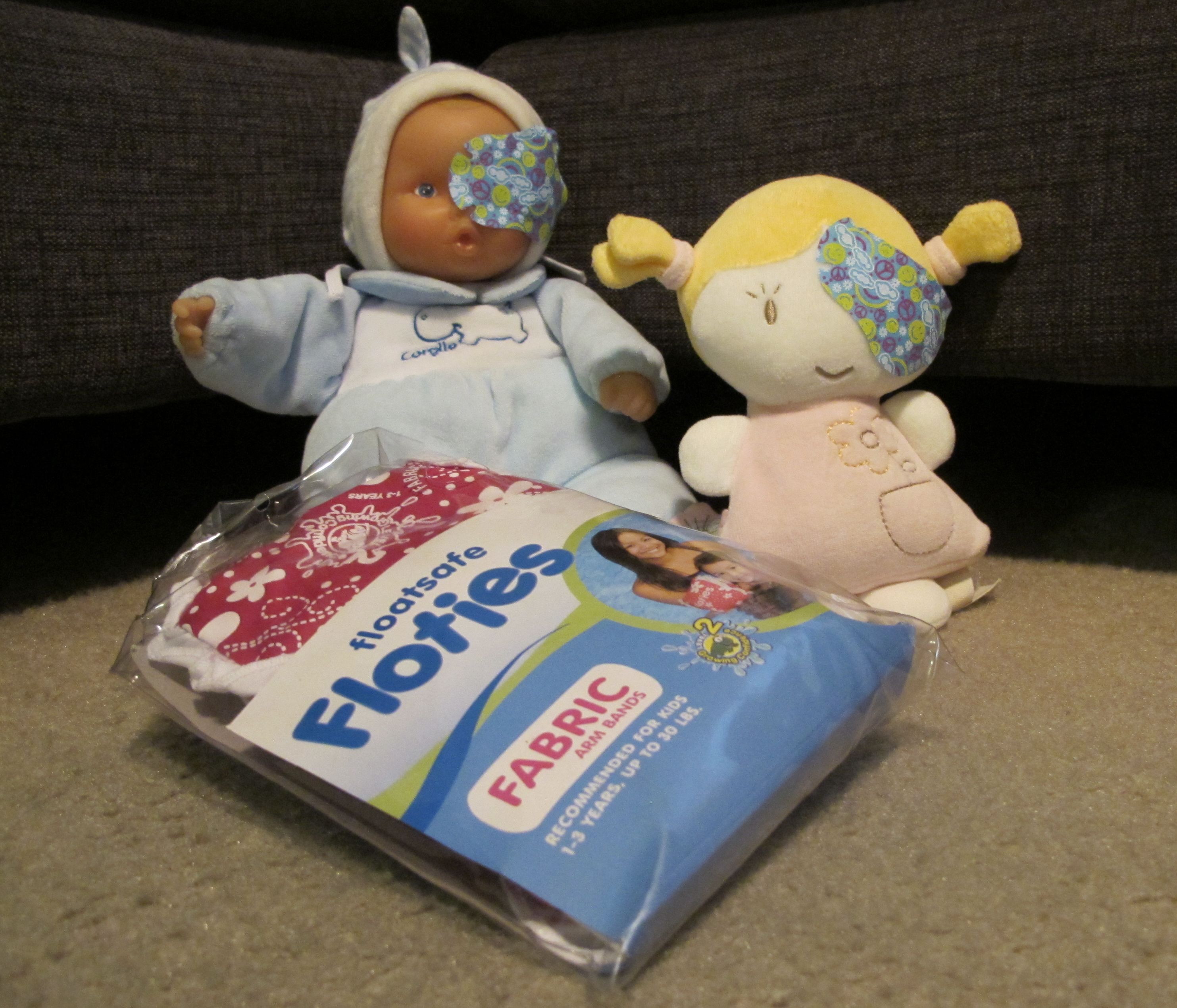
I’ve purchased a lovely pair of purple and white fabric covered swim floaties with flowers and ruffles on them for just such a task. That seemed like the least invasive way to go for the bracing measure. (However, I’m fully aware this swim floatie/brace technique could illicit another tantrum down the line as she gets bigger and we go swimming. But frankly, I can deal with that as a lot of people don’t like to swim. Plus, I’m banking on the theory that she’ll have blocked this whole experience out of her mind.)
I’ve been telling Ruby we need to patch her baby doll’s eye because it’s really important for her to see well. And now she brings me both of her dolls everyday for patching. She still is not patching that well, but her dolls are really good at it.
Ruby is 17 months old and I’ve read about 17 month old kids who do patch quite well for several hours a day so I know this can be done. But as all parents know, the toddler years aren’t exactly the most cooperative ones.
My question to the collective group is this: Did you try bracing to get your child to learn to leave the patch on? And if so, what did you brace with?
Fred Rogers in the late 1960s. By KUHT [CC0], via Wikimedia CommonsToday would have been Fred Rogers‘ – known to most of us as “Mister Rogers” – 85th birthday. For those readers who aren’t familiar with Fred Rogers, he hosted a beloved US children’s television show, “Mister Rogers’ Neighborhood” for over 30 years. He was known for his gentleness and directness and his unmatched way of explaining things to children at their level. He founded a non-profit, Family Communications, to produce the show, but also to produce books and videos and other materials to help support parents and children. His book “The New Baby,” was read to my husband to help him get ready for his new sister when he was young, we read that same book (with the same wonderful 1980s pictures) to Zoe when we were expecting her younger sister a few years ago.
Mister Rogers was gifted at helping children face unfamiliar and often scary situations of all kinds, including doctor and dentist visits. But imagine my surprise when I learned last month that he had also co-written a chapter of an ophthalmology book, Duane’s Ophthalmology.
He and a colleague at Family Communications, Hedda Sharapan, were asked by a Pittsburgh pediatric ophthalmologist to help to write the chapter “Physical and Psychological Preparation of Children for Anesthesia and Surgery.” Their part was looking at the psychological preparation. But that section doesn’t just talk about preparing a child for ophthalmologic surgery, it covers some of the special considerations of working with children during eye exams. And while it’s targeted at Ophthalmologists, I found it extremely readable, fascinating, and helpful. It’s written in his straightforward style and puts the child’s fears and concerns front and center. The section begins,
“You were a child once, too. That may be obvious, but knowing that and remembering what it was like being a child can make a significant difference in the relationship between you and your child patient. Some children are fortunate enough to be treated by physicians who recall the feelings of being a powerless vulnerable child.”
On the topic of general eye exams, he writes about the fact that people of all ages are especially sensitive about their eyes:
“People of all ages may be especially sensitive about their eyes. In our feeding experiences right from birth, as infants we actively use our eyes to search the face of the person who is feeding us, reading that face like a road map to gather information about the world. At that time in our lives, our eyes help us find answers to the most basic question, “Is the world a good and trustworthy place?” As we grow, we continue to rely on our eyes as an important source of our sense of self, independence, and knowledge of what’s going on around us.”
Because of this, eye exams, though they rarely hurt, can be upsetting and difficult. Exams generally go much better when kids are prepared for what’s to come, and when they are able to move their head freely, rather than having their head turned one way or another with a hand on the top of their head.
There are even tips for making eye drop administration easier, including:
Explain that the drops are important for looking at the eye.
Do not surprise the child with the drops, but tell him that they’re coming.
Be honest that the drops may sting.
Describe the drops as being “like looking up into the raindrops” or “like being splashed” and ask if the child has looked up into raindrops, or been splashed before. (This sounds lovely, I love the poetry of “looking up into the raindrops”, but I’ll admit, given our fights with Zoe and getting eye drops, I’m pretty skeptical that it will actually help. I’m still going to give it a shot.)
Demonstrate giving the eye drops on a doll or stuffed animal first.
He’s similarly thoughtful and spot-on when writing about what us parents are going through:
“Along with medical concerns for their child, parents also bring to your office their emotional concerns. Whenever a child has any problem (major or minor), parents tend to feel vulnerable, sometimes powerless, and often guilty. Everyone longs to have a perfect child, and when that dream is marred by some problem (no matter how small), parents often need extra doses of reassurance and trust from the physician and the staff.”
I encourage everyone to read the full section. And when you’re done, if you’re feeling nostalgic for Mister Rogers, enjoy this tribute by Symphony of Science’s John D. Boswell and PBS Digital Studios.
References:
“A Special Day in the Neighborhood Mister Rogers Celebrates 30 Years of Making Us Feel Good about Ourselves.” Pittsburgh Post – Gazette, Jan 18, 1998.
Jane M. Breck, Fred M. Rogers, Hedda B. Sharapan, and Albert W. Biglan, “Chapter 80, Physical and Psychological Preparation of Children for Anesthesia and Surgery, Part 2: Psychological Preparation for Anesthesia.” Duane’s Ophthalmology on CD-ROM, 2006 Edition. Lippincott Williams & Wilkins. http://www.oculist.net/downaton502/prof/ebook/duanes/pages/v6/v6c080.html#part
As we approach the fifth anniversary of Little Four Eyes, I’ve been thinking back through our own 5 year journey of Zoe in glasses. I know when I was starting out, I wanted to know what to expect and fervently hoped it got better (it did). Obviously, every kid is different, so I’d love to hear how things have changed year to year from other veterans out there.
Year 1: Mixed emotions and a steep learning curve
Our first year was was definitely the hardest. There were the crazy emotions when we learned Zoe would need glasses: surprise that she needed glasses; worry that I wouldn’t be able to keep them on her; anger at myself for being upset; bewilderment at the idea of getting my strong-willed toddler to leave glasses on her face; frustration with her taking the darn things off all the time; excitement as I watched her wear them better and begin to see well; irritation at the question after question and comment after comment about her glasses; disappointment at seeing her eyes continue to cross even as we tried prescription after prescription; worry about whether surgery was right; joy at seeing her look at me with both eyes at the same time.
Lessons learned:
consistency, staying positive, and distractions are key to getting a child to wear her glasses. But even then, it can take kids a long time before they’ll wear their glasses. But it will eventually happen.
take off her glasses in the car. She would get bored and the glasses would get bent or the nose piece would come off. Eventually she got much better at leaving her glasses on on the car, but that took a while.
watch her glasses when she’s in the stroller. We took a lovely walk one afternoon and upon arriving home, saw that she had no glasses any more. Thank goodness they were bright red and my husband was able to spot them when he retraced our steps
keep many microfiber cloths around for clean up. Because those glasses? Get dirty fast!
be ready to answer questions. A young toddler in glasses inspires lots of questions and comments. I got really good at answering how they can measure a toddlers vision. I also learned to ask people if they really wanted to know the answer, because I saw a lot of eyes glaze over as I talked through the multiple tests that occur at a typical eye exam for child.
Stats:
Number of eye appointments: at least 10
Number of prescriptions: 4
Number of frames: 1
Year 2: settling in
After the craziness of the first year, the next couple of years felt much easier. Her prescription stabilized and we moved to appointments every 6 months. I started to feel like a pro: Zoe wore her glasses well and reliably, I could answer any question a stranger threw my way about glasses, and I’d met a lot of great people through this site and no longer felt alone at all.
Lessons learned:
Two pair of glasses is awesome. That way you have a back up, and I could give Zoe a choice every morning as to which glasses to wear. Now she had some control over wearing her glasses.
After all those fights to get Zoe to leave her glasses on, we were all of a sudden having issues taking her glasses off. In her first year, I learned to take her glasses off to prevent her from flinging them off during tantrums, but this year, she started getting really upset by that. So we started a new rule in which I told her that someone should always ask her before taking her glasses off.
Stats:
Number of eye appointments: 2
Number of prescriptions: 1
Number of frames: 2
Year 3: even better
Year 3 continued the trend of things getting better. Zoe’s two pair of glasses from the previous year still fit, and she was doing great. This was the age at which she first started asking questions about why some people wear glasses, and why none of her friends do.
Number of prescriptions: same as the previous year
Number of frames: same two as the previous year – she outgrew one halfway through this year
Year 4: changes
After 2 years of the same frames and no prescription changes, we had a bunch of changes. Zoe’s prescription jumped due to a change in astigmatism, and that triggered amblyopia and patching, and she’d outgrown her frames. So, new frames, new prescription, and patching.
Lessons learned:
Patching is hard. Having a consistent schedule helped us a lot. As did sparkly eye patches that Zoe could choose each morning.
Vision screenings don’t catch every problem. A month before Zoe’s appointment where we learned she needed to patch, she had her vision screened at her pediatrician’s office. I watched as she peeked around the eye cover, and crept past the line to try to read the eye chart. It was clear to me that she was not seeing well. But the nurse passed her on the screening. Thank goodness we had a real appointment already scheduled.
One new sign of Zoe needing a new prescription is her looking sideways through the outside edge of her glasses.
Stats:
Number of eye appointments: 4
Number of prescriptions:1
Number of frames: 3
Year 5: still the only one in glasses
This year, Zoe started kindergarten. I was certain she’d have at least one other kid in her class in glasses, or at least someone in her after school program. She’s still the only one, but she’s still smiling.
Lessons learned:
Photochromic lenses (the ones that change in sunlight) are great, Zoe loves hers. They do not change back to clear very quickly when it’s cold out, though.













 , by Mo Willems


 is about Katie’s friend Pedro who needs glasses and does not like them at first. Katie helps her friend see why they’re important.








![Fred Rogers in the late 1960s. By KUHT [CC0], via Wikimedia Commons](https://forlittleeyes.com/wp-content/uploads/2013/03/fred_rogers.jpg)


 For Little Eyes