There’s a fun interview over at Great Glasses Play Day with Brandi, a member of the Little Four Eyes facebook group who put together a play date for her son with another little boy in glasses. She and Kristin talk about the fun of getting our kids together with other kids their age in glasses, as well as getting to meet other families that may be going through something similar.
I really hope that more of us can get together this weekend to celebrate 5 years of Little Four Eyes, yes, but more importantly, to meet and connect with others who understand what it means to have a little one in glasses, and to give our kids the chance to not be the only one in glasses. There are already a few communities on our Meetup page, and there is a lot of discussion on the facebook event as well (you need to be a member of the group, but we’ll approve requests to join quickly).
Nearly 5 years ago, on March 15, 2008, I published my first post on my new Little Four Eyes blog:
“… I still find myself wanting to connect with other parents of young toddlers with glasses. How do you deal with your kid flinging their glasses off? How is it going in daycare with other kids curious about your child’s glasses? How do you know if the glasses are helping? When will she learn how to put the glasses on herself? When I’ve looked for answers or even just discussions about this stuff, I’ve found mostly information for older kids with glasses …”
I had hoped to connect with other parents out there so we could share our experiences, difficulties and triumphs. Five years later, with over 500 posts, nearly 5,000 comments later, and a facebook group of over 2,500 members, I’m still amazed and grateful for what this community has done.
So to celebrate 5 years, I want to expand on that original goal of connecting with others, and help others connect as well. I’m partnering again with the Great Glasses Play Day to help make this happen.
For those unfamiliar with the Great Glasses Play Day, it was co-founded last year by me and Kristin Ellsworth, founder of the social enterprise Peeps Eyewear, to create a day to celebrate children in glasses, contacts, and patches. This year, we’re filing as a non-profit.
What we’re envisioning for the Little Four Eyes anniversary is “many mini-great glasses play days”. In essence, if you’ve thought about trying to get together with other L4E parents and kids near you, use the weekend of March 15-17 as your excuse. Find a park or indoor play area or even a house (but not mine, mine is a wreck) to meet and let your kids enjoy playing with someone their age in glasses. This will also be the kick off weekend for planning for the big Great Glasses Play Day event taking place all over the world on August 4.
We’ve set up a Meetup page to help you find others near you and figure out where to meet. You can log in to the page with your Facebook account, or with a meetup account (both are free). Using it is pretty simple:
When you go to the page, simply put your location in the search box in the upper right corner to see if there’s others that live near you.
Click on the link for your city to see if there are any events planned near you.
If there is an event, join the discussion to see when and where people are meeting.
If there’s no discussion yet, start one to let people know you’re interested and throw out some ideas of places or times to meet.
And after this celebration, the Meetup page will still be there if you want to set up other get togethers, and we’ll be using it for the big Great Glasses Play Day in August.
I’m hopeful that the meetup page will make finding and organizing these play dates easier, but if you run in to any problems, please let me know and I’ll see what I can do to help.
If you do end up meeting, I’d love to see pictures!
Georgina kindly shares the story of her daughter’s diagnosis and treatment of PHPV with us. Many, many thanks! – Ann Z
I wanted to share our story and experiences of discovering that our little girl had something wrong with her eye – a condition called PHPV (Persistent Hyperplastic Primary Vitreous, also known as Persistent Fetal Vascular Syndrome or PFVS). I found I searched the internet until I was blue in the face (not that I think it does any good), and it was nice to hear of people that had been through the same or similar.
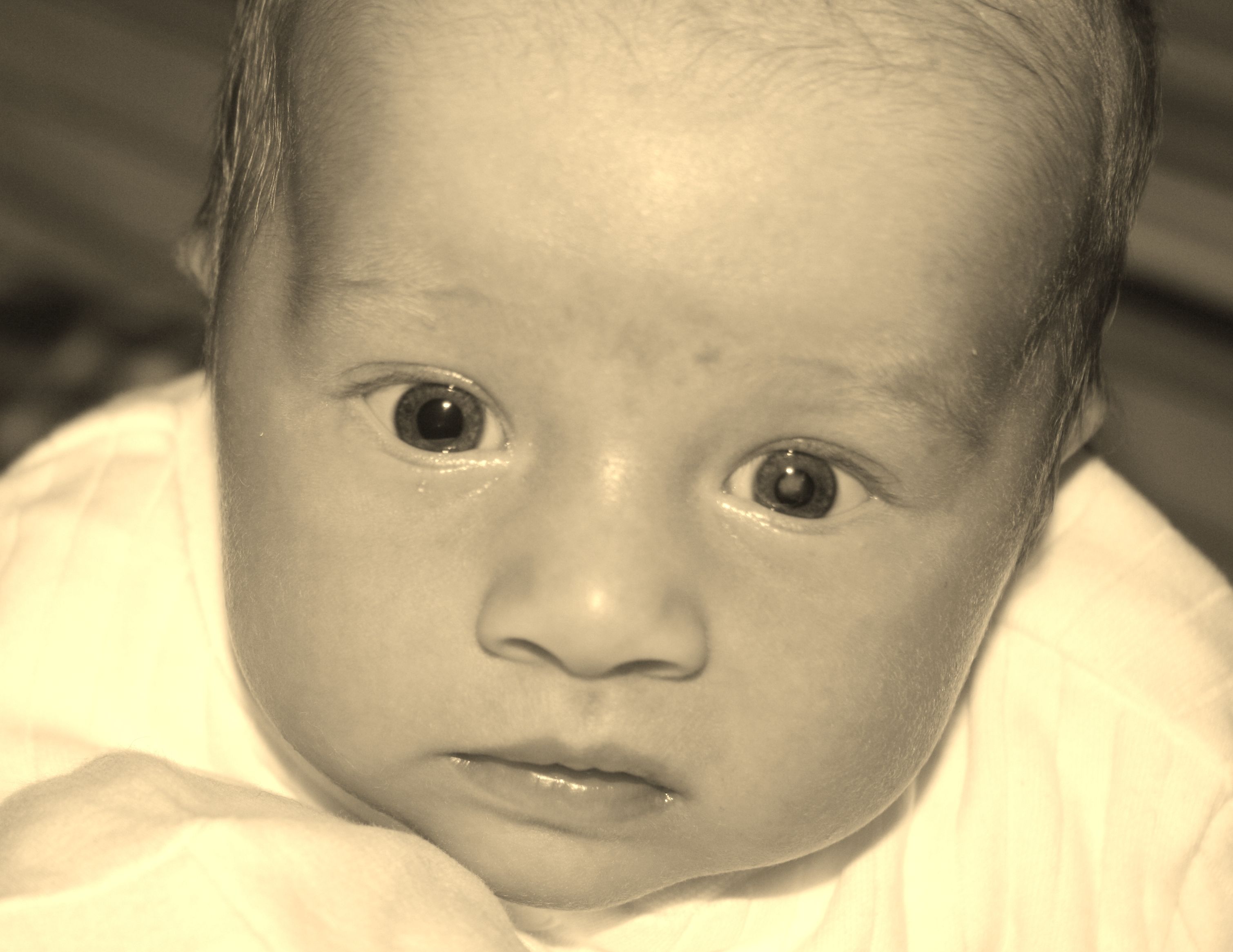
You can see the cloudiness in Evie’s left eye
It all began at Evie’s 8 week check, where the doctor noticed she did not have a red reflex in her left eye. Ok I thought, she has a perfectly good right eye so we can deal with this, as it was mentioned it may be a cataract. However, within hours I had received a call from the doctor himself, and we were seeing a specialist first thing the next morning. I wasn’t feeling so relaxed about it anymore – things don’t happen that quickly unless it’s serious in my mind. Luckily my husband could get the time off, and we went together, to be told that they thought it was possibly a birth defect which would dramatically affect her vision in that eye, if she had any at all, but that there was a chance it could be retinoblastoma (something you never wish to hear, cancer). My husband looked like he was going to collapse, but I don’t think it sank in immediately with myself. I knew nothing about the condition, so was slightly oblivious to what it could mean, but my husband had already been Googling things, so was far more in the picture than I was (I preferred my way, ignorance is bliss sometimes). It soon became apparent that this was serious as, within a matter of hours of returning home, The Royal London Hospital had been in touch to see how we were doing, and to arrange for Evie to go in and have further investigations in four days time.
So, on the following Monday, we left our little boy and travelled to London. We had an appointment with the specialist, who discussed with us what the following day would entail. At this point it almost seemed assumed that Evie did have retinoblastoma. The staff were fantastic and answered everything wonderfully. We went out for dinner, and actually had a rather lovely evening, including dinner and a walk along the Thames (funny how you deal with things).
I woke Evie to feed as she had to go four hours without (the bit I worried about most as she loved her food), but all went incredibly smoothly as she woke hours later, and only a little while before her general anaesthetic.
I took her down to surgery and held her, desperately trying to hold it together and not cry, but I challenge any one not to. Watching your baby being put to sleep is so heartbreaking. I think it’s the feeling of being utterly helpless even though I knew she was in the best place, and everyone was just wonderful. Whilst waiting for her to come back we had to have eye drops, as it can be hereditary, which took our mind off things, as I couldn’t see a thing and had to be guided to the restaurant and giggled trying to see what button I should press in the lift, or what was on the menu.
Finally I could get her, and we awaited the results of the investigations. When I was told that it was a cataract (later to discover Evie’s condition was called PHPV, which is similar) I broke down. It must have been the sheer relief that after all of this she just had a dodgy eye.
Evie’s pupil after her cataract surgery was teeny and did not dilate. She has since had pupilloplasty surgery to fix this but may still need to have another.
Evie’s pupil after her cataract surgery. She has had pupilloplasty surgery to fix this but may have to have another as they need to see into her eye to check her lense etc. As she can see it’s teenie in comparison to the other and does not dilate.
We were shortly referred to Great Ormond Street Hospital, where Evie has had two surgeries, and is likely to need a third, as her pupil has gone teeny as a result of the initial cataract operation. Luckily these operations were a success, and Evie now has a very swanky new lens in her left eye. The surgery was when she was 12 weeks old, and she was not fazed by it one bit.
Great Ormond Street Hospital is a very special place; it feels so upbeat, and it’s a very magical place to be. It can also make you realise that your little one really isn’t poorly at all in comparison to most of the children there. Although of course it’s still your baby and all you want in the world is for them to be ok.
I felt with Evie’s eye that she may not be able to see out of it, but at least it doesn’t cause her any pain or discomfort, and she doesn’t know any different anyway. Also, she could see the world and all its beauty, so if she was missing a fraction to her left it really wasn’t a big deal.
I wanted to share our story, really to let people know what happened after the surgery, as we were advised that it was unlikely she would regain her vision in that eye. After months of battling to get eye drops in, at times on an hourly basis (swaddling was the answer for us by the way), we finally got her first pair of specs when Evie was 5 months, and we started patching on a daily basis with the aim to get to four hours a day. At first this seemed impossible, after 15 minutes she was beside herself, and seemed so scared and confused due to the lack of vision.
Evie’s first specs at 5 months
But here we are four months later from receiving those first specs, and we are comfortably managing four hours a day of patching (we find it works best to pop it on when she is having a nap). Her prescription has gone from +9 to +8, and it seems her little eye is likely to keep improving. It’s amazing seeing the difference – I set her little challenges, and the other day she picked up a 5p piece with her eye patched and NO glasses. I find this incredible.
Evie in her patch and glasses at 8 months
Well there you have it, a not so brief version of Evie’s little eye adventure, but I wanted to share to offer any advice regarding patching, drops, etc. and to show people that it is actually ok, and she looks adorable in her little specs. They are part of her.
Many thanks to Megan for sharing the story of her daughter, Ruby – Ann Z
Ruby is just like any other 16 month old. She’s working on mastering the art of walking, enjoys searching for the perfect bedtime book by pulling them all off the shelf and playing with her parents and little friends. She’s just like any other toddler — any other toddler that is who wears a contact in their right eye and needs to wear an eye patch.
I realize a contact case and saline isn’t in your average diaper bag, but it’s in mine. My daughter was born with a pediatric cataract. It was discovered when she was three months old during trip to Urgent Care to deal with a scary cough that turned out to be our first case of RSV. However the during the exam, the doctor kept going back to her right eye. He mentioned it just didn’t look right. But I was more concerned with the fact that she couldn’t breath very well. Lucky for me, he was concerned with both issues.
Ruby after her surgery at 6 months.
Turned out, that night at Urgent Care (in the middle of a horrible snow storm, because really isn’t that when we all go to Urgent Care in the middle of the night in a horrible snow storm?) the doctor saved my baby’s eye sight. Within 2 days we were in a pediatric ophthalmologist office. Less that a week later we were visiting specialists at Seattle’s Children’s Hospital. The date was set. Her cataract was coming out. In early April 2012, it did. She was a trooper during the surgery and recovery. She even did well patching those first few months. Her little friends at daycare enjoyed picking out which patch she’d wear on her eye that day. She’d happily sit back and let them fuss over her and entertain her while she had her patch on. It was wonderful. I thought, hey this isn’t so bad. I can do this.
And then she turned one. And became a full-fledged toddler. And the days of wearing her patch are long gone. She screams when you get a patch out of the box. We wrestle and cry and try to get it on her. But she rips it right off. At daycare, her little friends still pick out her patch and keep her distracted – for about 10 minutes. If we can get a good 20 minutes of patching in, we call it a good day. However, we need to have her wear the patch 4-6 hours a day, every day. We have a long way to go.
And the patching only happens if the contact lens is on her pupil. Many days her contact floats off to the side of her eye. Sometimes we can manipulate it back on, but sometimes we can’t. Plus she’s gotten stronger and rubs it out more often. She’s so strong and fights her contact so much that her dad and I can’t get it into her eye ourselves. These days we seem to be making weekly pilgrimages to the contact specialists. Luckily, they love Ruby. They get us right in and it takes four of us to get her contact in her eye. She kicks, screams and cries during the process. I just hold her tight, tell her it’s all going to be all right and that she needs her contact to see. I tell her it’s very important for the future President of the United States to have good vision. She cries. I cry. They tell me it’ll get easier. They’ve been telling me this for a while now.
Ruby today
I do know it’l get easier. She’s just a baby. A baby who doesn’t know she can’t see out of her right eye without a contact lens. A baby who doesn’t know she needs to wear her patch everyday faithfully to have good eye sight. A baby who’s mother and father are trying everything to make this work. I’ve done the research and I’m constantly doing more on ways to get your baby to wear their eye patches. But every time I feel like we make progress, her contact floats to the side of her eye and there’s a day without patching. Or worse, the contact comes out. There’s three to four days without patching while we wait to get to the doctor or get a new lens.
If any parents have advice on how to get a spirited 16 month old to wear a patch, or how to deal with a contact in a toddler, I’d love to hear them.
Bill Curran is an optician who specializes in children’s eyewear at William J. Curran & Son Opticians. He has a passion for helping children find eyewear that fits correctly and looks great. I’ve asked him some questions about the importance of good-fitting eyewear, and about the line of rimless eyewear they’ve developed for kids.
How did you get interested in working with pediatric eyewear?
We saw a real need. There’s really two main reasons.
One: The number of children that need eyewear has increased dramatically in recent years. Parents and pediatricians are more diligent than in the past. Twenty-five years ago, a child wearing glasses at age three was rare. Now, we are fitting children with eyewear as young as three months old.
Two: The choices being offered to the parents of these young patients were terrible. Most Opticians were just finding the smallest adult frame they could find and make it fit. The result was a pair of glasses that was ill-fitting and overwhelming their tiny faces. It also came down to supply and demand. The supply of a good fitting children’s frame was terrible and the demand was great. What we wanted to do was solve that problem by designing eyewear that is custom fitted for every child.
Are there issues in fitting children that are different than fitting adults?
A child’s face is not as developed as an adult. A child’s bridge can not support large, heavy eyewear. Therefore, the frames and lenses must be very lightweight and the proper size. Also, the temples must be long enough to wrap around their ears. Many Opticians use a “cable temple”. We do not like this type of temple because they are very uncomfortable to wear, not adjustable, and they usually pull the child’s ears out. What we do, is use extra long temples that bend around their ears with no pulling on the back of the ears. This temple design results in a secure and comfortable fit for the child.
I know a lot of parents would love to know what they should look for in good fitting glasses, can you give some pointers?
Most importantly, the glasses should be the proper size. Too many times the lens and bridge size are too big and the temples are too long. Eyewear should look like it was made and fitted for the child and not be overpowering to the child’s face. Most young children have a very small undeveloped nose bridge, so we recommend a lightweight frame with adjustable nose pads.
On a similar note, what are things to look for that might indicate that our child is outgrowing their glasses?
When a frame is the proper size, the child’s eyes are more or less in the geometric center of the lenses. When the eyes are closer to the temples than they are to the center of the lenses,or if the child has marks along the sides of their head the frame is too small and the child should be fitted with new eyewear
A lot of us buy clothes that are slightly too big for our kids, since we know they’ll grow in to them, and given the expense of glasses, I think a lot of us would love to get frames for our kids that are a bit big so that maybe they’ll last a bit longer. Are there problems with getting glasses that are too big?
It is tempting to buy big to allow for growing room. However, this is a mistake and in our design unnecessary! Because of our frameless design, the glasses grow with the child! As the child grows, and the Rx changes, we can increase the lens size and change the shape, the child will be able to wear the same frame for years.
You have designed rimless frames for children. One of your very happy customers posted a picture of her daughter in your frames on our facebook group, and it caused quite a stir. What led you to design your frames?
Rimless glasses from William Curran & Son.
When my son was very young he needed his first pair of eyewear. The problem was that all available kids frames that I tried on him looked very heavy and nerdy. My son did not like anything I showed him and I really didn’t like any of them myself.
At this point we decided to design a rimless frame for him. We had to make many design changes because children’s facial features are so different than adults. After much work and design changes we showed my son the design and he loved it and I did too. Now, 13 years later my son is still wearing rimless eyewear and still loves the look.
After this we started to show this new rimless kids design to our regular young customers and both the kids and the parents fell in love with it. Today 95% of our children’s eyewear sales are with the rimless frames.
What are some of the features you designed into the frames that make them suited for children?
The frame is lightweight Titanium and consist of no nickel which can cause an allergic reaction to 10% of the population. In our frame design, there are no screws to come loose, no hinges to break, and it weighs less than 3 grams. The frame grows with the child and we can make it in any lens shape.
Are your frames available to people that do not live close enough to visit your optical shop?
Some of our children’s rimless frame designs are available at other Opticians, however, the expertise, design, and passion are only available at William J. Curran and Son Opticians. A few years after we designed the first kids rimless we felt a need for more colors and part sizes, so we met with the company that makes the parts and we did consulting work for them to help their company launch their first frameless kids line. This kids line that is available elsewhere is geared more for children from six years on up, but with our personal design, we are able to fit children from eighteen months and up.
We custom design our lens shapes to the child’s face which is something other opticians will not do. Most Opticians are sales clerks and will only sell what the sample frame is. Since we are designers, we handcraft all of our eyewear to the individual wearer. Also, most Opticians will have the eyewear made by a wholesale lab. We make all our rimless eyewear in our own lab, which gives us complete control on design and quality.
First, a huge, huge thank you to everyone that entered the patching contest. I loved reading all the entries, and seeing all the photos for the gallery (make sure to check out the gallery!). I wanted to pull everything together and post a quick follow-up.
There was one request for links to where to buy the items that were offered in the give away:
My favorite thing about the giveaway was reading all the activities that kids do while patching. I compiled them all in to a list for easy reference whenever you’re stuck and wondering what to do with your child during patch time.
Arts and crafts
finger painting
painting
coloring
play doh
Playing with toys
playing “hundreds and thousands” – looking for sprinkles on the tablecloth
legos
blocks
stuffed animals
a light-up wand
action figures
playing with friends and sisters
Games
doing puzzles
playing on the iPad
play with action figures
reading books
online games
“spotting hundreds and thousands” (trying to find colored sprinkles for cakes on a table cloth of the same color)
Jaymeson does karate
Other activities
watching favorite shows on tv or the iPad
everything
explore the outdoors and climbing
go about every day business
watch Andrea Bocelli concerts
sing
Other pieces of patching advice
don’t forget to get outside
start first thing in the morning and make it part of your regular routine. Then go about your regular day.
when you first put the patch on, count to 10 together while you press and hold to get the adhesive to warm up on his face.
Thanks again for all the great entries! I’m so impressed by the
I got an email from Molly who had a lot of questions about learning that your child needs glasses. I thought I’d turn to you for some answers.
I think I speak for all of us, that our biggest fear when we learn our child needs glasses, is for their vision. But setting that aside, what was your biggest worry (if it’s not on this list, leave a comment?
…
And once you’ve voted, I’d love to hear about how things turned out. Did your worries prove to be a problem , or were you surprised by something else?
Here’s Zoe on her first day with glasses. I was worried about a lot of things with her glasses. Worried that I’d lose them or that they wouldn’t work and she’d need surgery, but my biggest fear was probably that people would see her and only focus on her glasses, and not get to know the rest of her – that she would forever be known as “the girl in glasses.”
I did lose her glasses once, but Chris was able to find them in a neighbor’s yard. She did end up needing surgery. And to be honest, I think my biggest fear did happen, at least to some extent. She’s definitely known as the girl in glasses, and when she was younger, I think that her glasses were one of her defining features. And they still are, but I like to think now that she’s older, her personality is really shining through. She may be the girl in glasses, but she’s the girl in glasses who talks a mile a minute and laughs like crazy at her jokes and loves to bake and read stories.
I just learned of another great way of sharing pictures of kids patching! Amanda told me that some of the iMoms (moms who blog about their children’s vision journeys) have been sharing pictures of their kids through Instagram (an app for your phone that lets you share pictures with friends). They’ve started a tradition on Sundays of sharing pictures of their kids wearing camouflage patches. They’ve tagged the pictures #camopatchkids. As Amanda wrote, ” it’s fun for us parents, gives us something to look forward to with patching (which is rare, ha). And lately I have been able to share the pics with my 2 year old son, who can see other kids with a camo patch on, on the same day he is wearing one too!”
#Camopatchkids on Instagram
If you’re on Instagram and have a child who patches, please feel free to join in on Sundays!
Updated: Thank you to everyone that entered!! The winners, who were chosen this evening at random, are Jasmine and Kat. You both should be getting an email shortly. I’ll post links to the gallery as soon as I get it put together. (I’m closing comments on this post now).
Carmen Swick, author of “Patchland Adventures: Fishing with Grandpa” (2012 winner of the Seal of Excellence Award in the Children’s Book category), has just released her second Patchland Adventures book, “Camping at Mimi’s Ranch”. Both books follow the adventures of Preston, a boy who has amblyopia, and his dog Beau. They combine a realistic portrayal of amblyopia and the struggles involved with patching, with imaginative tales of Patchland, the place that Preston and his dog visit at bedtime when Preston sleeps with a patch under his pillow.
So we’re doing two things to help her celebrate her new book: First, we’re kicking off a new photo gallery of kids who are patching! Secondly, Carmen has teamed up with Peeps Eyewear and Patch Palz to put together a great giveaway for two lucky kids who patch. This is a fantastic giveaway package that really celebrates the positive and even fun aspects of patching and wearing glasses.
The Giveaway:
There will be two winners, each will receive:
Books 1 and 2 of Patchland Adventures!
Book one: Fishing with GrandpaBook two: Camping at Mimi’s Ranch
~ and ~
A Patch Pals package!
Your choice of one of the following packs from Patch Pals to help make patching more fun!
A Pirate Patching Package (in pink or black), includes a “Pirate in training!” t-shirt, two pirate-themed patches, and an awareness bracelet.
Patch Pals pirate pack (comes in black or pink)
~~~ or ~~~
A Princess Patching Package, includes a “Patch Princess” t-shirt, two princess-themed patches, and an awareness bracelet.
Patch Pals princess pack
~~~ or ~~~
A Purple Pal Z Package, includes a plush purple patch pal, a matching patch, and an awareness bracelet.
Pal Z purple pack
~ and ~
A dress-up kit and custom book download from Peeps Eyewear!
The dress-up kit includes the empowering 32 page storybook “Princesses Wear Glasses,” a pink satin cape, glasses pouch and felt crown.
Cape and crown dress up kit
Princesses Wear Glasses book
The custom iPad download of the book lets you customize the story with your child’s name and hair color!
iPad download of the Princesses Wear Glasses book, customized with name and hair color of the princess.
So just to sum up, the full prize includes
2 Patchland Adventures books,
a Patch Pals pack,
a dress-up kit
an iPad download of a custom-version of the Princesses Wear Glasses book!
And we’re giving away two of them!
How to Enter:
To enter the giveaway, simply leave a comment here with your child’s favorite activity to do while patching. Make sure you enter your real email address so that we can contact you if you’ve won.
To get extra entries:
Send me a photo of your child wearing an eye patch (ann@shinypebble.com). This picture will be posted in our brand new patching photo gallery. Include a short blurb of information you’d like to accompany the photo, this could include your child’s name, or age, or how many months he or she has been patching.
If you’ve done any of these, please leave an additional comment letting me know, so that I make sure you get the extra entries.
The contest is open to everyone, no matter where you live. It will close Monday, January 28, 2013 at . Winners will be chosen by random and notified via email.
Update: Thank you to everyone who responded! I’ve forwarded your names and email addresses on to Abigail.
I recently got the following request from Abigail:
I am writing a story on finding out your young child needs glasses for a national Canadian magazine’s web site. Would I be able to talk to one of you about your experience? If possible by early next week. Are any members/contributors Canadian by chance?
If you’re Canadian, and interested in talking with Abigail, leave a commen – make sure you put your correct email address in the email field – that will let me forward your email address on Abigail, without you having to post it where everyone else can see it.
There are a lot of misconceptions out there about children’s vision and glasses for young kids. Here are the seven myths I’ve heard and read the most (and likely you’ve heard some of them, too) about young children with glasses.
Wishing all of you a very, very happy new year! May 2013 bring all of you much peace, joy, and no broken, scratched, or lost glasses!
Three quick resolutions for 2013
1: Protect your child’s glasses:
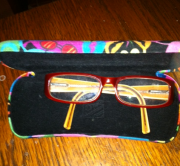
Safe in a glasses case.
Keep your house stocked for good glasses maintenance:
plenty of microfiber or soft cotton cleaning cloths around the house for quick clean up, mild soap or lens cleaning solution for the really dirty times that our kids seem to find so very often.
When you’re cleaning the glasses, check them over for scratches or loose screws.
And make sure you have a case or holder for their glasses for those times the glasses do need to come off – and need to stay safe.
2: Protect your child’s vision:
Charlotte in her cocoon sunglasses
Make sure your child’s vision stays as healthy as possible:
Make sure your child has good eye protection from the sun.
If he or she is involved in sports, look in to sports goggles if appropriate.
Check with your child’s eye doctor about when they’re next appointment should be, and what things they want you to watch for that you would need to schedule an earlier appointment for.
3: Share your story / your child’s story to help others:
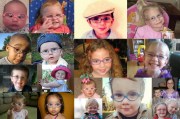
just a few of the beautiful kids in the photo gallery
Though vision issues are quite common in kids (about 1 in 20 preschoolers should wear glasses according to one study), they’re still not a lot of public awareness about how important it is to detect and treat vision problems early. One of the most common things I hear from parents who just found out their child needs glasses (or contacts, or patching, or eye surgery), is how alone they feel, and that they had no idea about vision issues in young kids. Given how amazingly cute our kids are, and how curious other people seem to be about our children in glasses, we’re in a perfect position to help others see the importance of children’s vision and to help other parents going through this feel less alone:
Respond to questions and comments about your child’s eyes and glasses with grace – at least most of the time. Nearly all the questions and comments are well-intentioned. (But if anyone questions your child’s need for glasses, or makes a rude comment about their glasses, then go ahead and respond with sarcasm or a chilly, “bless your heart”, or just ignore them if you just can’t find it in you to be civil.)
Share your child’s story – on facebook, twitter, google+, on your blog, or here (I am always happy to publish stories of your child’s journey – email me at ann@shinypebble.com). Or even just share his or her picture on our gallery.
Join the Little Four Eyes facebook group and share your hard-won wisdom with other parents (and ask questions and benefit from the wisdom of others).
When you meet other parents with young kids in glasses or with other vision issues, point them here or to the facebook group, especially if they’re feeling overwhelmed or confused.
Note – we have been lucky to enjoy a great relationship with Zoe’s pediatric ophthalmologist, but from comments here, in the facebook group, and other conversations I’ve had, I know that’s not always the case. – Ann Z
Image credit: National Eye Institute, National Institutes of Health
Dear Children’s Eye Care Providers,
First off, thank you! Thank you for you devoting your time and energy and career to the care of our children’s vision. Our children’s eyes and their vision are so very important to us and to them, and we truly appreciate your expertise and your care and your help. We know that you want our children to see as well as they can, and we want the same thing.
Please help us to understand our children’s vision and their vision problems. I know you studied the visual system and eyes, not how to calm a freaked out parent, and I know that we are not always easy to deal with (and especially after eye drops, our children aren’t always the easiest either). But we know that glasses and patches and eye drops and vision therapy and other treatments work best when they’re done as directed. But it can be hard to follow through, especially if we don’t understand what’s happening with our children’s eyes, or don’t understand why they need the treatments you prescribed.
Unless you have or had a young child with glasses or patches, you probably don’t know just how many strangers approach us to talk about our children’s vision. It would astound you the number of comments and questions we field. Many of them are from well-meaning and curious people, but we all have had our share of strangers (and sometimes friends and family) questioning the need for our child to wear glasses, and stating outright that we are harming our child’s vision by doing this. There is not a good understanding of the importance of early diagnosis and treatment of childrens’ vision issues. And that’s a real shame, given their prevalence! And us parents who have children in glasses? We’re the best ambassadors for raising awareness and understand. But only if we understand the issues and why treatment is important! When we understand what’s going on, we can reach a lot of parents and grandparents and others and explain why it’s so important that a child’s vision be corrected if need be. But when things aren’t clear, then those questions, even the well-intentioned ones wondering how on earth you can check a baby’s vision, raise doubts in our minds about whether it really is such a good idea to go ahead with glasses, or patches, or contacts, or what not.
Please know that turning to the Internet to learn more about our child’s condition and treatment is not necessarily a sign that we don’t trust you. Even if you have explained everything as well as possible, there will be questions that you probably can’t help with. Things like how to deal with a glasses on a toddler throwing a temper tantrum, or how to explain patching to an older sibling or teacher. And even if you explained it perfectly, chances are, we were freaked out when you told us, or our child was crying, or very likely both. The Internet can be a huge source of information, support and help for us, especially since many of us do not know other parents whose children have vision issues, and sadly, many of us are scared to ask you.
Also know that many of the treatments for vision issues – glasses, contacts, patches – are not covered by insurance, at least not in the US. While none of us would ever put a price on giving our child the best vision possible, these treatments can be a huge financial strain, and that can lead to a lot of stress for us as we’re facing not just how to get our child to wear glasses, but also how to afford them (and quite likely, how to afford a second pair when the first one is broken or outgrown). I know that you can’t fix those issues, but you can be sensitive to how much it can stress us, and if you have information on resources for financial assistance, or places to purchase glasses that are not expensive, that helps!
I know I often get too wordy, so I’ll summarize the things that you can do to help us parents:
Explain the tests. The tests often seem like they’re doing nothing. Just simply letting us know that you’re looking at the shape of the eye, or looking to see the range of eye motion helps.
Explain the diagnosis. If you have information that we can take home to read when we have the time to absorb it, so much the better.
Explain the treatment. Which eye needs patching? How long should the glasses be worn? When would I need to bring my child in next?
If there are places you recommend going to for support or more information, pass them along!
Be sensitive to the financial stress this may cause. Pass along any finance assistance information, or sources for glasses that you can recommend.
Answer our questions. Even if you already covered it, or it seems like a stupid question, it’s very likely we’ll get the same question from a nosy stranger. And we need to understand.
And thank you again for caring for our children and their eyes and their vision! We will do whatever it takes to ensure our children see as well as possible. I would also welcome input from any children’s eye care providers about what we as parents can do to help you.
Julie sent in this update to her daughter’s journey. Many thanks again, for sharing! You can read more of Julie’s writing at Balancing Mama. – Ann Z
I have learned a lot about personalities this year, especially how different personalities can affect our medical journey through strabismus and surgeries. Physicians, believe it or not, are people. They each have their own personality, their own way of doing things, and a uniqueness in communicating with others. When it comes to strabismus and other pediatric eye issues, personality can be as critical to a good outcome as ability.
I shared our confusing and frustrating journey a few months ago in this post: Measure Twice, Cut Once. We first visited a Pediatric Ophthalmologist based on our regular pediatrician’s recommendation and his close location to our home (we’ll call him Doc #1).
Doc #1 is very skilled and well known. But as we quickly found out, he is also extremely confident in his abilities and not much of a talker. He knows what he wants to do, and he just wants to do it. When we thought that we were going to have one surgery and be done with it all, this was fine. We liked his go-get-‘em attitude and overflowing confidence. But as surgery number one failed and number two was scheduled, we began to be uncomfortable with his technique. Medically, he is brilliant. But we could not freely ask questions without receiving very short answers. I have some background in research and analytics and my husband is an engineer – we are the type of people who ask a LOT of questions. We want to understand every step of the process. This doctor seemed to think we just did not “need” the details.
So along came doctor #2. I found him via online searches. He has the same qualifications and associations as Doc #1, plus he had a few glowing reviews on a website or two. His office is less convenient to our home, especially in city rush hour. But oh my, what a difference he made! Doc #2 is never in a rush. He spends a long time with us in his office and patiently answers all of our questions. He is generous with details. His compassion is obvious and puts us at ease. He is the physician who suggested glasses before diving into a third surgery. He takes his time. He measures over and over and over again.
We know now that a pediatric ophthalmologist will be part of Amelia’s life for a while, so it is crucial to have one whom we really like and trust. We are in a relationship with him. We need to be able to trust him, he needs to be able to listen. He needs to see things through our eyes, and we need to be able to hand our sweet girl over to him.
My husband and I handed her over to him last Thursday for surgery number three. It was still a difficult thing to do, but we were more confident this time than ever before. Because he explained. And because he cares. He even called me twelve hours after surgery to check on his patient. I could barely talk, I was so surprised. Doc #2 had reassuring words for me and many cheers for our brave girl. I will happily drive to future check-ups, knowing I have the right person to care for this little lady who holds on to my heart.
— Julie is a part-time working mom, mother to 4-year-old Amelia, and the blogger behind BalancingMama.com.
Those of us in the US are preparing to celebrate Thanksgiving later this week, a day to eat turkey (or tofurkey or whatever) with family and friends and to think about what we’re thankful for. We often complain about the rude comments or stares from strangers, but in the spirit of giving thanks, I’d love to know what comments you’ve gotten about your child’s glasses that really made you – and your child – smile.
And, a few links on a Thanksgiving theme:
First, did you know turkeys have excellent eye sight? I did not, but they do. They may see three times more clearly than we do, and have excellent peripheral vision. They don’t have stereovision, though. Now I know.
There’s a new website about children’s vision development and eye conditions: Kids’ Eyes Online was created by an Orthoptist to provide information for parents about children’s eye conditions. The articles have a lot of great information. I’m always thankful for well-written information on these topics!
ORBIS International has a lovely video of a young brother and sister in El Salvador who both had cataracts. They were treated by the ORBIS Flying Hospital 2012 program:
Happy Thanksgiving to all! I’m so thankful for Zoe’s continued good vision, for the support from all of you, and for good warranties on glasses.




 )
) )
)












 For Little Eyes