It is always fun to get mail, a new patch in the mail is like icing on the cake =) WHOOOO HOOOO! Oh, can you tell patching for umpteen million hours a day for the last thousands, no wait, gazillion days gets boring….
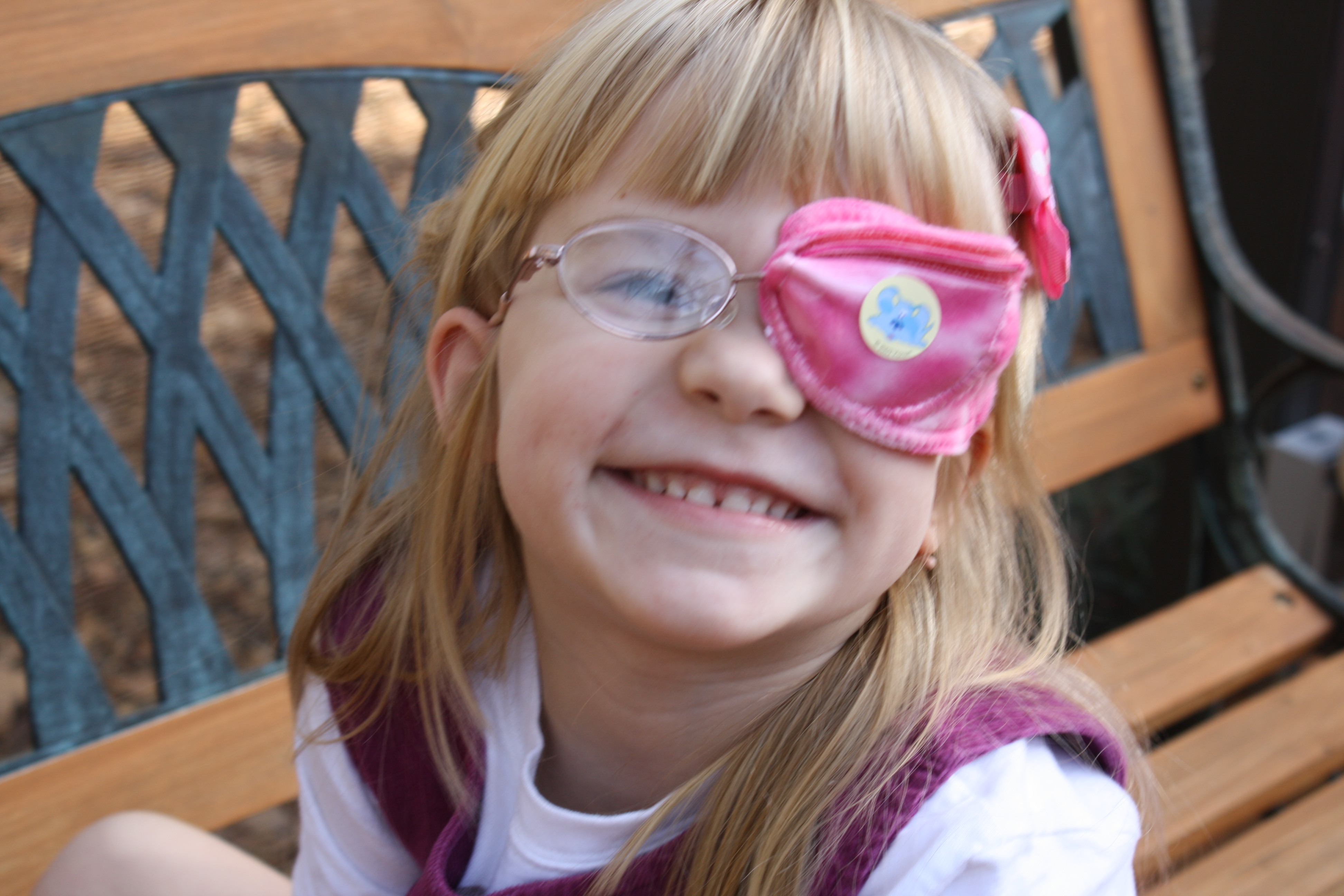
A new patch is always exciting in our house. Sometimes our sweet neighbor girls make my daughter one and leave it on our doorstep so they can be patching twins (she patches too) other times Camille at frame huggers sends us a new product she is trying out for our input. I guess it is one benefit to being a long time patcher.
Her latest trial is a sticker slicker… which is a soft patch with an extra vinyl piece to put a sticker on. Elly was extremely excited about putting stickers on it, although I can see a little goo build up as we are a little sticker happy at this household. All in all, we gave it a seal of approval. Besides, who can resist an adorable little girl with a hot pink patch!!!!
To see all of her products, visit https://www.framehuggers.com/index.htm and if you need something for your glasses or have a specific patching request, she is very talented, creative, and dedicated to helping our little ones, so just send her an e-mail.
A couple of quick things. We’re trying to get our house ready to put on the market (we’re just moving within the same city, not across country), so I finding I have less time to write for the next few weeks. I’m also finding about a thousand of those lens cleaning cloths, but that’s a different story. While I always love to get your stories and posts, now I’m going to send out an extra call. I’d love any posts you’d like to write – the story of how you found out your child needs glasses; a tip or strategy that’s worked for you; a book review; a question; etc. Email me ann@shinypebble.com.
Second thing, a group called Eye Care for Kids is currently in the running for the Pepsi Refresh Project, which awards $250,000 to the top two vote-getting ideas. Eye Care for Kids provides serves visually impaired, low income children in the state of Utah, USA. They would use the money if they won to provide 4,000 kids in Utah with free eye exams and glasses. You canvote for their project every day until Feb. 28. It does require that you login with your email address, or a facebook account.
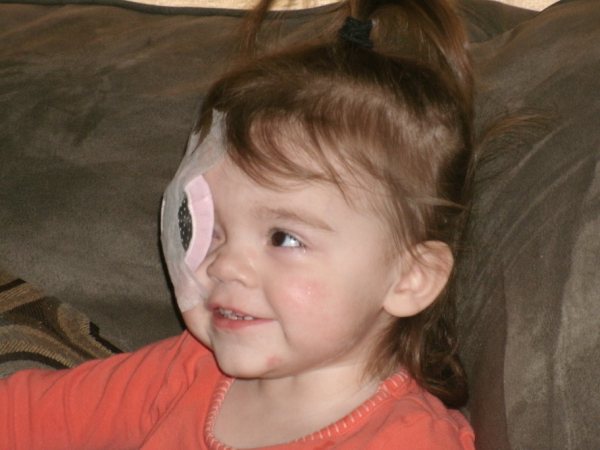
I have been avoiding little four eyes because we have been having a tough time with contacts and patching. As Mia gets older, the stronger she gets, not only with physical strength, but with mental strength and stubbornness. She is my little firecracker and she does not like having her vision taken away. She has become crafty with her contact lenses and has learned how to remove them, or a new trick where she puts her finger on her occlusion lens and slides it to the corner of her eye. It must be very uncomfortable, however she chooses to be uncomfortable in order to see. Mia’s vision without correction is 20/1300 so she is legally blind in her right eye; and with correction she is 20/360. I compare her vision with someone that is blind, so when she is patched I am literally stealing her vision and expecting her to function and move around like she can see; which she can’t. I understand that patching will increase her vision, however the time it will take to regain vision in her right eye is torture to her.
Mia after her glaucoma surgery
During an exam under anesthesia 2 months ago, we found out that Mia’s glaucoma returned. She had valve surgery 3 weeks ago and everything went really well. As usual she was starved when she woke up and wanted her juice and crackers, and to get the hell out of the hospital; saying “bye bye” every few seconds. Since Mia is so strong willed about having anything on her face, we purchased soft splints for her arms to prevent her from removing her eye shield and bandages. She hates the splints and learned very quickly to keep her hands away from her eye or they will go back on. It broke my heart that she does not even realize that her right eye is covered; which means she is pretty much blind in this eye. She is walking around like normal, not even skipping a beat. It kills me, it makes me feel like I have not done everything in my power to prevent her right eye from going blind. I am sitting here crying as I type thinking, how and why. This has been such a hard and devastating road that we have traveled. But I hope and pray that it is not to late to save her vision. Sometimes I think about the choices we have made; what if we decided to do nothing when we were informed about her cataract when she was 12 days old. Yes, she would have gone blind in her eye, however she would not have to endure surgery after surgery, or nystagmus, amblyopia, exotropia, glaucoma, patching, glasses, contact lenses, eyes drops, ointments. My father always says “you make the best decision based on the information you are provided with, that is all you can do”. But this does not make me feel like the decisions we have made were the right decisions, or even the best decisions. Mia is only 20 months old and she has had to endure more than most people during her short 20 months of life. I just wish I could take it all away, that I could be the one going through all of this rather than her. I am sorry that this post is so pessimistic, I am just having a difficult time and I need to get this off my chest and this is the best place for me to vent, you all know the pain I am feeling.
We are planning to use her arm splints to help with patch time. I just hope that we have not lost all that we have worked so hard to save.
To all the parents that are faced with surgery, it is hard, the hardest situation you will ever be placed in, and going in the operating room to assist with putting your child under is the hardest part. I have done this 4 times and it does not get any easier.
I have attached a few pictures of Mia. I hope everyone is doing great, and you all had a wonderful Christmas and/or holiday season.
There’s been a few questions posted at the Little Four Eyes facebook group about where to go to get glasses, especially when local stores don’t have a good (or any) selection of very small frames. So where did everyone get their child’s glasses? Independent optical shop? Chain optical shop? A big retailer like Wal-Mart or Target? Did anyone have a shop order frames special for their child? Anyone order frames online and bring them to a shop?
We went sledding this weekend, which was a lot of fun up until the final ride when she fell off the sled and ended up getting snow pushed up between her glasses and her eye. Ouch and brrrrr, Zoe was really – understandably – upset. Miraculously, the glasses weren’t scratched.
~ ~ ~
After a walk yesterday (it was a balmy 12° F/-11º C), we came in and Zoe said, “oh, my glasses are getting really dirty.” They were fogging up, the bane of every bespectacled person during the winter. It was the first time she’s ever mentioned it, the first time she’s ever said anything about her glasses getting dirty.
~ ~ ~
This morning I asked Zoe which glasses she wanted to wear. “My princess glasses!” she said. When I asked which ones were princess glasses, she said she had 2 pair of princess glasses, her Sleeping Beauty glasses (the blue ones), and Cinderella glasses (the red ones). She’s wearing Sleeping Beauty glasses today. I have no idea where she came up with this, but I’m going with it!
Anne from Is this a boardinghouse or something? just sent me a note with some great news. Her son, Alex – now 9 years old, has worn glasses since he was 3 1/2, and has struggled with amblyopia for years. From her post:
Over the years, we patched, dropped, argued, bribed & begged. We had sticker charts, bought webkinz and occasionally sat on him to get him to wear the patch. …. The Atropine changed Alex’s personality and sometimes gave him nightmares. When he started school, his vision was so bad he qualified for special education funding; he had special paper with black lines…
On Tuesday, they learned that all of their hard work with patching, dropping, begging and bribing paid off. Alex has gone from being legally blind in his right eye, to having 20/40 vision, and has been released from monthly visits to the eye care clinic.
I encourage everyone to read the full post, it’s a great story of why patching is worth the effort and the tears.
I was just sent this question, and have no experience with this, so I thought I’d see if anyone else had dealt with this:
My daughter has been crossing her right eye for about six months and it is getting progressively worse. We finally got in to the children’s hospital and the doctor was shocked to find that the eye she is crossing is her stronger eye. Essentially she is favoring her weaker eye. Do you know of any other parents whose children did this? The doctor said it made no sense.
Just today I ran across a couple of different cases of Nickelodeon characters wearing glasses or going to the eye doctor. Maybe Nickoledeon is a big
First, Ann W sent me a link to the book The Eye of the Fry Cook: A Story About Getting Glasses (Spongebob Squarepants). It’s a Spongebob Squarepants story about needing and getting glasses. Apparently, the reading level is for 9-12 year olds, but I know we’ve got some smart kids, and if your child loves Spongebob, it may be worth checking out.
printable put the glasses on the character game – like pin the tail on the donkey, but with less pinning, thankfully, who wants their child to think you have to pin their glasses on? (featuring Pablo, YeYe, Walden, and Uniqua – I have to admit, I don’t know who any of these characters are, Zoe could probably tell me, though).
I love the stickers, and the put the glasses on game could be fun, especially if you threw a party to celebrate your child getting glasses. The printable eye charts kind of bother me, because they really aren’t any kind of real eye chart (and they don’t claim to be), but it could be a nice way to introduce the concept of eye charts to your child if they’ve never done that before. The eye exam flash cards go over some of the different things that happen at an eye exam. I’m not sure how much Zoe would enjoy something like that, but again, it may be a nice way to explain what will happen to a child facing their first eye exam.
In any case, it’s nice to see Nickelodeon creating fun games and activities around glasses and eye exams. I wish that some of the characters stayed in glasses, though. As far as I can tell, the characters that are wearing glasses in these print outs don’t wear them on a regular basis. Ah well. I’ll take what I can get.
Edited on 26-Jan-10 to correct the errors that Dr. Bonilla-Warford pointed out (thanks Nate!) – Ann Z
Glasses prescriptions can be confusing – lots of numbers and abbreviations that aren’t necessarily easy to figure out, or at least, they weren’t when I first tried to understand Zoe’s prescription. And in fact, I thought I understood what all the numbers meant, but after doing more research for this post, I found it to be far more complex than I’d originally thought. (On that note, if any eye doctor types read this and catch any mistakes, please, please let me know and I’ll correct them).
Before we get too far into what a prescription is, I thought it might be worthwhile to mention what a prescription isn’t. It will not tell you:
what your child’s diagnosis is. You can tell whether glasses will correct for nearsightedness or farsightedness, but that doesn’t tell you what the cause of the vision problem is.
your child’s visual acuity, that is, how well your child sees (either with glasses or without them).
if your child has strabismus, it will not tell you how much his or her eyes are turning in or out.
how well your child’s eyes work together, and whether or not he or she has stereoscopic vision.
how advanced your child’s cataracts or glaucoma is, and how that affects their vision.
anything that is not related to how glasses or contacts should be made in order to correct your child’s refractive errors (that is, due to the shape of the eye not being able to focus light correctly).
Okay, so back to the eyeglasses prescription then, and what it can tell you. Prescriptions have a lot of different components, and I’ve seen them written a number of different ways, but they do have common elements at the core. I’ll go into more detail on each piece, but I tried to put together something of a “cheat sheet” here:
Which eye are we talking about?
Since we’re nearly always looking at prescriptions for two eyes, you’ll nearly always see two sets of numbers, one for the left eye, and one for the right. I’ve seen some prescriptions that label them “left” and “right” or “l” and “r”, which even I can figure out on my own. But more often, I’ve seen “O.D.” and “O.S.”. These are abbreviations for the Latin words for left eye and right eye. For the record:
O.D. : right eye
O.S. : left eye
O.U. (which I’ve never seen before, but found this information so figured I’d include it) : both eyes
Sphere
Sphere, often abbreviated as “sph” is the spherical refractive error, or nearsightedness or farsightedness. The first part of this number will be a plus or minus sign:
+ : farsighted, or longsighted prescription: hyperopia.
– : nearsighted, or shortsighted prescription: myopia.
0, Pl, or Plano : no error
How strong is the spherical prescription?
The number is in “diopters” but we don’t need to know too much about that (read about it on Wikipedia here), it’s a measure of how much the curvature of the eye is off from normal. Basically, the higher the number (ignoring the plus or minus), the stronger the prescription.
Myopia (-)
0.00 to -3.00 : mild myopia
-3.00 to -6.00 : moderate myopia
-6.00 and higher : high myopia
Hyperopia (+)
0.00 to +2.25 : mild hyperopia
+2.25 to +5.00 : moderate hyperopia
+5.00 and higher : high hyperopia
Cylinder
Cylinder is the measure of astigmatism. Astigmatism is when there’s an irregular shape to the cornea, often described as an oval shape (if you’re in the US, think the shape of a football, if you’re other places, think the shape of a rugby ball). It causes blurriness at any distance. There are two measurements that go along with astigmatism, the first, cylinder, is a measure of how severe the astigmatism is.
How strong is the cylinder prescription?
Like the spherical error, the cylinder number is measured in diopters. The thing you want to pay attention to is the number. The higher the number after the plus or minus, the more severe the astigmatism.
0.00 to 1.00 : mild astigmatism
1.00 to 2.00 : moderate astigmatism
2.00 to 3.00 : severe astigmatism
3.00 and higher : extreme astigmatism
Note: The cylinder may be written as a plus or a minus, but that doesn’t actually make any difference in how bad the prescription is, ophthalmologists use a “+”, optometrists use a “-“. You can use an online cylinder conversion tool or convert on your own by 1) adding the cylinder power to the sphere power; 2) Changing the sign of the cylinder:- if +, then use -, if – use plus; 3) Add 90 degrees to the axis if it’s less than 90 or subtract 90 if it’s greater than 90.
Axis
The axis tells you which way the astigmatism is oriented on your child’s eye
If you think of astigmatism as an oval shape, it makes sense that the oval might be turned any direction. The axis number then, tells you the orientation of the astigmatism. The number is in degrees, it doesn’t have anything to do with how severe the astigmatism is, just how it is situated on your child’s eye.
Add
If your child needs bifocals, you will likely see a number here. This tells you how the prescription should be changed for close up. Let’s say your child has a regular glasses prescription of +3.00, if the add number is +1.00, then the near distance prescription will be +3.00 + 1.00, which equals +4.00 (3+1=4). In the same vein, if your child is nearsighted, say -4.00, but has an add of +2.00, then the near distance part of the bifocals will have a prescription of -4.00 + 2.00, which equals -2.00.
Sometimes, you don’t have an “Add” part of the prescription, and instead you’ll just see a prescriptions for distance vision and a separate prescription for near vision.
But what does that mean for how my child sees?
If you’re wondering what your child’s prescription means in terms of how they can see, there are a couple of places online where you can plug them in to see how blurry things appear. Keep in mind that an eyeglasses prescription is not the final word in how well a child sees. For instance, it will not tell you how your child’s weak eye is seeing if your child has amblyopia, or how your child might be seeing if he or she has cataracts or glaucoma.
When we took Zoe in for her first eye exam, I was still a bit in denial that there was any problem at all. Add to that Zoe’s meltdown by the end of the exam, and I really wasn’t prepared to ask any questions of the doctor. At her second appointment, the one in which she was prescribed glasses, I shouldn’t have been surprised by the outcome, but I was. And again, I was completely unprepared to ask any questions, except for “where on earth will we find glasses for her?” Luckily, Chris was with us at both appointments, and was able to ask some good questions, and more importantly, pay attention to the answers.
So here, are some questions I can think of, that I wish I’d asked. For those of you that are experienced at this sort of thing, what other questions do wish you had remembered to ask, or which questions you’re really glad you asked?
What is the name of the diagnosis for my child’s vision problem? Can you spell it for me? Or can you write it down for me? (suggested by Jodi)
Do you have any recommendations for placed to go for more information on this?
If I have more questions at a later time, can I get a hold of you to ask them? What’s the best way / time to do so?
When should we make another appointment for my child?
Are there things I should watch out for between appointments? Should I bring my child in if I see those, or just call?
If my child requires equipment (glasses, patches, etc), do you have any recommendations for where I could go to get these?
Do any of my child’s relatives need evaluation? (Many conditions run in families and it can be beneficial to evaluate siblings and parents in some cases). Suggested by Dr. Bonilla-Warford.
There’s been a lot of news about myopia (nearsightedness) recently, much of which I thought might be of interest to some of you.
In December, the results of a large survey were released in the Archives of Ophthalmology. The findings were that the number of nearsighted people in the United States (age 12 – 52) has risen by 66% in the last 30 years (abstract here).
The reason for this increase is the subject of quite a lot of discussion and debate. Just last week, NPR (National Public Radio) ran a story on one of the investigations into the cause. While genetics certainly play a role, it appears that time spent outside is another big factor. One study found that children who spend 14 hours per week outside see a dramatic reduction in the risk of becoming nearsighted. And the outdoors part seems to be the key – children who get plenty of exercise indoors don’t see the same benefit. And perhaps even more surprising, the amount of time reading or doing other close-up activities doesn’t seem to make a difference in how likely a child is to develop myopia. You can read or listen to the full NPR story here.
One final recent report, this one on the topic of the progression of nearsightedness in children – the tendency for some children’s nearsightedness to get worse over time: Archives of Ophthalmology just published the results of a 2 year study of nearsighted children age 8-13 years old who had seen significant worsening of their myopia in the previous year – their prescription changed by at least 0.5. The study looked at whether prescribing bifocals instead of single focus glasses made any difference in how much their prescription changed over 2 years. In all of the cases, the prescriptions worsened over the 2 years, but for children who wore bifocals or prismatic bifocals, their nearsightedness increased less (the progression was reduced). The children with prismatic bifocals saw the least amount of worsening. The authors of the study caution that prismatic bifocals should not be prescribed to all nearsighted children, and it remains to be seen if the bifocals continue to control the progression of nearsightedness past the 2 year window. Nonetheless, the research is promising. You can read the full study here.
Many thanks to Dr. Bonilla-Warford at Bright Eye News and Dr. Maino at Mainos Memos, their blogs first pointed me to these reports.
In a funny coincidence, my dad happens to have a model of one of the ORBIS International Flying Eye Hospitals sitting on his desk.
Wanted to post quickly a big thank you to everyone who participated in the Delurk for Sight week. I hope you’ll all continue to post comments, and submit your stories and pictures of your children.
The final tally was 57 comments and 5 photos, which brings us to $67 donated to ORBIS International.
Is there any way to find out if your child is color blind? Everett is now 2. He can count to 10 in Spanish, he knows his shapes, all kinds of things…but he doesn’t know his colors. It’s really bad – he doesn’t know hardly any of them and it seems like that is one of the first things they learn. I don’t know if there is a test for kids his age so we stop pestering him all the time, or if we just have to wait and see.
From what I could find online, most children are tested at 4 years old. Has anyone had their child tested earlier?
Zoe’s 3 and well into the “why” stage of life. “Why it’s called ‘breakfast’?” “Why it is snowing?” “Why I can’t wear a dress and a skirt at the same time?” And recently, “why he (or she) doesn’t wear glasses?” (Her word order for asking questions isn’t quite right, but I find it kind of charming.)
"why?"
Sometimes it seems like the only question she hasn’t asked yet is “why do I wear glasses?” I think that starting glasses at 14 months, plus having family who wear glasses, it just hasn’t ever occurred to her that there was even a possibility that she wouldn’t wear glasses. And I’ll be the first to say that we’re very lucky in this regard, and I am not complaining about that.
But I’m still struggling with answering why someone else doesn’t wear glasses. I often find myself using analogies when I try to explain things to her, but I haven’t found a good one to explain glasses. I don’t like telling her that other people have “better” eyes, even if that is essentially what’s going on, because she has the most beautiful grey-green-blue eyes I’ve ever seen. I can’t think of any eyes that are better.
I end up trying to explain that other people don’t need glasses to help them see, but that never seems to quite satisfy her. Then again, she’s 3, and none of my answers to her “why” questions seem quite good enough. Have you explained glasses to your child? Any explanations that seemed to work especially well?
 one and leave it on our doorstep so they can be patching twins (she patches too) other times Camille at frame huggers sends us a new product she is trying out for our input. I guess it is one benefit to being a long time patcher.


 . It’s a Spongebob Squarepants story about needing and getting glasses. Apparently, the reading level is for 9-12 year olds, but I know we’ve got some smart kids, and if your child loves Spongebob, it may be worth checking out.


 For Little Eyes