I mentioned in my review of Fixing My Gaze, that I had two copies of the book to give-away, so here’s the details.
If you’re not sure what the book is about, Fixing My Gaze, by Susan Barry, is an autobiographical account about the author’s experiences growing up and living most of her life stereoblind, and then later in life regaining her stereovision through vision therapy. Barry provides a fascinating look in to how the brain works and how it is that we see, along with the interesting story of how she learned to see in three dimensions. Check out my full review for more details.
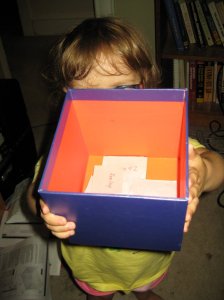
Ok, so if you’d like to be entered in a drawing for a copy, all you need to do is leave a comment on this post. I will do the drawing on the evening of Sunday, August 23. On that evening, I will put all the entries into a bowl, and let Zoe draw two names. This giveaway is open to anyone, anywhere in the world.
If you’d like more chances to win, you can also do any or all of the following – each item is worth one extra entry – NOTE: you must first comment on this post to be entered:
Print up 5 of our coloring pages and take them to your eye doctor or eye glasses shop. Leave me a comment on this post to let me know you did that.
Send in your child’s photo for our photo gallery to ann@shinypebble.com. If your child is already featured in the photo gallery, just mention that in your comment.
Write up your story of your child getting glasses, for our in the beginning… category (or if you’d prefer, you could write about a different aspect of your child and their vision), and send it to ann@shinypebble.com. I will post these stories from time to time on the blog. It doesn’t need to be a long story, I just think it helps everyone to hear each other’s stories. If you’ve already written a post for Little Four Eyes, mention it in your comment.
Join the Little Four Eyes facebook group. Again, mention it in your comment.
Add a Little Four Eyes badge to your blog or website, and let me know in your comment that you did that.
Update — Thank you to everyone who entered! I wish I had enough books to give one to each of you. Zoe helped me with the drawing tonight…
we put everyone's name in a box - with extra entries for anyone who qualified. Zoe insisted on having her name in there, too. I figured I'd just have her pull another name if her's came up.Janet was the first name pulledLarry was the second name
Congratulations to Janet and Larry! I’ll email you with details.
Fixing My Gaze: a scientist’s journey into seeing in three dimensions (find it at a library | buy it from Amazon.com), is an autobiographical account by Susan Barry about her experiences growing up and living most of her life stereoblind, and then later in life regaining her stereovision through vision therapy. While that may sound a bit dry, Barry provides a fascinating look in to how the brain works and how it is that we see, along with the interesting story of how she learned to see in three dimensions.
Barry had infantile strabismus (strabismus that develops before 6 months of age), and had undergone numerous strabismus surgeries as a child, leaving her eyes straight, but with no binocular vision. Her descriptions of life without stereovision were probably the hardest parts of the book for me to read, and I expect that’s likely to be true for any parent of a child with monocular vision. I kept wanting to believe that those parts of the book were exaggerated to make for a more compelling story, and I still don’t much like dwelling or re-reading those parts. Vision is quite a personal thing, and different people adapt differently to things like stereoblindness, so I asked my mother, who is also stereoblind, about some of Barry’s stories, and was surprised to have them confirmed, though my mother’s problems are not as severe as Barry’s despcriptions. Like Barry did, my mom does have trouble reading signs while driving and finds it difficult to navigate in unfamiliar settings. On pages 58 and 59, Barry recounts how her stereoblindness led to her driving difficulties.
. . . I paid attention to the input from only one eye at a time. I switched rapidly between the two views, which made my world unstable or jittery, particularly when looking out in the distance. Not surprisingly, I was a pretty lousy driver. . .
“How far in the distance are you looking? he [Barry’s husband] asked.
“I don’t know. Maybe one or two car lengths ahead of me.”
“That’s what I thought,” he said. “Try looking much further in the distance.”
But looking in the distance was unnerving. I felt disoriented, unsure of my location in space. I felt like the car was drifting off the road.
But the book is not just made up of Susan Barry’s story alone, and that is one of the great strengths of this book. The author strikes a very readable, and much more interesting balance between explaining the neurobiology behind how it is that we see, how the field of vision science has developed, and anecdotes from her own life and others who have had similar experiences.
Barry shines when she is giving us the science behind our vision, particularly how it is that we see in three dimensions. Even more intriguingly, she discusses her thoughts on how the brain can rediscover it’s binocular vision pathways in adulthood, something that had been thought to be impossible. Her professional background, as a professor of neurobiology is so apparent in these sections. She is clearly practiced in explaining such complex concepts in a very understandable and engaging way. My understanding of vision is so much more enriched from reading this – her students are lucky! Her descriptions of the history of vision science, and how we have arrived at our current understand of vision and vision treatments are similarly interesting and well-presented. She has done her research, and leads the reader deftly through what must have been pages and pages of articles. She specifically focuses on strabismus and amblyopia (those being the most common reasons for loss of stereovision).
The other highlight of the book are the almost lyrical, and sometimes quite funny, descriptions that she gives of her first encounters with stereovision after starting her vision therapy treatments, from page 123:
When I gained stereopsis, I felt like I was immersed in a medium more substantial than air, a medium on which tree branches, flower blossoms, and pine needles floated. I wondered if this sense of the air was what Monet spoke about in the quote at the beginning of this chapter: “I want the unobtainable . . . I want to paint the air.
After reading those passages, I found myself staring more intently at the branches on trees, noticing how the leaves and twigs stood out from one another, and truly appreciating my ability to perceive the spaces between them. This book would have been worth it just for my newfound gratitude in my sight (though I appreciated much of the rest of the book).
At times, some of the anecdotes, particularly those from other people who have had their similarly stereovision restored, read like advertising testamonials for vision therapy, which dragged the book down. Thankfully, these sections were short, and they did serve the purpose of making the point that her experiences are not unique. Barry also refrains from wholesale denouncing Ophthalmology or surgery as an option for some forms of strabismus, though she calls on them to update their assumptions about the possibilities for treatments later in life. The most hopeful passage of the book for me is from page 151:
While the best approach may vary from patient to patient, one basic principle needs to change. The brain may be more plastic, more responsive to treatments in infancy, but this period of high malleability does not exclude the possibility that improvements can occur later in life [emphasis mine].
I would recommend this book to any one who is interested in vision, or in stories of the wonderous ways in which the brain can adapt and change. I would especially recommend this to parents of children with strabismus or amblyopia, as it provides well-written insights to our children’s vision. If you are one of those parents, though, do keep in mind that some of passages may be difficult, particularly if your child has not developed binocular vision.
Full disclosure: After hearing about this book from many different sources, I ordered the book from my library to review. When I was about two-thirds of the way through, I noticed an email offering me a free copy to review. I responded to the email saying that I was already reading the book, but would love to have a copy to give away to my readers. I was sent two copies to give away, and one copy to keep for myself. I do not believe that that has colored my review of this book, but I feel it’s important to be open about these things. Also, she thanked a couple of librarians in her acknowledgements, and as a librarian myself, I have a very soft spot for people who thank us. That may actually have colored my review more than the free book (actually, I don’t think it did).
Book Give-away: As mentioned above, I’m be giving away two copies of Fixing My Gaze, all the details are in my give-away post.
This came in from Anne at Is this a boarding house or something? Her son Alex had eye surgery when he was 7 1/2 for strabismus and amblyopia. This is the poem that he wrote a month after the surgery. All of the original spelling has been preserved. I really love the cadence and rhythm that Alex sets up in this poem. It took me back to some of my fears when Zoe had her surgery. -Ann Z
My Surgery by Alex
scared
to
deth
almost
crying
eye
turned
haert
beting
fast
operaiting
room
talking
asleep
stiches
eye
straiter
happy
Alex before the surgeryAlex after the surgery: "eye, straiter, happy"
So much stuff! I just got an influx of all manner of things for you all – it just all kind of accumulated at the same time.
Coloring Page!
Amomofelly has made a new colorpage! In response to requests, this one features a boy with glasses and a patch. It’s one of the thick-lined coloring pages, which makes it a great page for kids to color while they’re patching. Click the picture to download a pdf of the coloring page that you can download and print out! Also check out all of our other coloring pages on our Gear page.
~ ~ ~
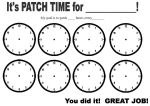
daily patching chart
Patching Charts!
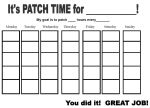
Amomofelly also made two patching charts for kids to use to keep track of their patching goals. There are two charts, one for daily patching (color or use stickers to fill in the clocks for each hour of patching), and one for a week of patching (color or use stickers to fill in boxes for each day). Amomofelly wrote the following about how they use the patching charts:
I will say they don’t work for all kids all the time, but may give a needed boost if patching is just starting out or they hit a rough “I don’t want to patch” time. I would have Elly color the clocks in with crayons or marker. The weekly one can either be colored in, or you could put stickers in the boxes. Since we are on 10 hours a day patching, I would just make each box worth 2 hours of patching.
weekly patching chart
Some great rewards for meeting goals are; tons of hugs and kisses, trips to a special place, getting to choose their favorite meal or snack for dinner, movie night, small toy, having a friend over for a playdate, game night and much more. I prefer fun times vs fun toys as they create more memories =)
You can also download the patching charts from the Gear page.
~ ~ ~
Blog Badges
If you have your own blog, now you can support and link to Little Four Eyes with one of our blog badges. Nicole from GrudgeMom (whose daughter Penny is in our photo gallery, and who also writes Carrots make you blind?!?!) created 7 badges for you to choose from, using the art by Scott Donaldson that’s featured on this blog! Five of the badges are specifically for those of you who have submitted a your child’s picture to the photo gallery. Visit our badge page to see all of the choices and to pick up the code to add a badge to your blog or website.
~ ~ ~
Book Giveaway
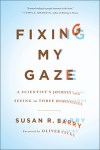
I am most of the way through the fascinating book “Fixing My Gaze: A Scientist’s Journey Into Seeing in Three Dimensions” by Susan Barry. The author is a neurobiologist who had infantile strabismus and never developed binocular vision until late in life when she started doing vision therapy. Barry explains vision and vision development in a very readable, and extremely interesting way. I will be writing up a full review of the book soon, and have two copies of the book to give away as part of National Vision and Learning Month (August). Watch for the review and details on how to get a copy of the book.
We found out on Monday that our 2 year old needs glasses. I was hoping to post a question to the blog, but not sure how I go about doing this. I’m wondering if parents have had any experience with Crizal Scotchgard lenses. Supposedly, they help cut down on scratches, smudges and dust, and glare. The optician’s other main selling point was that you will not see the glare in photos you take of your child. However, they’re also about an extra $180 and I’m not sure its worth the money. Any help would be much appreciated.
UPDATE: The vast majority of comments coming in appear to have nothing to do with children’s eye glasses. I am closing the comments. If you have something to add from the perspective of a parent purchasing glasses for your child, you can contact me, and I’ll add the comment (ann @ shinypebble . com)
I know that we all want the best for our kids. We are lucky to have such a great Opthamologist and a kid that has some vision (just not the greatest) AND the potential to make her eyes stronger.
BUT, it is hard to watch a toddler in the examination room each month struggling to see the large letters on the eye chart.
It is hard to place a patch every morning on her “good eye” and take away her vision.
It is hard to look at her alligator tears when she is trying to convince us to keep the patch off for just 5 minutes so she can see.
It is hard to watch her run into walls and fall off playground equipment.
It is even harder to hear that her vision is decreasing.
For the past 3 months, our daughter has not had the greatest visits. For the first 2 of the 3 visits, the staff thought maybe we were just catching her on bad days or on her silly moods… but I knew better. Last week we were given the news that she needed another prescription change and is now up to -8.5 in her right eye and -1.5 in her left. Was the 10-12 hours of day of patching not helping??? No, it is helping because both eyes are getting worse together. Her nearsightedness is getting worse because she is growing and will unfortunately continue to get worse.
I am getting better at holding it together until I get home from appointments and can remove myself from her view. I really need to be positive for her. But behind the closed doors, I cry. I cry because I want the best for my child. I cry because I want her to have every opportunity in the world. And I cry because I feel helpless.
Then it’s time to open the door and face reality; I get to work. I called the vision specialist. Because Elly’s vision is doing the opposite than we had hoped and we are patching full time, they are going to qualify her for temporary vision services. Additionally, the OP said that she is sending a referral to occupational therapy as it may help strengthen the eye – so I called to schedule an initial appointment. And last, but not least, I put a smile on my face, thankful of all the joy my daughter brings to my life and for all the opportunities she will have because we have caught her vision issues at such a young age.
When people ask what Zoe’s vision is, they’re normally expecting to hear her visual acuity – usually given as 20/20 or the metric equivalent 6/6 – and then they want to know how she compares with other children. I don’t actually know what her uncorrected acuity is, but I was curious about what you might expect a preschooler’s acuity to be.
Visual acuity is the measurement of how clearly we see at a specific distance, usually 20 feet or 6 meters, though that can vary. It is generally tested in adults with the well-known Snellen eye chart (the one with the big E on top) and with a variety of charts for children. The acuity is usually presented as two numbers that indicate how close a person will need to be to an eye chart to see the letters or symbols clearly, compared to what a person with “normal” vision would see. Let’s say my uncorrected visual acuity is 20/200 – that’s 6/60 in metric – (which it is, more or less, in my right eye). That means that I have to stand 20 feet – or 6 meters – away from the eye chart to read the big E. A person with good vision, on the other hand, could see the E at the top of an eye chart from 200 feet – or 60 meters – away.
It’s worth keeping in mind that visual acuity is not the whole picture (so to speak) when it comes to measuring vision. Visual acuity does not indicate how well the eyes work together, or peripheral vision, or even what the prescription needs to be to correct vision.
For adults, it’s pretty easy to look at the acuity numbers to see how good your vision is: if the first and second numbers are the same, 20/20 or 6/6, that means normal visual acuity. If the second number is smaller than the first, you have better than normal acuity, and if it’s larger than the first your vision is poorer. But for young children, it’s not quite as straight forward. Because children’s vision hasn’t completely developed, a child can have “normal” vision that is worse than 20/20.
In 2003, the American Academy of Pediatrics adopted a policy on Eye Examination in Infants, Children, and Young Adults by Pediatricians. According to those standards, pediatricians should refer any child under the age of 5 with a visual acuity of worse than 20/40 – that’s 6/12 in metric – to an eye doctor. At age 6 and older, they should refer any child with acuity of 20/30 – 6/9 metric – or worse.
More recently, though, a study called the Multiethnic Pediatric Eye Disease Study looked at visual acuity norms in preschool children with the goal of gaining more accurate visual acuity norms for children. The results were published in Optometry and Vision Science in June 2009 (abstract and full citation). They measured the visual acuity of 1,722 children ages 30 to 72 months with no significant refractive errors – so kids that should have good vision. From those measurements they determined the threshholds for visual acuity that would include 95% of the children tested. That means that if the test were done by pediatricians and these guidelines were followed, you’d expect that 5% of children with no refractive error would be referred on to an eye doctor for a follow up. You’d hope that all of the kids with visual problems would also be caught with the testing and also be referred on to an eye doctor. That’s not necessarily the case, the researchers note that children who have “normal” visual acuity may still have visual problems, but that’s a topic for a different post. The nice thing about this study is that it breaks out the age range in to more detail, understanding that vision is still developing significantly in children between the ages of 2 1/2 and 6.
So, according to this most recent study, normal visual acuity for preschoolers may be better defined as:
I asked my friend, and poet Heather Tompkins to write a poem for Little Four Eyes (and Zoe) for Poem in Your Pocket Day (which is celebrated at the end of April). She did, and it was beautiful, but she wanted to polish it just a bit before I published it. So here, at last, a poem for all the little four eyes out there…
Little Four Eyes
(for Zoe G.)
Little trend setter, little go getter, little mud pie maker,
bake me a cake as fast as you can and
mark it with a Z.
Old Ben Franklin knew today is worth two tomorrows
What do you see through your spectacular spectacles,
fabulous glasses, and gorgeous frames?
Are they horned-Rimmed, solid gold, big bold plastic,
Coke bottle, Wire framed, Anne Klein, on a chain
Little bitty half moons, shades of bright yellows and blues
Rhinestones, tortoise shell, Jackie O
Sixty-four and more?
Puff the dragon, peeked out the backpack
wearing a pair of Cat’s Eyes that were to die
for, ready to play in the sea.
Pay no mind to what Dorothy said about passes
There is plenty of time for that later
Blend in, stand out, shake it off, make it work,
show them what it’s all about
It is not OK to take your glasses away
Except if you are swimming or sleeping but not
Baking, playing, catching, dancing, singing,
Running, dreaming…
When your child is wears glasses, the question of sunglasses can be complicated. We can’t just stop by the local store and pick up a pair of inexpensive kid’s glasses. Last week I asked for people’s experiences with the different options for sunglasses for kids with glasses, so here’s my round-up of the three options, as I see them (if anyone knows of any other options, please, please let me know): Clip-on sunglasses, Prescription sunglasses, Transition lenses
Why your child needs sunglasses
First, though, I want to touch on the need for sunglasses. When Zoe first got her glasses, the glasses shop asked if we wanted to add transition lenses to her glasses so they would act as sunglasses in the sunlight. It was December in Minnesota, the middle of winter, in Minnesota in December, it’s pretty easy to believe you’ll never see summer again, so we put off the question of sunglasses. That summer (this was last summer in 2008) with all of Zoe’s eye appointments and prescription changes and eye surgery, we never quite got around to getting sunglasses – not transition lenses, not clip-ons, not prescription sunglasses. I felt a little like we were already doing so much, I just couldn’t manage to think about one more thing to do with her vision.
I would NOT recommend anyone following our example from last summer. Sunglasses are extremely important to help protect eyes and they’re even more important for young eyes. Young eyes are more susceptible to UV radiation, and most people get the majority of their exposure to sunlight before they’re 16 (from the Eye Care Blog). Exposure to UV radiation is linked to lens and retinal damage, and your eye does not repair that damage, so the damage from sun exposure accumulates over time. Make sure that any sunglasses you purchase block both UVA and UVB rays (from Dr. Greene.com).
Clip-on sunglasses
Elly's glasses with a pair of clip-on sunglasses
Clip-on sunglasses fit over existing glasses, there are a number of different options for how they fit, but they often have “feet” that hold the tinted lenses on the glasses. How well they stay on depends on how well the fit to the glasses.
Price: Some clip-ons can run as cheap as $10, and can get more expensive from there.
Availability: Readers have found clip-ons at optical shops. You can also find some sold online. You’ll want to try them on your child’s glasses, and may need to have someone adjust them to fit better. If your child has particularly thick frames, or thick lenses, it may be difficult to find clip-ons that fit.
Advantages: An inexpensive option. You don’t need to worry about these not being comfortable in terms of the frames, since they fit on your child’s existing frames. If your child’s prescription changes, you probably won’t need to replace the clip-ons, unless the new prescription results in lenses that are too thick.
Drawbacks: Clip-ons may be difficult to find for very small children and babies, or for certain frame styles or lens sizes. Clip-ons are one more thing to keep track of, and it may be a bit of a pain to put them on and take them off when you’re going in and out. Clip-ons may not be as durable as other options as they can get easily bent (depending on their quality). If your child gets new frames that are quite a bit different, you may need to get new clip-ons.
Prescription sunglasses
Aubrie's prescription sunglasses from Zenni.com
Prescription sunglasses are simply an additional pair of prescription glasses with the lenses tinted. Like regular glasses, the price of prescription sunglasses will differ depending on the options you choose for the glasses.
Price: If you order from our optical shop, it will likely be a similar price as, or a bit more than, your child’s every day glasses. Many readers have purchased prescription sunglasses from online retailers such as Zenni.com for $20-$30.
Availability: Any pair of glasses can be made in to sunglasses with tinting. You can order prescription sunglasses from your favorite optical retailer.
Advantages: Prescription sunglasses allow your child to get the more “fun” sunglasses look for outside. Most people will not realize your child is in prescription glasses when they’re wearing prescription sunglasses. You can get the sunglasses to provide better protection for your child’s eyes by getting larger lenses. If your child breaks their primary glasses, you can, in a pinch, use the prescription sunglasses as back up.
Disadvantages: Prescription sunglasses are one more pair of glasses to keep track of, and clean, and maintain, and adjust. Switching from glasses to sunglasses to regular glasses again can be a bit of a pain. If your child’s prescription changes significantly, you’ll probably want to get a new pair of prescription sunglasses (though if the change is minor enough, you might be alright with the older prescription).
Transition lenses
Emma in her glasses with transition lenses on a sunny day.
Transition lenses are a type of tinting that is applied directly to the lenses that will darken in sunlight, turning regular glasses in to sunglasses.
Price: The price of the transition tinting runs around $85 – $100. If you need to replace the lenses for any reason (scratches, prescription changes) you may need to pay the additional transitions tinting when you replace them.
Availability: Any pair of glasses can have the tinting applied.
Advantages: Nothing additional to keep track of – no switching of glasses or putting on/taking off of clip-ons. The glasses will darken and lighten according to the amount of sunlight.
Disadvantages: Some people have complained about the glasses not darkening sufficiently in cars because the car windows already block out UV rays. The costs can add up if you’re replacing lenses often.
~ ~ ~
Thanks to everyone for all the feed back that made writing this much easier. Please share any other experiences in the comments! And enjoy the sunshine.
This question came in from Nicole, whose 6 month old, Penny, wears glasses because of congentital cataracts.
I need a little bit of help. The last few days or so, I cannot get Penny to keep her glasses on. I can distract her for a few minutes, but as soon as I turn away, she pulls them off. If she tries to pull them off and I stop her, she tries to rub her eyes through the lenses. I’m getting very frustrated, and leave them off as a result. And I do see her weaker eye wandering because of leaving her glasses off.
With a very active 6-month-old, I just don’t know what to do. I’m going to call her PO tomorrow and see if they can squeak her in for a prescription check to see if it hasn’t shifted majorly again.
Anyone here had a young one who wore glasses just fine, only to all of a sudden start refusing to wear them? Any advice for Nicole?
This came in as a comment from Danielle, but it deserves it’s own post. The video is a day brightener that brought tears to my eyes, too -Ann Z
Hello, I could not start a new post, however I wanted to share this news clip with everyone. It’s a school that has blind/visually impaired children in the same classroom as children with normal vision, learning together. It brought tears to my eyes.
Annie brought up this topic on the Little Four Eyes facebook group. -Ann Z
How many of us Little Four Eyes parents have had to attempt to fix glasses until new ones come in? We just ordered Aubrie’s new prescription & her backup pair broke. She’s rocking some serious duct-tape on her temple until the new ones, and the backup replacements come in. Usually we ALWAYS have backups, but her 3rd pair are just way too small and she said they hurt. Anyway, I figure I can’t be alone. I felt absolutely terrible sending her to a library program around all her peers in duct-tape, but hey what can you do until they have your new ones ready? I’m just glad she’s 3 and doesn’t realize she’s rocking the duct-tape…if it happens again in Jr. High I’ll be doomed!
I know for a fact that Annie isn’t alone in trying home repairs. So, what kind of glasses repairs have you had to do? Duct tape? Rubber bands? Anything work particularly well – or not well at all? We’ve only tried to repair Zoe’s glasses once, and that was pretty close to a failure (she refused to wear them with the electric-taped ear piece). Thankfully her new glasses arrived the next day!
Ann has created such a great resource for parents just starting out with glasses, I would love to create a similar resource for parents just starting out with patches. Although we have been patching for almost 2 years and now for 10 hours each day, I don’t have all the answers and I would like your help for coming up with advice for parents just starting out with patching.
How to begin
Keeping the patch on
Finding the right patch
How to stay positive
Other people’s reactions
Pictures of your kids with their patch on!
Please post as much as you can below or send me an e-mail at ajrenchin@yahoo.com and I will begin to compile all the parent advice into one post!!!!!
Alright, so reading the comments recently, it sounds like we’ve got a number of people with different experiences with the different sunglasses options. I’d like to write a round-up post that talks about the pros and cons of the different options: transition lenses, prescription sunglasses, clip-ons, (am I missing any other options? I suppose you could do non-prescription sunglasses.). So this is where you come in. If you’re child is using one or more of these options for sunglasses, would you either leave a comment with a brief comments on what you liked and didn’t like? Or email me – ann@shinypebble.com – especially if you wouldn’t mind submitting a picture. Also, if you’re willing to share what you paid for them, and where you got them, I’d love to include that as well.
Thanks!
Here is a picture of Elliana’s clip-on sunglasses.






 ” by Susan Barry. The author is a neurobiologist who had infantile strabismus and never developed binocular vision until late in life when she started doing vision therapy. Barry explains vision and vision development in a very readable, and extremely interesting way. I will be writing up a full review of the book soon, and have two copies of the book to give away as part of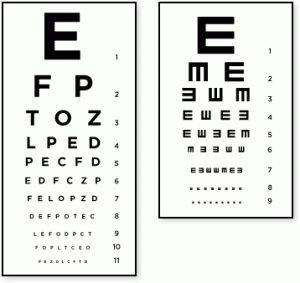

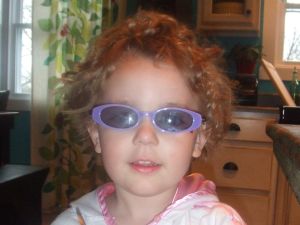


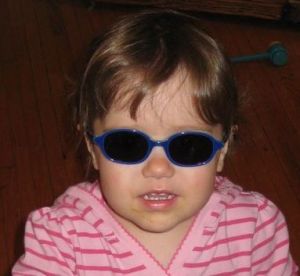 Alright, so reading the comments recently, it sounds like we’ve got a number of people with different experiences with the different sunglasses options. I’d like to write a round-up post that talks about the pros and cons of the different options: transition lenses, prescription sunglasses, clip-ons, (am I missing any other options? I suppose you could do non-prescription sunglasses.). So this is where you come in. If you’re child is using one or more of these options for sunglasses, would you either leave a comment with a brief comments on what you liked and didn’t like? Or email me – ann@shinypebble.com – especially if you wouldn’t mind submitting a picture. Also, if you’re willing to share what you paid for them, and where you got them, I’d love to include that as well.
 For Little Eyes