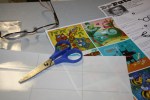
Mia’s contact lens

I’m posting this update on Mia from Danielle.   -Ann Z

Mia finally received her contact lens with a prescription of +8.  We had to try 3 different contact lenses and all 3 were sliding around inside her eye.  Due to Mia’s glaucoma her eye is not shaped normal and is what the doctor called “steep” so her optometrist had to order a custom fit contact that will stay in place. Mia will have to wear a contact that slides until her new lens comes in. It was crazy how good Mia was through all of this, I had to insert and remove 3 different lens and she didn’t cry.  The last lens we tried was slightly thicker and more rigid and must have been uncomfortable sliding around, however she only tried to rub her eye a few times.  I think she was much too busy trying to get off my lap so she could go through the cabinets in the doctors office.   It amazes me how comfortable she is at all of her eye appointments, she screams the entire time we are with her pediatrician, however her PO is a different story.   We find out in 3 weeks what we will be doing with her glaucoma valve and scarring on her cornea.   I will keep everyone updated.

Back to the contact lens, I have this routine I follow every morning, mind you I work evenings and I don’t get home until after 12am and I have to submit a daily report, so I don’t get to bed until 2 or 3am.  Needless to say, I am up with the kids at around 8am, 9 if I am extremely lucky.  So inserting a contact lens on only a few hour so of sleep can be difficult.  I need to have caffeine before I even attempt.  Once I get the contact lens in, Mia is fine, she seems very comfortable wearing a contact lens. We have an in ground pool so when I take the kids in, I have to take Mia’s contacts out before going into the pool, and back in when she gets out.

Mia in the pool with her "PopEye squint"
Mia in the pool with her "Popeye squint"

Mia’s aphakic eye is extremely light sensitive, she has this squint that we call the “Popeye squint”,  she is so light sensitive that she either squints or covers her eye when she is outside.  I just wish she could go outside and enjoy a sunny day like her brother.  Sorry, back to the contact,  this evening while I was at work my husband called me in a panic, Mia was crying and screaming for almost an hour.  My husband thought her contact lens folded or slid up under her upper lid and he could not find it.  I had to rush home from work and when I got home Mia was clamping her eye shut and she did not want me near her eye.  We had to hold her down while she was screaming so I could get the lens out.   This was the 4th day we used this lens and we have not had any problems until this evening.  I can’t imagine how she will react when I try to insert her lens tomorrow morning, it must be so irritating having a lens sliding around inside your eye.  I just wish they sized her eye during her last appointment. We had to wait so long for her contact lens and now it doesn’t fit right and slides around.  My poor little angel has endured so much.  I just wish I could take it all away.  Sorry, I’m just venting, it so hard watching her go through this.

Mia birthday glassesOn another note, Mia had her 1st birthday about 3 weeks ago (I can’t believe she is 1 already), I got the kids these silly glasses with different flowers and animals glued along the frame.  My mother had to hold Mia’s arms so we could take a picture of her with these glasses on.    She is still very stubborn about wearing glasses, even when they are pretend glasses.
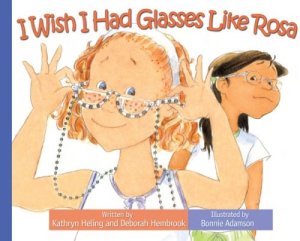
Book review for “I Wish I Had Glasses…”

There is nothing more rewarding than snuggling up with your child and a good book!  It is important to have books in your home that reflect your family values and show diversity.  Unfortunately, there are not a lot of children’s books about getting glasses, wearing glasses, even showing kids in glasses.    I wanted to build our home library with more of these books.   The public library, garage sales, Good Will, the Internet, and bookstores are all great places to get books.  If you purchase one through the Little Four Eyes Store a portion of the proceeds go towards maintaining this website.  Hopefully this review and future book reviews will help you choose books to add to your collection that reflect your child’s age and interests.

eyes

I Wish I Had Glasses Like Rosa.” is a short sweet story about a little girl who wishes she had glasses like her best friend. I love how it begins, “I wish I had glasses like Rosa.  They make her look beautiful.” The main character then goes on to try out all types of glasses from her grandma’s reading glasses to ones she has made from clay in art class so that she can be more like her friend, none of which ending up working for her.  In the end, she still wishes for glasses, but acknowledges that Rosa wishes she had freckles like her. It is a story that highlights the fact that people are unique and that is what makes them beautiful.

If you don’t already have this book at home, I highly recommend it for pre-school to kindergarten age especially. The illustrations are large without lots of small details with a white contrasting background making them easier to see.  The story has great vocabulary and teaches children about the different kinds of glasses that people wear.  Another benefit is that it is available as a bilingual book and has the words in both English and Spanish.

Activities to do after reading the story;

  1. Gather different types of glasses (goggles, safety glasses, reading glasses, party glasses) in a basket and talk about how they are the same and different.
  2. Look at pictures on the Internet of people wearing glasses to show that all types of people wear different types of glasses.  Here is a short video that shows several kinds of glasses.
  3. Discuss how people are all different and that is what makes everyone special.  Look at pictures of the people in your family and talk about how each person is unique; hair color, eye color, height, glasses, things they like to do and more!

Reader question: experiences with contact lenses/implants?

This second question came from Barb K in a comment.  -Ann Z

We have a lovely 4 years old daughter  who – unfortunately like her parents –  is extremely farsighted. Her eyeglasses are +20.00 and even when she wears them she has very poor vision. I s there a chance, however, that she can  grow out of her farsightedness, or must we prepare for her to be visionally impaired for the rest of her life?  What experiences do you people here have with contact lenses/implants?

Reader question: other issues beyond vision?

I have a couple of questions from readers today.  As always, if you have a question you’d like me to post to the blog, please just send me an email (ann@shinypebble.com) or leave a comment. -Ann Z

Dawn sent me a question wondering how many children with vision problems have other issues as well.  Her daughter Jillian has a benign heart murmur, and screened positive for Trisomy 13 before she was born, but they have since been told that she is “normal.”  I know that some medical issues are associated with a higher rate of vision problems: for instance, autism, down syndrome, and hearing loss.  Has anyone here had their children tested and/or diagnosed for other issues that might be related to their vision problems?

To patch or not to patch at the airport?

We have stepped up our patching the last 2 weeks and done away with the atropine drops since she is keeping the re-usable patches on SO much better than the “peel and stick” variety.   This weekend, we are traveling across the USA to visit Grandma and Grandpa in Minnesota.  Since we arrive in the airport 2 ½ hours ahead of time and have 3 hours on the plane, I was faced with the question, “Should I try to have her patch or not worry about it?”  Here were my thoughts…

Pros to patching

–      Keeps with the morning patch time routine

–         Gives us new things to look at while patching

–         The airplanes and people may help her stay distracted and the patch on

–         Every day of patching makes her eye stronger

 Cons to patching

–         Would draw extra attention to us

–         May have increased negative comments with the amount of strangers present.

–         May make my morning traveling alone with a toddler more difficult

 After going back and forth on the topic for a couple days, I decided that we would go ahead and patch.  If it became a problem, then we would praise for patching and take it off for the remainder of the trip.  And, it turned out to be a good decision.    While we were in the long line for security a family with a cute little boy around Elly’s age in glasses came up in line right behind us.  The little boy exclaimed, “Cool mommy, she has glasses just like I do!”  Elly was excited and the toddlers started talking about each others glasses (it was pretty cute) The mom said “That’s right, isn’t she cute! When we get home, you’ll get to wear a patch just like she does.  While the kids talked, the mom asked me some questions about patching. She said the little boy had just gotten glasses and will start patching this Monday and how nice it was running into another patching kid so that he realizes he is not the only one. It was a really nice conversation that affirmed to the kids that they are not alone in this glasses and patching experience. We didn’t have any other comments ( just a few stares) and Elliana kept the patch on the entire travel time (a little over 5 hours), which meant we could relax when we got to our destination!  WOOO HOOO.

 Looking back, I was glad we decided to patch, it is not often that you can make a positive connection with a total stranger that benefits both of you.  Without the patch, we would have been just another family in the sea of travelers.

Picture request: strabismus photo for the cover of Optometry and Vision Development

Dr. Bonilla-Warford, from Bright Eyes News has been asked to find a cover photo for an issue of Optometry and Vision Development.  He is looking for a high quality, high resolution (large) photo of a child or adult with strabismus.  I asked if the picture should clearly show the strabismus, or if it would be better to use a picture showing successfully treated strabismus, and he thought a photo showing the strabismus would be preferable.  You can see the table of contents for the issue here.

If you are interested, you can email any pictures to Dr. Bonilla-Warford at natebw@gmail.com.

Week 5 – i patch

Welcome to our patch challenge- WEEK 5.  My daughter is 2 ½ and has Amblyiopia.  We are currently trying to help her brain recognize her right eye.  She has perfect vision in her left eye and -7.75 in her right.  Right before her last visit we made sure to put the atropine drops in and she was still able to see 20/30 with her strong eye.  To me, that doesn’t blur her vision much, so we have stepped up the patching since it is more effective.

This week we tried  I PatchComes with this cut already made

http://www.goipatch.com/

Cost: $7.00 per patch shipping for 1-6 patches is $4.95

Ratings given 1-5 for the following criteria. 

1 Doesn’t meet my expectations, 5 Exceeds my expectations

Cuteness Factor           5

Durability                      5

Full Eye Occlusion        5 * With adding a cut to the center of the patch for the nose piecemay 395

Performs with sweat     5         

Patching Support          2

Reusable                      Yes

Total patching hours for the week (Goal 28), Actual = 28 hours with this patch

Elly’s response: Take it off.  (Ok, so she is not a big fan of patching this week)

Mom’s response: I am very excited that she kept this patch on 4 hours a day!!!! It is lightweight and soft.  I did have to make my own adjustments by adding a cut for the nose piece so that it would not slip and occur her vision.  I am not sure why most companies only put the temple slit or the nose piece slit, but I have found that the re-usable patches stay on and block vision better when both are present.  

There are 3 kids of eye patches that they offer.  Elly like putting the pirate style patches on her dolls, because they were not useful or effective with glasses.  The 2nd kind of patch is one that is an INTERIOR patch that slips over the glasses.  It has a “pocket” on the inside of the patch. may 376 We tried this first (it is the purple patch) and were EXTREEMLY disappointed and not looking forward to writing another bad review.  It did not stay on the glasses at all and kept slipping off.  We tried both the small (available on request) and the large and both did the same thing.  Due to the way it is made, I couldn’t make any adjustments to keep it on her.

The 3rd kind of patch is the EXTERIOR patch which has the pocket on the outside of the patch.  We had the same slipping issue, but were able to cut the fabric so that it slipped over the nose piece.  Now, I was worried that this patch would not work because it is so lightweight and the bottom of the patch ended up folding under.  (See the nose shot)   may 393I thought it may irritate her, but she actually has put up the least amount of fight with this patch.  If you have a young child, I would make sure to request the small size.  I think the larger would be more effective for older children and adults.  In conclusion; I will definitely be ordering a couple more!

Prevalence of refractive errors in young children: The Baltimore Pediatric Eye Disease study

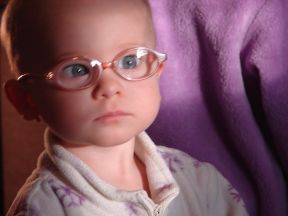
Glasses are uncommon on young children, and even less common in bear statues.

I finally got around to reading the full article published in Ophthalmology on the Baltimore Pediatric Eye Disease study (link to the abstract, link to a press release). The study looked at nearly 2300 children ages 6 months to 5 years old. The researchers examined the children and recorded the refractive error and astigmatism to find out the prevalence of myopia, hyperopia, and anisometropia (difference in the prescription between the two eyes), in young children. They applied the prescribing guidelines of the American Academy of Ophthalmology to determine how many children would benefit from glasses at this age.

I was particularly interested in this study because it was the largest study I’ve seen that looks at very young children to see how many are wearing glasses, and how many should be wearing glasses.  They also broke out the numbers by age, by race (African-American, and non-hispanic white), and type of vision problem (nearsighted, farsighted, astigmatism, or anisometropia).  I’d been looking for these number for a long time, as I’d like to be able to say just how common it is for a baby or toddler to need glasses.

So here’s a run-down of some of their findings that I found particularly interesting, though not necessarily surprising:

  • Severe refractive errors are uncommon at this age (like I said, the results aren’t actually surprising).
  • The average refractive error for white children was +1.24, and for African-American children, it was +0.43.  The astigmatism was 0.50 for white children,  and 0.58 for African-American children.   This number did not change significantly with age (between 6 and 72 months), and there was no gender difference.
  • Of the 2,298 children examined, only 29 wore glasses – that’s 1.26%.  10 of those 29 children with glasses did not meet the prescribing guidelines (so possibly don’t need glasses at all).
  • Based on the exams and prescribing guidelines, 116 of the children, or 5% of the population, would benefit from glasses.

Ok, so to break down the numbers even further, here’s how the numbers fall out for the children who did need glasses, by age and type of refractive error.  It’s worth noting that the numbers are small enough that it doesn’t make sense to get caught up too much in percentages.  I’ve listed the recommended threshold for glasses in parentheses.

6-11 months old (167 children examined):
myopia (-4 D or stronger): 1
hyperopia (+6 D or stronger with no esotropia, +2 D or stronger with esotropia): 2
astigmatism (3 D or stronger): 2
anisometropia (2.5 D or greater difference between eyes):  1
total: 6 of the 167 (3.6%) children needed glasses

12-23 months old (366 children examined):
myopia (-4 D or stronger): 0
hyperopia (+5 D or stronger without esotropia, +2 D or stronger with esotropia): 4
astigmatism (2.5 D or stronger): 0
anisometropia (2.5 D or greater difference between eyes): 0
total: 4 of the 366 (1%) children needed glasses

24-47 months old (887 children examined):
myopia (-3 D or stronger): 2
hyperopia (+4.5 D or stronger without esotropia, +1.5 D or stronger with esotropia): 11
astigmatism (2 D or stronger): 11
anisometropia (2 D or greater difference between eyes): 14
total: 38 of the  887 (4.2%) children examined needed glasses

48-71 months old (878 children examined)
myopia (-1.5 D or stronger) 16
hyperopia (+3.5 D or stronger without esotropia, +1.5 or stronger with esotropia): 29
astigmatism (2 D or stronger): 20
anisometropia (2 D or greater difference between eyes):  17
total: 82 of the 878 (9.3%) children examined needed glasses

It’s worth noting that the numbers may change considerably depending on location and population, but the numbers really fit with what I’ve experienced: It’s uncommon for young kids to need glasses, and sadly more children need glasses than are prescribed glasses, probably because vision exams at young ages are still not common.

Your stories – Jillian

This story was sent in by Dawn.  – Ann Z

Jillian at 15 months

My Jillian had surgery recently at 20 months.  We didn’t discover her eye problems until she was about 13 months old or so.  I saw her eyes turn in when drinking but they always corrected.  I think I got used to them being off center.  My dad pointed them out to me saying they were just like mine had been.  I also had surgery as a small child, and while my eyes were made straight, my left eye would be considered blind.  It disturbs me first of all to think my daughter was blind all that time and I didn’t know it, and that though she had surgery she may not see better.  She does have glasses, and since surgery she throws them off.  We do have a follow up appointment today, so I have questions to ask.

I think it’s interesting that there can be ways a child gives signals to problems, but of course we parents cannot possibly know.  I think back, Jillian didn’t use her hands for a long time like other babies.  She learned to sit up crawl and walk on time, but that first several months I thought it was strange she didn’t reach out for toys.  She would reach with her feet.  Then, when she did crawl, it was on hands and feet not knees.  She didn’t look forward, she looked at the floor.  She also often shook her head, I thought it meant she was happy.  She did this VERY early on within weeks, I recall wondering if something was wrong with her but she seemed healthy and all her doctor’s visits were normal.  Now I think she was just trying to see.  Because she is my 6th child, these things she did were different than the others…but I chalked it up to the unique qualities of each one.  She had things she did differently, but it was just her.  Now I know more…

online glasses special for adults from SelectSpecs

I’m straying a bit from our normal focus (oh dear, please forgive that unintentional pun – there are just too many puns to be made when it comes to vision…), as this post is about glasses for adults, but since many eye problems are inherited, I know that many of us wear glasses ourselves.  I received an email from SelectSpecs, an online glasses shop.  They’re running a special on prescription glasses for just $7 or $11 (plus approx $5 shipping), which includes anti-scratch, anti-reflection and UV protection coatings.  There are 10 frames available (8 fully rimmed at $7, 2 semi-rimless at $11), and there’s about 1,000 available of each frame.  They’ll be officially launching the offer on June 8th, but they are letting us have access to the offer now, which is nice since there’s a limited number of frames.  You can follow this link (link removed, no longer valid) to see the offer and order from there.

I want to be up front, I have not ordered from SelectSpecs so I cannot offer any first-hand reviews of their service, but my interactions with them have been very pleasant.  (They also have not offered me anything beyond the offer I’ve listed here.)

I did ask whether they would ever consider offering glasses for children.  It turns out that in the UK (where they are based), glasses for children require fitting by an optician due to PD measurements.

Great web resource: A Child’s Eyes

I just stumbled across this page – A Child’s Eyes – and was struck by just how much great information is here – information on different types of frames, how to know if your child’s frames fit right, age-specific hints to get kids to wear glasses, and more.  I’ll add it to our list of resources, but I wanted to post about it, too.  Danielle Crull (Miss Danielle) is a Master-Certified Optician (there are only around 330 in the US) who has specialized in fitting glasses to children.  Her masters thesis is “The Pediatric Optician: Dispensing for the Infant and Young Child” (links to pdf).  It includes a lengthy explanation of ways to measure the pupillary distance for young children, which I found particularly relevant given the discussion on the ordering glasses online post.

I’ve contacted Miss Danielle, and she has graciously agreed to an interview about the types of frames, how to fit them correctly, and glasses maintenance.  If you have any other questions that you’d like an expert optician to answer, let me know and I’ll add it to my list.

Toronto Event: Eye of the Tigger – a panel discussion on strabismus treatment

I wanted to share this information from Lisa:

To Parents of Children with Strabismus…

Strabismus: A condition in which the visual axes of the eyes are not parallel and the eyes appear to be looking in different directions.

I had/have strabismus. Now my sweet baby Lúa also has strabismus.

I am creating an event, an evening with a panel of doctors from all sides of the spectrum of treatment from surgery to vision therapy and everything in between. This is for parents to learn about what exactly it is, how it comes to be and what ALL the treatment options are.

Currently, I am looking for anyone interested in being involved in making this event possible. If this is you, please e-mail me – info@theeyeofthetigger.com

I am so excited about what is possible here not only for Lúa but for all of the babies/kids with this condition.

www.theeyeofthetigger.com

This is going to be one heck of a night!!

Lisa

I will update people when there’s more details available about this.  I’m also hoping that some of the event will be recorded and made available on the Internet for those of us that cannot get to Toronto.

Surgery Update!

Bilateral medial recession

SURGERY COMPLETE!!

McKenna’s surgery was 5/21 at 9:30am. We had to be there 2 hours early and the drive was an hour! So the wait was horrendous! I do not understand why we have to be there so early but anyway. My husband went in when they gave her the gas and he couldn’t talk about it for about 15 mins, he said he never wants to see her like that again (that’s why I made him do it). The surgery took about an hour, and that went by VERY fast. We went into the phase 1 recovery area and she was already fighting with a nurse, I think she woke up alone and got tangled in her IV line. She couldn’t open her eyes and focus on anything from the anesthesia and she was still groggy so the first 20 mins were the roughest. Her tears were blood and since the nasal passages and everything are connected her runny nose (from crying) was bloody as well, but that passed within a minute or so, THANK GOD! We moved to phase 2 recovery and once they took off the board and IV from her arm she calmed down because that is the thumb she sucks and she couldn’t get to it. She drank some juice and didn’t get sick so within a total of about 30mins from the end of surgery we left to come home. We brought her sunglasses which I think helped and she fell right to sleep once we got on the road. She napped again after about 20 mins at home and did well the rest of the night. She never did vomit from eating and we gave her milk for bed.

She only tried to rub her eyes when she first came out of anesthesia but I think that is because she couldn’t see correctly. Since then she has been great! Putting in the ointment is difficult and definately takes two people, but once I am done she doesn’t cry anymore. We noticed double vision for the first 2 days as she would try to pick things up. This is actually a good sign in that her eyes are trying to work together as they hadn’t before. We worked with her like “Where’s mommy’s nose” and having her pick up small objects, and it has improved dramatically. Her eyes do wander slightly to the outside now and then but for another few weeks we won’t be able to tell if they are just adjusting or if it was an over correction.

McKenna also has a Hypoplastic Cerebellum; this effects her balance and coordination; so on top of not having any depth perception her balance has been delayed so at 22 months she has still been working on walking. Since the surgery she has really been more balanced and is doing wonderfully with her practicing! She is even carrying things while she walks now which she sould never do before because she needed her arms out to balance.

So, right now we are very pleased with the surgery and look forward to her further development. I am sure she will be happy when she can play in the bath in about a week and we don’t have to put the ointment in her eyes anymore. Here is a picture the day after surgery so you can see what to expect with the redness.

Take care!!

Week 4 – Dr. Patch

Update: 11/21/2013:  I was contacted by a representative of Dr. Patch: ” Amomofelly mentions how easy it is to peak through the patch… We listened and created a new patch that fully occludes the eye”  We will see if we can review the new design and will link to that review when it’s done.

Welcome to our patch challenge- WEEK 4. My daughter is 2 ½ and has Amblyiopia. We are currently trying to help her brain recognize her right eye. She has perfect vision in her left eye and -7.75 in her right. Right before her last visit we made sure to put the atropine drops in and she was still able to see 20/30 with her strong eye. To me, that doesn’t blur her vision much, so we have stepped up the patching since it is more effective.

This week we tried DRPATCH INC. © All Rights Reserved.

Patent Pending. 783 Shefford, Bromont, QC, Canada J2L 1C4 450-919-0722 / 877-919-0722

http://www.drpatch.ca/

Cost: Order child eye patches at six for $19.99 may 092

Ratings given 1-5 for the following criteria. 1 Doesn’t meet my expectations, 5 Exceeds my expectations

Cuteness Factor 5

Durability 2 *

Full Eye Occlusion 1

Performs with sweat 5

Patching Support 4

Reusable Yes

*When out and about, unless you remembered to bring their “bookmark” to keep the patch, there is really no place to put it so that you can re-use it. We tried the window of our car to hold it and the patch didn’t work afterwards. Also, when she took it off before I was able to stop her… the dirty toddler fingers did a number on the stickiness of the patch and we we’re not able to use it again.

Total patching hours for the week (Goal 14), Actual = 12 hours with this patch

Elly’s response: She loved the pictures and kept the patch on 12 hours in 2 days.

Mom’s response: I have procrastinated writing a review of this patch because I was very disappointed in how it occluded vision and knew my review was not going to be good. This patch is similar to a sticker that is placed on the outside of the child’s’ glasses. It comes with easy to read directions. It was pretty easy to make, even though I couldn’t find any scissors but kids’ scissors and it was cute.may 090 The package comes with 6 re-usable patches, but we could make 2 patches out of each (total of 12) because her glasses are so small. Although Elliana kept in on no problem for 6 hours every day, I know may 091that it wasn’t occluding her vision. She would tilt her head up or down to see things. I tried one on my glasses and found it very easy to peek around it. After telling her a minimum of 300 times to stop peeking, I realized that this patch was not meant for us and we switched the next day to a different patch. Since the whole point of patching is to occur the vision in the strong eye in order to strengthen the vision in her weak eye, I really feel that this product does not meet my expectations and is unfortunately not a patch that is perfect for everyone as they claim. Yes it is colorful and fun, but it is definitely not effective.
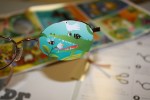
Maybe this patch would be better for someone with really big glasses that cover more of their eyes???

Monday morning round-up: May 18 edition

  • Hearing and vision– an interesting and important post by Amblyopia Kids about her daughter’s difficulties with a hearing screening while wearing a patch (she passed with flying colors when she didn’t have the patch on).  Definitely worth reading and keeping in mind for hearing screenings.
  • Anesthesia and learning disabilities – Danielle alerted me to this article from the Pediatric Glaucoma & Cataract Family Association.  A new study shows a correlation between repeated exposure to anesthesia and learning disabilities.  However, the article, and the study’s authors specifically note that “These data cannot reveal whether whether exposure to anesthesia itself may contribute to” learning disability.  Read the full article for all the details.
  • Spending time outside may reduce risk of myopia – researchers in Australia have found that populations where children spend most of their time indoors have a much higher rate of myopia, according to this article.  They theorize that the effect may be related to dopamine released in response to outdoor light.  Found via a tweet from Bright Eyes News’.
  • Astronomy technology for viewing eyesvery cool article on The Eye Care Blog about how technology used by astronomers to get a clearer view of the stars may give eye doctors a clearer view of the retina.
  • Calendar contestWe’re at 15 photos now!  Thomas Rogers from the Children’s Eye Foundation also sent me a note to clarify the contest.  The top 12 vote-getters get a digital camera, but CEF will decide which photos to include in the calendar,“the end result will be representative of our organization and its goals, to eliminate preventable blindness in children.”

Hope everyone has a great week!