Question: looking over the top of the frames

This question is from a comment by Anna, looking for thoughts or suggestions.  Remember, today is the last day for comment for sight – leave a comment today and not only will you help out a fellow parent, but I’ll donate $1 to Unite for Sight for every comment left -Ann Z.

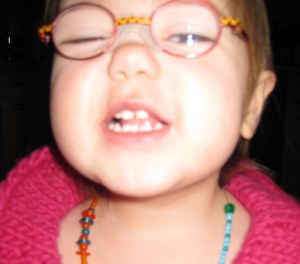
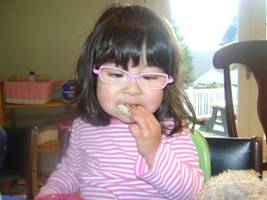
Does anyone else have the problem of their child looking over the top of their glasses? My daughter was 2 when she got her glasses and has looked over the top of them since day one.  Shes wonderful about wearing them, but I worry that somethings not right.

Any suggestions are appreciated.  She has done great with them, but like others doesn’t need them to see far away so she will sometimes pull them down to see off.  Do they ever put small ones in progressive lenses?  I also think that the bridge of her nose is so small that the nose pieces stand out to far.  I am looking into getting her plastic frames without nose pieces.

one frame, two frame, red frame, blue frame

img_0197
old frames, without tape

The new frames arrived today!  Given that Zoe’s old frames were holding on by a bit of electric tape and a prayer, it was welcome news. I decided to take Iris’s suggestion, and the old glasses are now in Zoe’s memory box.  I think it’ll be fun to look back years from now, at just how tiny those glasses are.

I had naievely assumed that since Zoe had been so good with her glasses, that the switch to the new frames would be an easy one.  I forgot a few important points:

  1. the old frames were wire, the new frames are plastic – they fit her face differently.
  2. her prescription has changed (it’s weaker).
  3. but most importantly: she’s two – not an age known for making things easy.

img_0207 img_0254She wore the red pair home from the glasses store and then took them off and refused to wear either pair.  I was afraid we’d be in for another week or so of getting her back to wearing glasses.  We let her eat lunch without glasses, having learned that fighting with a hungry toddler is an exercise in futility.  After lunch, we let her examine the new glasses and clean them.  Then the grandparents arrived, they were very upbeat and asked Zoe to show them her new glasses.  She’s been wearing them happily ever since.  Yay grandparents!  She’s switched between the two a couple of times each day, yesterday and today.  She’ll have to choose just one for tomorrow.

not sure whether to laugh or cry

When I picked up Zoe from daycare this afternoon, the first thing I noticed was the white tape on the side of her glasses.  “Glasses break, mama!”  Yeah.  Apparently during their free play time, one of the other toddlers took her glasses and the earpiece broke off.  They taped it back on because it’s not something that can be repaired.  She has an adorably nerdy air about her now with the tape on the frames.

On the one hand, we’re expecting the new frames to show up in a matter of days, so the timing is about as ideal as you can get for something like broken glasses.  On the other hand, I’m still annoyed that it happened,  I mean yeah, she’s two, and she’s in daycare in a room full of toddlers, what did I expect would happen?  The surprise should be that it took so long for them to break.  But I was kind of getting excited about donating them.  And I worry that this will happen again, but I don’t want people at daycare coddling her or treating her differently because of her glasses.  I’m not sure why I’m so bothered by this.  It’s not unexpected or surprising or even that big of a deal in the end, but it feels a little personal (which is completely silly, I know).  I do feel vindicated in our decision to buy two pairs of frames this time around.

Zoe didn’t want to wear her glasses this evening after I took them off and tried to adjust them in some way to get them to sit on her face a little better.  She gets so tired when she doesn”t wear her glasses.  She kept rubbing her eyes and holding her head when we read bedtime stories, but she didn’t want to put the glasses back on.  It made bedtime easier because she was so tired, but broke my heart a little bit to see her struggle without the glasses.

The Patch

Today was McKenna’s followup from getting her glasses. Dr. Glaser says that he does see a slight improvement and also says that the fact that her right eye occassionally crosses in is a good thing. That since her right eye crosses in, her left eye gets used. He does though want us to patch her right eye for an hour a day. Her next appointment isn’t until the beginning of April so we have plenty of time to work with her on that. The next step of course is then eye muscle surgery. I guess I am still a little unsure about why eye muscle surgery is needed. If she has accommodative esotropia, it is crossing because of her farsightedness. If the farsightedness is addressed with glasses, why would she still need surgery. Her eye isn’t crossed all the time..so I am still confused. I know that glasses can help crossing to an extent but the muscle may still pull a little. But, since her eye is straight some of the time and then at others her right is crossed, I just don’t see how fixing one eye would help. The doctor is great, but I never seem to get the answers I am looking for. I really need to write down my concerns so I remember what to ask when I am there.

Has anyone here had any luck with patching? Anyone have similar issues(farsightedness and esotropia) that were helped with patching and glasses?

Activities to do with your toddler when patching or wearing glasses!

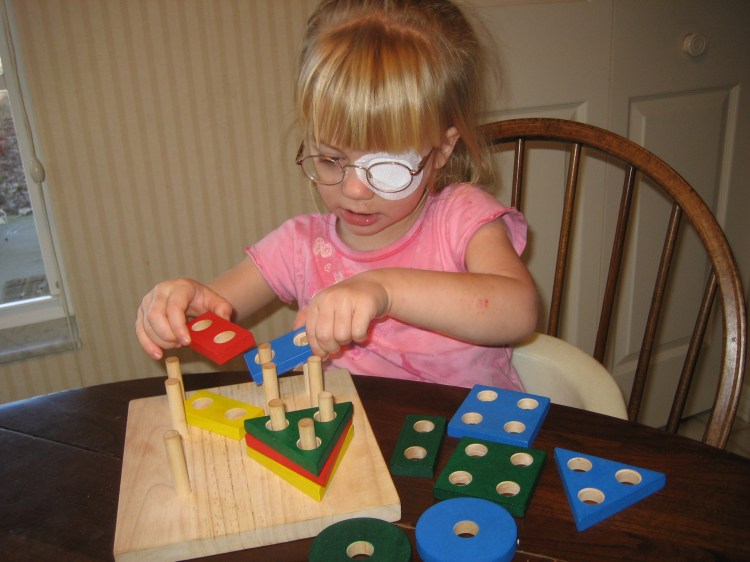
Our Ophthalmologist encouraged us to make sure patching time was active learning time. This encourages both sides of the brain to interact and is better for this age than traditional eye exercises.  One-on-one activities will help strengthen our children’s eyes as well as providing a strong educational foundation. We found it also helped keep the patch and now glasses on.  Here are some of my favorite learning activities to do with toddlers when patching or glasses.  Please ad to the list if you have some other great activities to do with your little ones!

 1jan09-103

  1. Puzzles * Peg ones that require sorting as well
  2. Play dough
  3. Rice pouring using little pitchers
  4. Making a pillow obstacle course (great for balance)
  5. Throwing a ball into a clothes basket
  6. Blocks *
  7. Trips to playground
  8. Have a play-date with another toddler
  9. Sing Clapping songs; BINGO, This Old Man, If Your Happy and You Know It, Pat-A-Cake, The Wheels on The Bus
  10. Making music with instrument
  11. Building sandcastles in the sandbox
  12. Pasta playtime (I put a large container of pasta in the kitchen for her to play in while I am cooking – like an indoor sandbox)
  13. Catch (throwing or rolling) with a ball
  14. Put her on a towel and pull her around the living room (also good for balance)
  15. BUBBLES!
  16. Crank up the music and have a dance party
  17. Color with crayons, markers, pencils, pens and more! Encouraging them to stay in the lines of coloring books *
  18. Stickers
  19. Have a pretend Birthday Party, wrap up their toys and let them unwrap them.
  20. Scarf dancing
  21. Bathing baby dolls
  22. Cooking with mom in the kitchen
  23. Computer games that require kids to drag and drop *
  24. Reading picture books and talking about the pictures


*Star activities were recommended by the ophthalmologist.

delurk for sight!

Apparently it’s National Delurking Week in the blog world – honestly, I have no idea who comes up with these, or if it’s even real, but I’ve been looking for a good reason to ask all you readers to take a moment and leave a comment.

So here’s some incentive, this week only (starting today, Jan. 6, until Monday, Jan. 12) I will donate:

  • $1 for every  comment we receive – regardless of which post or page it’s left on (Spam comments don’t apply).
  • $2 for new photos submitted to the gallery (if your kid is already featured in the gallery, sorry, you’ll just have to get the donation through commenting).

ufslogoDonations will go to Unite for Sight.  A charity that works locally and internationally to improve eye health and eliminate preventable blindness and eliminate barriers to eye care.  They work locally in the US to to provide vision screenings and education programs and match those screened with free health coverage programs so that they can receive a complete eye exam by an eye doctor.  Internationally, they provide community-based screening programs in rural villages, where eye doctors diagnose and treat eye disease in the field, and surgical patients are brought to the eye clinic for surgery.  You can read more about Unite for Sight on their web page.

So leave a comment!

Update, January 13, 2009: Thanks to everyone for leaving comments and sending in pictures. We had 35 comments in the past week, and 3 new pictures added to the photo gallery. That means that $41 will be donated to Unite for Sight.

Update, January 22, 2009: View the online Thank You card from Unite for Sight.

tell me what you want!

As we head into the new year, I’m wondering what sorts of articles and posts you’d like to see on this blog (you can vote for more than one thing).  Feel free to comment with other ideas or specific topics you’d like to see.

getting new frames

farewell, old frames.  You served Zoe well.
farewell, old frames. You served Zoe well.

We took Zoe in to get new frames today. She has a new (slightly weaker) prescription and has really outgrown her current frames. The optician told us she’s grown 3 mm over the year – I assume that’s the spacing between her eyes, but I’m not sure if that’s really a large amount or not.  In any case, it was clear that it was time for new frames.

The good news is that Zoe is bigger now, so we had a larger selection of frames.  The bad news is that a larger selection of frames means more time subjecting my daughter to the torture of trying on every singe pair that fit, in every color available.  We’re nothing if not thorough.

If I ever doubted that her glasses help her see, that doubt is gone.  After about 15 minutes of trying on different frames, she’d ask to just put her own glasses on and we’d let her take a break.  She seemed so relieved to be able to see.  And so confused to be putting on glasses that didn’t help her see.

Even though we love how she looks in wire frames, we ended up ruling out wire frames right now since they would have the nose piece which just looked like it was begging to be snapped off, or at least bent enough to bother her.  So we’re moving to plastic frames.  The eye glasses store had a buy one, get one half off sale, so we even ordered two frames.  What a luxury!  If she scratches a lens or breaks a pair – she’ll have a back up!  We got one round, red pair and one more rectangular blue pair.  I figure she’s starting to develop a sense of style, so we’ll let her pick each day which she wants to wear.

And this leads me to my final question.  What do I do with the old pair?  Given how small they’ve gotten, and how much her prescription has changed, and the fact that we’ll have 2 pair, it doesn’t seem worth it to keep them as back up.  Can I donate them?  Even though they’ve been beat up, scratched, thrown, stepped on, and bent nearly beyond recognition?

bifocals

Another request for help – I just got an email from a mother of a 3 year old whose ophthalmologist is recommending bifocals to correct strabismus that is persisting despite the glasses.  I know that some of you have kids in bifocals, and I feel like there has been some discussion of them before but my quick search didn’t turn much up.

So, what have your experiences with bifocals been?  Any things to watch out for or be aware of?

New Year’s Resolutions

2009

Dr. Bonilla-Warford of Bright Eyes News has a great post up with a list of resolutions for children’s vision.  My favorite is number 2: spend some quality vision time with your children, which includes talking to your kids about what they see.  I know Zoe isn’t quite verbal enough to really express what she sees (heck, I’m not sure I have the words to always express what I see, especially before coffee), but I do want to be sure to make a habit of talking with her about her vision so that if something changes, we can catch it early.  And as for number 4: bring their glasses in for cleaning and adjusting, well, our eye glasses place can attest to seeing us quite often.

For my part, my 2009 resolutions include:

  1. Help Zoe pick out new frames
  2. Teach Zoe to put her glasses on right side up
  3. Be better at cleaning her glasses (they’re always so dirty, I hardly notice it any more).

How about you?

Clumsy

I’m re-posting this comment from Anna who is looking for anyone with ideas or experiences with their child getting clumsy after getting their glasses. -Ann Z

My 23 month old son, Frank, was diagnosed with Strabismus. Right before Thanksgiving we noticed his left eye turning in. We took him to the doctor immediately because there is a family history of Strabismus.

The opthamoligist said his eye sight is +3.50 in both eyes. He said patch and get glasses. Thankfully Frank has never been bothered by the patch and has never pulled. We ordered his glasses and they finally came in last week. He has been good wearing them so far, but the past 2 days he has become extremely clumsy. Yesterday he fell and scratched his face all up and scratched one lense very bad. Thankfully we got insurance on the glasses and they will replace the lens for free. Then this morning the babysitter calls me at work and says that he fell again and his glasses are completely bent and the lens fell out. Not only that, but the nose piece went into the corner of his eye and he has a cut.

This has made me a little stressed out since he has suddenly become so clumsy. Do you have any suggestions on what I can do to help him out and not be so clumsy?

Your stories – excerpts from a journal about starting with glasses

These are exerpts from Sue’s blog about her daughter Mia’s first few weeks with glasses.  Mia and her twin sister, Cate are 2 1/2 years old.  Cate does not need glasses, but Mia does. – Ann Z

Mia in her glasses
Mia in her glasses

Oct. 27, 2008 – Update on Mia’s eyes

I took Mia to the eye doctor today.   She was diagnosed as severely far sighted (can’t see things close up).  As a result, her brain and eyes are trying to compensate by focusing too hard up close, and it’s causing her right eye to wander and veer inward.  It’s very noticeable when she looks at you close up.  They recommend glasses.  She’ll be able to wear contact lenses around age 7, but will likely require corrected vision assistance of some sort, for life.  They don’t know what really causes this.  But the doctor felt that prematurity is certainly a common factor.  Thus, we’re getting Cate checked next week as well.

Mia was such a brave girl for most of the appointment.  She sat so well and cooperated way more than any two year old should, for a good hour or so.  At the end of the hour though, the doctor put eye drops into Mia’s eyes to dilate them.  Mia was surprised and scared, as we had to hold her down on the floor to get the eyedrops in.   The doctor then wanted to have us come back in 20 minutes, which is how long the eye drops take to work.  When we returned to the doctor’s office, Mia wanted nothing to do with it anymore.  She just kept saying “no, no, bye bye, go home”.  She kept covering her eyes with her hands and was crying and just beside herself.  She was in no sort of mood to select or get fitted for glasses.  She napped like a charm this afternoon, but was squinting for a couple of hours even after her nap.

Tonight, when Chris came home, he brought her a little puzzle toy as a gift for being so brave.  When we presented it to Mia, we told her that she did such a good job at the eye doctor.  We also said that we recognized she was scared there and that it wasn’t fun for her.   She repeated the word scared several times, as she put her puzzle together.  “eye doctor”…”scared”, “scared”…. So heartbreaking.  I’m so proud of her though.

Now comes the hard part.  How will she handle wearing glasses?  And as she gets older, how will the other children treat her?   Will some children make fun of her?  What will the impact be on self esteem?Continue reading “Your stories – excerpts from a journal about starting with glasses”

a new wrinkle

We’re now past the one year mark with glasses – and into the age of the terrific (or is that terrifying?) twos – and Zoe’s throwing us a new twist.  She’s started refusing to take off her glasses when it suits her wishes and her mood.  I first noticed it at her eye doctor appointment last week.  It all went well, but she refuses to take off her glasses for her ophthalmologist.  She was fine having them off for the assistant who does the first set of eye tests, but not for her doctor.  As far as I could tell, she just didn’t want to doctor to be able to reach her eyes – I’m not sure if she still has memories of the surgery, or what it is.  It’s not the eye drops, since she gets those before she even sees her doctor.  Luckily the doctor was able to do the exam with Zoe’s glasses on.

And now she’s started not letting me take her glasses off if she doesn’t want to go to sleep at night or naptime.  The little stinker – she keeps getting smarter, and I have to keep up.  It’s certainly not the problem I expected to be having a year ago.

Patching vs Atropine Drops

Since we have patched for many months and struggled with keeping it on daily, our PO recommended Aptropine drops.  The Atropine blurs the near vision in the better-seeing eye and has statistically shown the same improvements in Amblyopia patients.  The Pros of the drops is that the children do not have an option to take them off and therefore receive the necessary time strengthening their good eye, The Con is that is a chemical that stings upon placement in the eye.  In our hand-out is says “In some children, it is necessary for one adult to hold the child while the other gives the drop.”  Others have compared the feeling to how Chlorine would feel if put in your eyes. 


I was very nervous about putting eye drops in.  We would rather patch, but Elly is so stubborn and opinionated that unless she made the choice to keep them on, we would not be able to patch 6 hours a day every day.  My husband and I talked and we decided to be honest and tell Elliana simply what was happening.  Her eye is not working and we need to make it stronger.  We then gave her a choice. “Do you want to wear a patch all day or put eye drops that hurt in?”  She choose Eye Drops.


So, we had her gather her animals and dolly to squeeze, laid her down on the bed and warned her that it will hurt, but that it will be ok soon.  My dear husband put the eye drops in and we waited.  Elly pointed to her other eye and said. “Put the drops in this eye too.”  Ha ha ha – no, only one eye necessary. About 1 minute later, she said “owie, owie, owie” and tried to rub her eyes, but that was it.


I’ve noticed her coordination is off, just like when we patched.  We do rice pouring often and have never spilled any on the floor.  Today there was rice everywhere.  She also seems to loose her balance when she is walking and ran into a couple things already this morning.  So that must mean the drop is working.


I still worry (Yes, I am a worrier!) And we will ask her again tomorrow morning which she would like.  For now, the drops seam to be the better choice for us.


Did anyone else have this choice?  What helped you make the decision? How did your child react?

Our typical Visit to the Ophthalmologist

In the car on the way to the Ophthalmologist, Elly and I talk about what will happen in the Doctors Office and how I expect her to behave.  Our Pediatric Ophthalmologist sees around 60 children each day she is in the office so sometime the waits are long.  We are now on an every 2-4 week visit.  Here is how our visits go.


1. We check in with the receptionist

2. Then we wait in the waiting room until our name is called.  Today there was another girl her age with glasses and a patch to talk to.  Usually we walk to get a drink and read books since the wait is always long.12dec08-183

3. Tami brings us to the exam room and does a whole bunch of activities with Elly.  12dec08-185Lots of them involve stickers and covering each eye.  This time they used picture cards rather than lenses to asses her vision as Elly is old enough to name the pictures.  We are at an estimated 20/400 in her right eye today – our best so far!12dec08-187

4. Then I ask my millions of questions while I try to keep Elly entertained with snacks and toys.  I have found that I need to have my questions written ahead of time and have the doctor write the answers and big words that I know I will not remember.

5. After the initial assessment, we wait again for the Doctor.  When she comes it is more stickers and sometimes puppets depending on Elly’s focus.  Some times we sit in the chair and the doctor looks at her eyes through the phoropter12dec08-188
6.  Then the Dr explains her progress, concerns, and what our treatment plan will be for the next X days including worse case scenarios. Words like “severe” and “hardest to treat” are like knives in my chest.

7.  Once again, I try to keep Elly entertained again while I ask my second million questions.  Thankfully today, they had an information sheet printed out with information on our current treatment plan; Atropine Drops

8.  By this time, almost 2 hours after arriving at the office, Elly and I are overwhelmed and exhausted.  We get our very cool sticker and head back to the receptionist to pay and schedule our next appointment. 


I am always super exhausted and overwhelmed at the end of the visit.  During the visit I try to be as upbeat as possible, but have cried on the drive home multiple times.  Elly is always well behaved for the most part, I am well prepared with entertainment and talking about the visit before, but I am always worn out and emotional afterwards.   Any ideas?