Updated:Thank you everyone who entered! Congratulations to Sheri and Fran, whose names were chosen as winners.
Patching is never much fun, but sometimes a little bit can go a long way to making it a bit better. We have a great giveaway with items from Kids’ Bright Eyes and Patch Land Adventures to help with patching time!
The two winners will receive a beautiful patch from Kids Bright Eyes, a Patch Land Adventure book by Carmen Swick and a sweet stuffed bear wearing an eye patch.
The patches
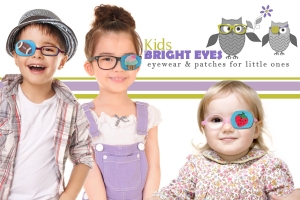
Kids Bright Eyes has a great selection of hand-made eye patches that go over glasses. They come in fun, bright colors with very charming, very cute decorations. The company is a husband and wife team that formed when their daughter was born with PHPV, causing loss of vision in one eye. She has worn glasses since 2 months old and will for the rest of her life in order to protect her good eye. They have been inspired by their experiences to offer fun patches and frames at affordable prices. We offer a variety of designs and colors to help kids feel confident and proud.
The books
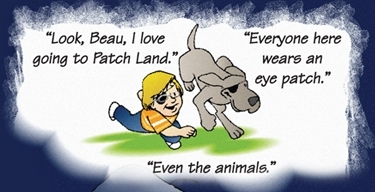
Carmen Swick’s son, Preston, has amblyopia. She has written a series of books, called Patch Land Adventures, about his adventures with his dog Beau. The books are fun and imaginative, while also providing relatable characters who don’t like wearing a patch, but understand why it’s important. The books have been recognized with awards such as a 2012 Seal of excellence award for book 1 and a 2013 book of the year award (Kids-Health Challenges category) for book 2. The winners will receive their choice of Book 1: Fishing with Grandpa, or Book 2: Camping at Mimi’s Ranch!
The Bear
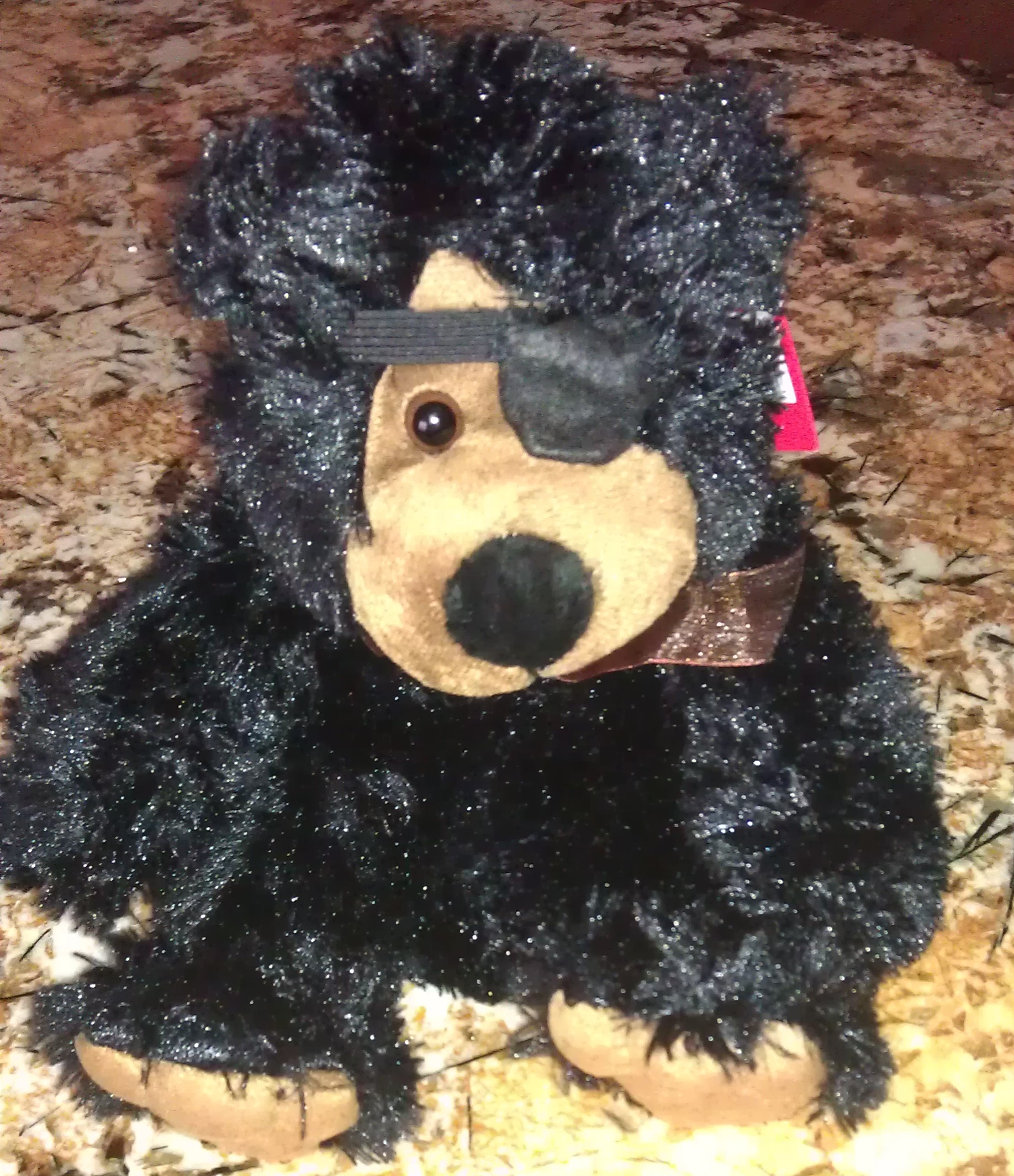
Patching is always easier when there’s someone else doing it along with you! “Beary the Black Bear” is a 12″ plush bear that comes with your choice of a black or pink eye patch. The bear is a character in the Patch Land Adventures books, and will keep your child company while they’re patching.
The Giveaway
Two winners will be chosen at random on Monday, November 25 at 9:00 pm.
Each winner will receive a Kids Bright Eyes eye patch of their choice, a Patch Land Adventures book of their choice, and a plush bear!
The giveaway is open to anyone.
To Enter the Giveaway
Simply leave a comment here saying “enter me” (and you can add anything else to the comment as well). That will get you one entry into the giveaway.
Want more entries?
There are a few things you can do if you’d like to be entered more than once. You will receive an extra entry for each of these that you do. After you’ve done one or more of these, and leave a comment here saying which you did:
Send a photo of your child wearing an eye patch to be added to our patching gallery (email to ann@shinypebble.com).
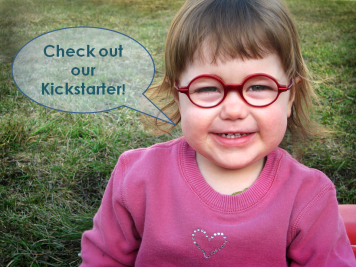
Take a look at the Glasses! A board book for young ones in glasses Kickstarter and share the campaign – it can be through Twitter, Facebook, Google+, on your blog, or by talking with your child’s eye care provider or glasses shop, or some other way of getting the word out. I’d love it if you backed, too, but you don’t need to be a backer to get the extra entry.
Today, November 17, is World Prematurity Day (yes, the byline for this blog says Nov. 18, but it’s still the 17th where I am). It’s a day to focus attention on the global problem of premature births. Many of the readers of this site and our facebook group have children who were born premature. To them, it will not come as a surprise that prematurity is closely linked with vision problems
Retinopathy of Prematurity
The vision problem that most people associate with prematurity is Retinopathy of Prematurity (ROP). ROP occurs in around half of all infants who weigh less than 2.75 pounds (1250 grams) at birth and are born before 31 weeks gestation. It is thought that the eye finishes developing in the last weeks of pregnancy, and that in babies born prematurely, the edge of the retina does not have adequate blood vessels, and so abnormal blood vessels form, which can lead to retinal scarring and detachment. The good news is that 90% of infants born with ROP have a mild case which improves on its own and leaves no permanent damage. For more severe cases, treatment involves laser or cryotherapy to remove the affected outer edges of the retina.
Other vision issues
While ROP is the most well known vision issue associated with prematurity, children born preterm are at higher risk of many other vision issues as well. An article in Nature notes that studies looking at children aged 7-10 years old, found that those born prematurely had a much higher incidence of many vision issues, including:
myopia
hyperopia
strabismus
astigmatism
anisometropia (large difference in prescription between the two eyes)
The Kickstarter for the Glasses! board book is still running. There are only 9 days left, and we’re almost two-thirds of the way there!
The book will have photos of toddlers and babies in glasses, doing the sorts of things that young kids do: having fun, playing, being kids. (The photos for the book have not yet been taken)
I have heard so often from so many of you that seeing pictures of other children in glasses has helped so much. For kids, seeing other kids in glasses helps them feel less alone and get excited about their own glasses. And for parents, it can help make the idea of your child in glasses less scary and unknown. I know when I learned that Zoe needed glasses, I couldn’t think of a single child under the age of 5 in glasses, so it was really hard to imagine what we were getting in to.
There are just so few books out there that are aimed at the very youngest of kids in glasses, and so little awareness of the importance of good vision in young children. This book project addresses that directly. But I need your help to make this happen. We need to raise the full goal of $6,000 by November 26. If that goal isn’t reached, then none of the funding comes through (that’s the way Kickstarter works, and it’s a good protection for backers – if a project can’t raise enough money to continue, then you don’t have to worry about losing money).
Many people have said that they wish this book had existed when their child was little – heck, it’s the book that I wish existed when Zoe first got glasses. Well, even if your child is past the board book stage, you can still back the project and have a copy sent to a childcare provider, or preschool, or library of your choice. I’ll include a resource page for parents and caregivers. That way, the book will be there when another family needs it!
There’s a lot of recent updates that I haven’t done a good job of keeping up with, so here goes:
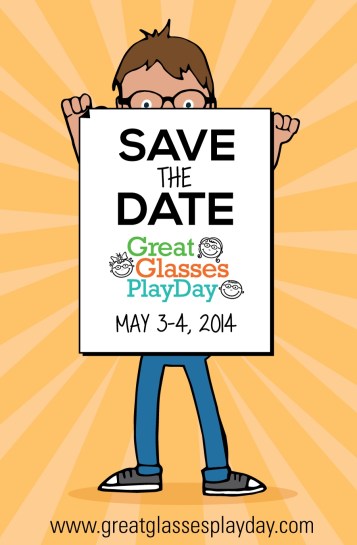
The 2014 date for the Great Glasses Play Day has been announced. We had a lot of requests to move away from the August date due to weather issues in a lot of locations. After running a poll about the timing, the winner was early May. So…. I hope we’ll see you there!!!
“Glasses” board book – we’re now 40% funded through Kickstarter and have 16 days to go. The campaign ends November 26. You can learn more about the book at the website GlassesBoardBook.com.
There is a huge Ultimate Holiday Giveaway for Kids Who Patch or Wear Glasses going on at Eye Power Kid’s Wear. This is seriously one of the best giveaways I’ve seen, with a whole lot of award packages to fit everyone’s situation. It is open to everyone, but international winners will need to pay shipping. The giveaway ends in 3 days, so you should jump over there quick
In an earlier post, I mentioned that I had a book that I was working on a board book and would be launching a Kickstarter soon. Well the Kickstarter has launched! And I’d love your support.
Glasses: a board book
The book is titled Glasses. It will be a board book that features photos of young children, 3 and under who wear glasses. It will have a simple poem that accompanies the pictures that celebrates glasses and the kids that wear them.
Some glasses are red, Some glasses are blue. I think your glasses look great on you!
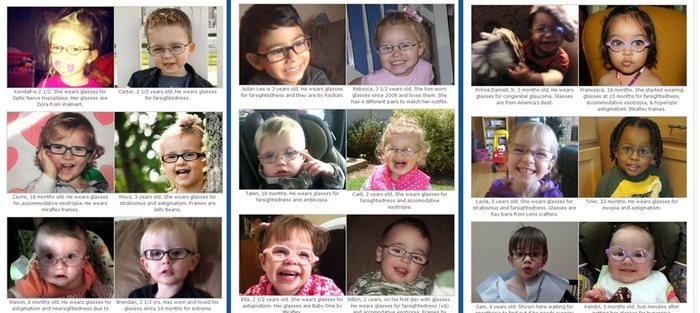
The book is inspired by the many messages I’d heard from parents whose children asked to look at our photo gallery to see other kids their age in glasses. And it’s inspired by Zoe, who even at seven asks about why there aren’t more kids in glasses. I want the youngest of kids who wear glasses to not feel alone, and to see and hear about why their glasses are lovely and how they help them to see!
a few of the beautiful bespectacled faces in the photo gallery
I am not one who has always wanted to write a children’s book. I’m a librarian, I’d prefer to find books for people, not write them. But this idea for a book is one that has stuck with me for years and tugged on me to get it made. Recently, as I’ve watched other authors write their books, I’ve been inspired by their willingness to make it happen, and to get their books out there for other kids. So I decided to take the plunge and give this a shot.
So what is Kickstarter, anyway?
Kickstarter, for those that haven’t encountered it before, is a way to raise money for creative projects that will result in some kind of product. Basically, the creator (that’s me!) explains the project and the funding they will need to do that project. And anyone can pledge any amount, and the creator sets reward levels. So for instance, if you pledge $17, you will get a copy of the book when it’s completed. Now, if the full funding isn’t reached by a certain deadline (Nov. 26, in my case), then no one gets any money, and nothing is lost. You will only get charged if the project is fully funded. I have backed a few Kickstarters – my husband has backed quite a few – we’ve been very happy with the projects we’ve backed so far.
Click the photo to get to the Kickstarter page
The funding for Glasses will help cover the costs of the photo shoot for the book, as well as the production and printing costs of the first run of the book.
This is one of the questions that comes up very often in the Little Four Eyes facebook group. The question usually reads something like this:
My child just started wearing glasses a few weeks ago for farsightedness. Before getting glasses, we noticed that her eyes would cross, but only occasionally. When her glasses are on, her eyes are staying straight now, but now when we take her glasses off, her eyes always cross, and it seems like they’re crossing even more than they used to. Are her glasses making her eyes worse?
It has always frustrated me that this isn’t covered by more eye doctors with parents of farsighted children. Short answer is that it is nothing to worry about if a child’s eyes are straight with glasses on, but crossing without glasses, in fact it’s quite common. However, it’s very startling and upsetting for parents to see what looks like their child’s eyes getting worse after they get glasses.
Eyes crossed without glassesEyes straight with glasses
This happens with kids with accommodative esotropia. That is, their child uses their accommodative reflex to focus through the farsightedness, but that causes eye strain and crossed eyes. Monica Wright from Kids’ Eyes Online has a good overview.
Once a child has adjusted to their glasses, they become used to seeing clearly. When their glasses are taken off, they want to continue seeing clearly, and so they try to accommodate, which causes their eyes to cross, often more strongly than before they had glasses.
We saw this with Zoe (as you can see in the pictures), and it was really upsetting to see, especially since I so strongly associated crossed eyes with vision problems. As Zoe has gotten older, she’s been better able to keep her eyes straight even without her glasses.
It is also important to note that if you see your child’s eyes not lining up correctly while their glasses are on, you should contact their eye doctor. For many children, it’s a sign that their prescription needs adjusting.
It should come as no surprise that I love books and turn to books especially when it comes to children’s books. I’m a librarian, after all. When Zoe first got glasses, I set out to find some good books for a young toddler in glasses. And I came up pretty short. There are certainly books about glasses out there (our book list is a testament to that), but very few of them speak to the experiences of a young toddler or baby. In fact, if I had to characterize the books out there, they almost all fall in to one of two categories:
Main character wears glasses. Their friends tease them about the glasses, so they try not wearing their glasses. Usually funny hi-jinks (going into the wrong bathroom, misidentifying something, etc) ensue. (ex: Arthurs Eyes, Princess Peepers).
Main character’s friend gets glasses and the main character is super jealous, even though their friend doesn’t really want glasses. Usually funny hi-jinks ensue as the main character tries to find ways to convince their parents and eye doctor that they really need glasses. (ex: Fancy Nancy: Spectacular Spectacles, I really absolutely must have glasses).
Of course, there are some books out there that don’t fall into those categories. And falling in to one of those categories doesn’t necessarily mean that a book is bad – there are some fantastic books out there. But the fact remains that those scenarios aren’t really ones that our very youngest kids in glasses will encounter. And after you’ve read a few with the same story line, they can start to feel a bit contrived.
But I feel like recently there’s been an upsurge in books that are written by parents of young kids with vision issues, or even written by people who had vision issues growing up. I can think of a few off hand:
I’m certain I’m missing some — please leave comments with other books that I missed!
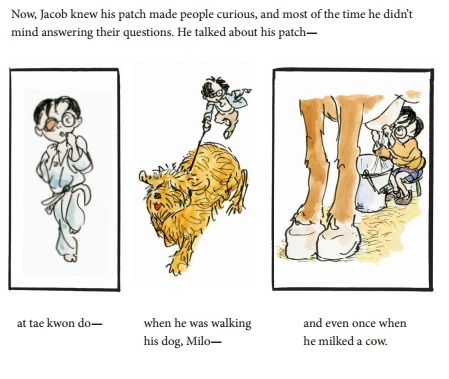
There are some things that set these books apart. The books tend to be more positive. The glasses or patches or contacts are a part of the kids’ lives, but the stories tend to show more of the kids doing normal things. And there are more of the little details about what life is like after the initial period of adjustment is over: In Samantha wears a contact, you see that sometimes mom has trouble removing her contact. In I can see just fine, there’s a glimpse of just how dirty our kids’ glasses get (all the time). In Jacob’s eye patch, we see just how often kids and parents are asked about eye patches.
And now there self-publishing, which has allowed some of the books mentioned above to be published. When I talked with a children’s book publisher about a board book idea I had (stay tuned!!), I was told that the audience for the book was just too small. Board books are expensive to print, but don’t sell for very much, so publishers want a guarantee that the books will sell a lot of copies. But now that more and more books can be printed on demand, it makes it more possible for parents to write books that reflect our experiences and get those books out to others in similar circumstances. Even if the group is small, the experience can be shared. And I think that’s a fantastic new change!
I know that there are many books written by parents in our community currently in the works:
Alison Joyce has a Kickstarter for her board book, “I see. You see. We ALL see!” Take a look and please consider supporting her!
Cynthia Davis is working on a book, “My Bright Blue Glasses”, planned to be out in November, 2013, that follows the journey of a toddler “who had to deal with learning he has to wear glasses, patch and go to vision therapy.” She’s also working on another book targeted at older kids.
I will be launching a Kickstarter soon for my own board book that features photos of babies and toddlers in glasses with rhyming text that celebrates the role of glasses in a child’s life
I’m certain I’m missing some — please leave comments if you know of other book projects that should be included.
If you are working on a book that relates to young children with vision issues, please, please let me know. I would like to help you get the word out about the book you’re working on! I will also continue reviewing and sharing traditionally published books – as far as I’m concerned, the more books out there for our kids in glasses, contacts, or eye patches, the better!
Jacob cannot wait to get to the store to get his very own light up globe, but there are few things his mom needs to do first: pick up his brother, and get some ice cream. Along the way, much to Jacob’s chagrin, people keep stopping him to ask about his patch.
Jacob’s Eye Patch, by Beth Kobliner Shaw and Jacob Shaw, comes out today. It’s a charming and quite funny story of Jacob dealing with all the questions that so often come with a child wearing an eye patch. By the end, he not only gets his globe, but he realizes that everyone has a something. A something that makes them different, something that people will ask about or comment on. Something that you don’t always feel like talking about.
The illustrations by Jules Feiffer are simply gorgeous. They convey Jacob’s excitement and frustration perfectly.
This book captures one of the ongoing difficulties that comes with patching. After the initial period of adjustment to wearing a patch (which is its own difficulty), there are still the questions that seem to come from all directions every time you leave the house. Jacob’s Eye Patch not only gives voice to the frustration that can come with having to answer those questions over and over again, it also encourages kids to use their own voice to tell the story of their eye patch, or any other difference they have.
There’s an accompanying website with the tagline “Being different can be hard. But everyone has something. What’s your something?“ The site has stories submitted by parents, as well as materials and activities. I found the tip sheet for parents to help kids cope with differences to be especially helpful.
Beth Kobliner Shaw has very generously given Little Four Eyes 20 copies of Jacob’s Eye for a giveaway. There are no strings attached, simply leave a comment letting me know you’d like to be entered. I’ll draw 20 names on Tuesday, Oct. 1.
If you’re as inspired as I am by this book and the authors’ generosity, there are a few things you could do:
Share a picture of your child wearing an eye patch or glasses to go into our photo galleries (email it to ann@shinypebble.com with “photo gallery” in the subject line. I know a lot of kids who wear glasses or an eye patch like to see pictures of other children patching.
New Update, 11/9/13:Author Beth Kobliner-Shaw was so touched by the comments that she is going to get a copy to everyone that commented. If you did not hear from me about this, please email me at ann@shinypebble.com! And many thanks to Beth!!
Update:Thank you all for reading and commenting, and again, many, many thanks to Beth for the books that we’re giving away. Winners of the giveaway are: From an ink smeared page, Priya, Jasmine, Jessica S, Jessica D, Joanne, rhanderson, MB, Karin, Joanna, Lirpa, Rachel, Cynthia, Daddy NYC, Vivian, Stanley, Amber, Dawn, Laura, and Mary.
September 19 is International Talk Like a Pirate Day. It’s a silly day to enjoy saying “ARRRR” and “avast!” And in recent years, it’s also been a day to raise money for charitable causes such as Childhood Cancer Support. I’m a big fan of silliness, and a huge fan of supporting worthy causes, but as Nicola reminds us in her wonderful story of her son and his eye patch, pirates are not always cause for celebration for our kids. – Ann Z
No! My son is not a pirate!
Today is International Speak Like a Pirate Day, which is a fantastic awareness and fundraising day for Childhood Cancer Support. It’s a day when people are encouraged to speak like a pirate all day in an effort to help this very worthwhile charity.
But I have to admit, every time Giggle and Hoot have come on the tv in the past week promoting the day, I’ve groaned inwardly a little. Just a little. Okay, a bit more than a little. I’m sure it’s fabulous fun for all those people who love shouting ‘yar’ all day but as the mother of a child that has to wear an eye patch for medical reasons, it’s just not jolly, Roger.
My three year old son Dane has been wearing an eye patch since he was 7 months old. He had a congenital cataract which led to his lens being removed and a contact lens having to be used every day for the rest of his life. He has to patch his ‘good’ eye to make his ‘bad’ eye work better. And he has to do that for four hours every day.
Pirate. Used under the Creative Commons license, copyright Kate Haskell.
Just like any kid that looks a little bit ‘different’, he’s been stared at, pointed at and laughed at. And the sad thing is, it’s usually adults that are the worst. I had to use all my self-restraint one day when a father pointed Dane out at the shops to his young child and said ‘oh look, doesn’t he look weird’. Seriously? What kind of parent highlights another child’s differences in a negative way like that? I was furious!
I have no problem explaining to any child that asks (and it’s usually the children that are brave enough to ask) why he’s wearing a patch, and once you tell them, they’re totally fine with it and get on with whatever it was they were doing. What frustrates me is adults that constantly call him a little pirate and follow it up with a laugh (it’s the laugh that tips me over the edge). The joke’s getting a bit old people, not just for me but for my son as well. What you need to understand is that you are not the first person in his life to make the connection between a pirate and an eye patch and feel the need to comment on it. It pretty much happens on a daily basis. So I’m sorry if I give you a forced smile/grimace and not a standing ovation for your outstanding wit and humour.
I usually give this forced smile and then explain that he has to wear the patch to strengthen his eye and that it’s not a fashion statement or a costume. And just for the record, I do it super politely. But a few weeks ago, I was mentally fist pumping the air when Dane shot back at a pirate commenter ‘no, I’m not a pirate. I’m just a boy and I have to wear a patch to make my eye better’. Good on you buddy!
Not a pirate. Just a boy. (not just a boy, a smart, well-spoken, persistent, awesome boy!)
I’m sure adults just don’t know what to say and they think they’re making light of something they don’t understand or don’t know how to respond to. I get that. But put yourself in the shoes (and take note that he’s not wearing pirate boots) of the child and imagine how you would feel if every single day of your life perfect strangers told you YOU looked like a pirate. And then laughed at you. Doesn’t make you want to go ‘yo ho ho’ does it?
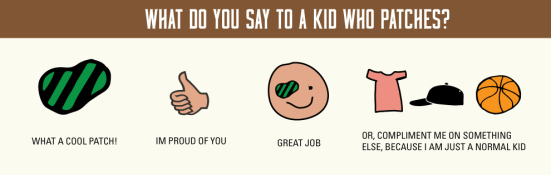
So what can people say to a kid that’s wearing an eye patch? Well, here’s one simple comment that could easily replace the ‘pirate’ one – ‘wow, what a great red eye patch!’. And I don’t even mind if it’s followed up with ‘why do you wear that?’. Dane’s only three but he knows why he has to wear his patch and will happily explain it to anyone that asks.
I’m sure this type of commenting or questioning could be used for any type of ‘noticeable difference’ that a child has. By turning your comment to a child that has something a little bit ‘different’ – no matter what that difference is – into something positive, that child might just feel good about their eye patch, their glasses, their wheelchair or whatever it happens to be. And that’s the way a child should feel.
So this International Speak Like a Pirate Day, if you happen to see a kid wearing a patch maybe just say ‘what a cool patch’ and not ask him where the treasure’s buried.
A long time ago (well, long time in Internet land), I wrote a post about the good side of having a kid in glasses. My favorite was that everyone seemed to notice Zoe’s glasses, so they probably didn’t notice the stains on her shirt. I’d been thinking about that post again as I’ve recently come up with a few more side benefits. And of course, I’ll note that the absolute best thing about glasses is that they improve and protect our children’s eye sight, but a few other perks don’t hurt :
Citrus Picking, photo by Amomofelly
Sun protection. We all know that it’s important to protect our eyes against the sun’s UV rays. Well, the lenses of our kids’ glasses provide UV protection. So any time their wearing glasses outside, they’re getting protection. Now, a lot of glasses have small lenses, so they don’t provide protection from sun that comes in around the lenses, but it’s still far more than if they were out without glasses. And now that I also have a second daughter who doesn’t wear glasses, I can say, it’s way easier to get Zoe to wear her glasses (be they prescription sunglasses or regular glasses) outside than it is to get her sister to wear sunglasses regularly.
Side benefit: Siblings may be more likely to wear sunglasses because they’re jealous of their brother or sister’s glasses.
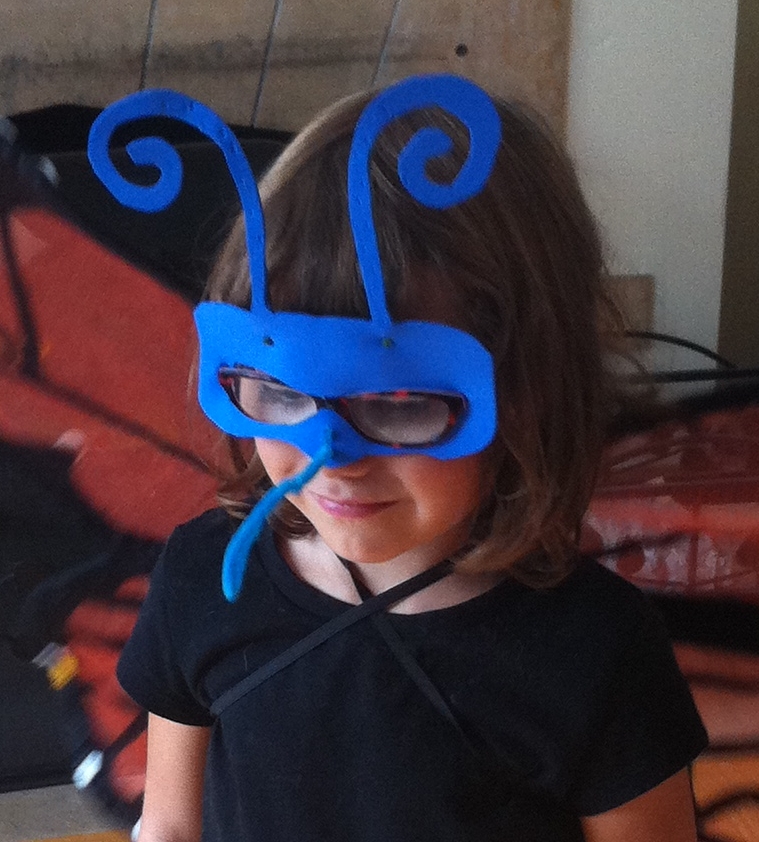
Zoe in her butterfly mask.
Masks. A while ago, someone on the facebook group asked about masks for kids in glasses. Amomofelly came up with a fantastic design, using craft foam to make a mask that slides on to your child’s glasses. You can get the instructions here. I’m in love with this mask! It stays on and in place so well, and it looks awesome, and it’s super easy to make! I’m actually sad that Zoe’s little sister doesn’t have glasses, because they’d make her chicken costume for Halloween much easier. I’m also thinking about making a mask this way for myself this year, too.
Advocacy. We get asked about Zoe’s glasses all the time – and we got asked a lot more when she was littler. There’s still not a lot of awareness of the importance of children’s vision. As exhausting as the questions can sometimes be, they’re a great opportunity to help other parents understand how important it is to have their children’s vision tested and to get treatment if there’s a problem.
I’m sure there are other great side benefits to a young one in glasses. What am I forgetting?
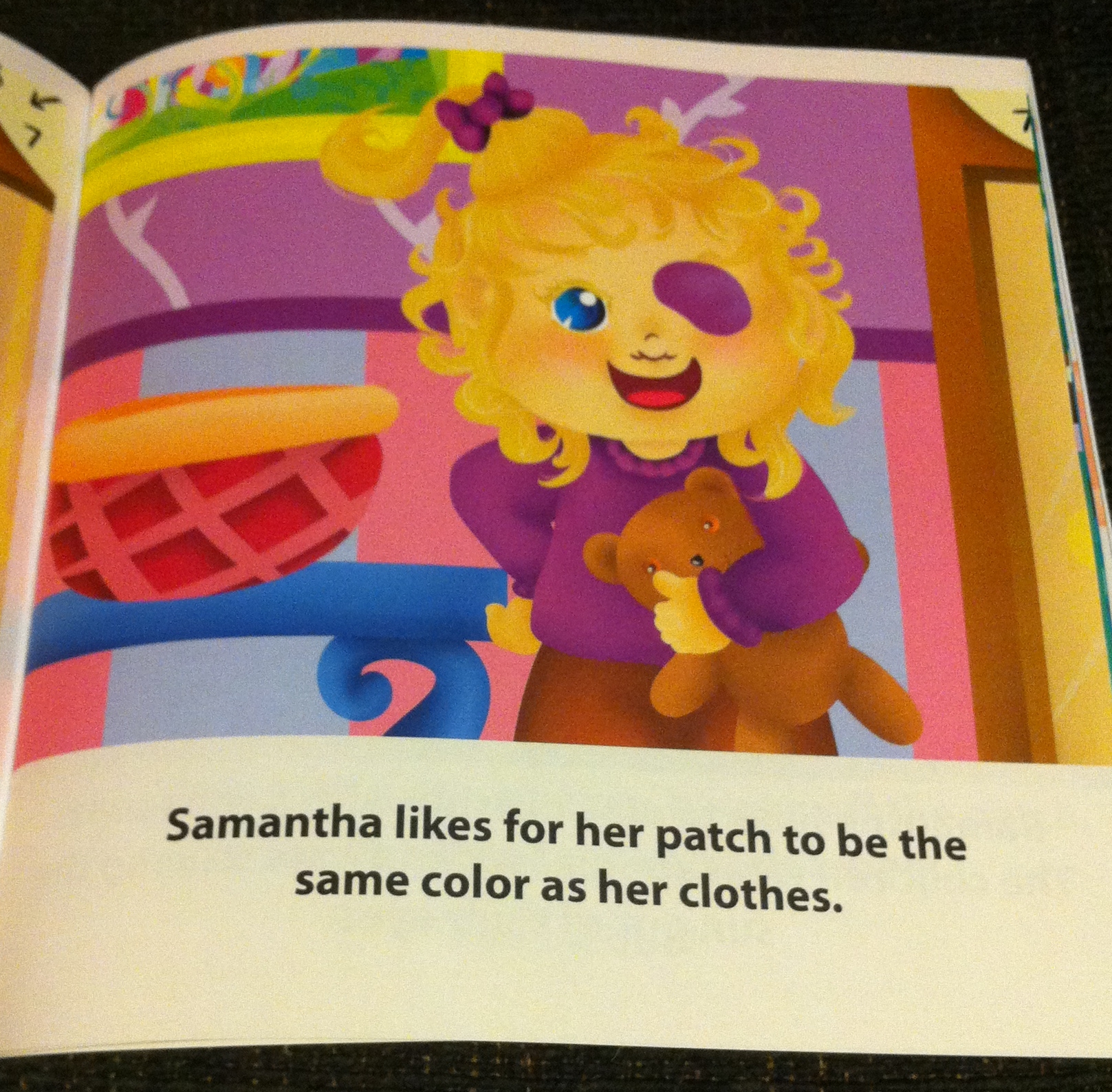
Samantha is like most other kids: She love to read books, she plays outside with her friends, she gets hugs from her mom to make her feel better. Oh, and Samantha wears a contact lens and a patch due to a congenital cataract.
In Juliette Vignola’s book, “Samantha Wears a Contact Lens and a Patch,” we get to see a day in the life of Samantha. She is a happy girl, whose day includes having her mom put in her contact and patching. But neither of those activities are portrayed as being something strange, rather they’re simply presented as a normal part of her day. It’s very refreshing to find a book which simply incorporates these as a day to day activity. Most aphakic kids do not remember a time before contacts or patching, so even if they’re a struggle, they’re still a part of of their daily life. The book is also peppered with questions to the audience, “Does your mommy or daddy put your contact lens in for you?” The questions further normalize the experiences of the young readers, helping them feel less alone.
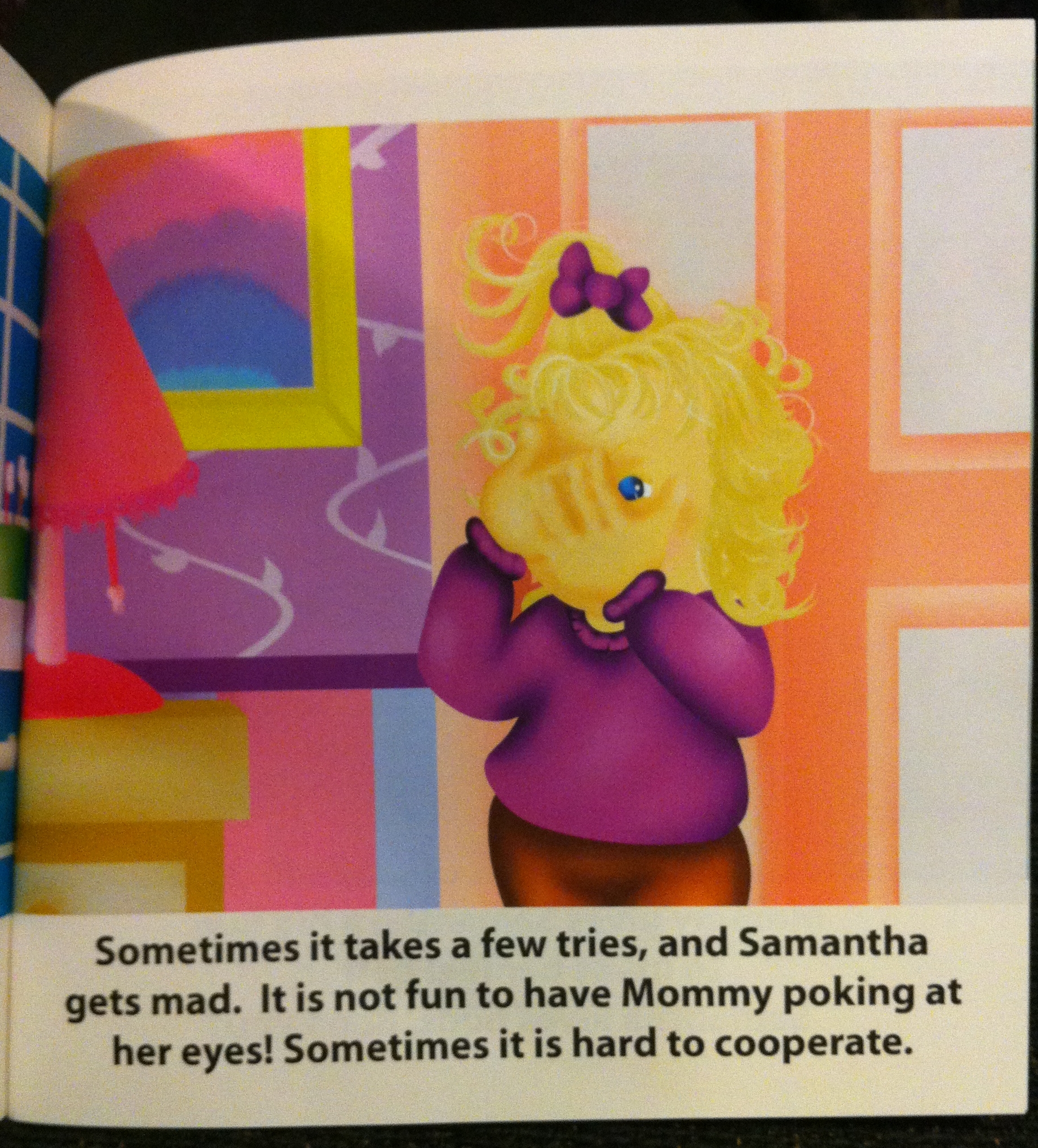
This isn’t to say that the book sugar-coats patching or contact-wearing. Samantha gets mad when her mom has trouble removing her contact, something I imagine most kids and parents reading the book will relate to. I found myself laughing when the contact was correctly put in or removed, and Samantha’s response was, “Not so bad!!”
The writing is simple, clear, and charming. The illustrations in the book are bright and cheerful. They work perfectly with the tone of the book (my photos don’t really do the illustrations justice).
This is simply a wonderful book, and I believe it is the only book out there that is targeted at young aphakic children (probably the only one targeted at any aphakic children), so it is a very welcome addition to the growing list of books for our kids. The author is planning a second book for kids with bilateral contacts. If your child does wear a contact lens and a patch, I absolutely recommend this book!
Giveaway
Updated: The giveaway ended on Sunday, Sept. 15. Congratulations to Terri, who is the winner of the giveaway!
While my daughters and I enjoyed reading the book, neither of them has cataracts. I would like to give my copy to someone who does have a child who wears a contact and patch like Samantha. Leave a comment here to be entered. I’ll do a random drawing of all the commenters on Sunday, September 15. And many thanks to Juliette Vignola for sending me this copy.
Disclosure: I received the copy of this book for review. This did not impact my review.
Peeps Eyewear was created by Kristin Ellsworth in response to her young daughter saying she didn’t want to wear glasses because “princesses don’t wear glasses.” She designed fun and durable glasses for kids aged 2 – 7, and wrote a book to go along with it, “Princesses wear glasses.” You can customize the book with your child’s name and hair color. The best part about the book, for me, is that the Princess is adventurous and does the rescuing herself (here’s my review of the book). Zoe loves the book, and loved her Peeps glasses, too.
There have been a lot of open letters posted recently in the kids in glasses community. I’ve had so much fun reading them, I wanted to put together a list of the ones I know of, and I wanted to put forth an invitation to all of you to write your own.
Most of the letters have been written to the often-maligned eye patch:
“I really hated you the first time I saw you. Actually, if I am being honest, I not only hated you, I resented, despised, loathed and cussed you.
. . .
“Through all of my crazy range of emotions, you remained a stable presence in our lives. You have changed colors and designs. You smell a little differently at times and sometimes you are a little stickier, which I appreciate, especially in the summer months.” . . .
“I despise what you do to our mornings. “A” dreads getting out of his bed because of you. He will lay there awake and tell me to go away when I check on him to avoid contact with you. We are inserting a cuddle session sans you in the mornings to avoid this.
. . .
“I appreciate that you have given my child not only usable vision in a previously blind eye, but much better than the doctor’s expectation. I think that I have decided that because of this fact alone, I partially love you.” . . .
“you are on my son’s face
everyday
for most of the day
for nearly the next
decade
his entire childhood
I would be the fool
to not accept that
to not capture him
his life
let’s be clear
I’m not photographing you
I am remembering HIM” . . .
But it’s not just the patches that are receiving letters, some have been written to people as well:
“You’ve never known your brother without glasses. Now that you’re grabbing things, they’re one of your favorite things to grab when he comes in for one of his many kisses a day. You’re very lucky for many reasons. One is that you don’t have cataracts, but I think you are the luckiest because you have a brother that did. Your brother is the strongest, bravest, neatest kid I’ve ever met. He is such a good big brother and loves you so much.” . . .
“Hello! Yes, I wear an eyepatch, isn’t it cool? My favorite one is the one with dinosaurs, I like to roar like a dinosaur. Guess what? I can see you, even with an eye patch. These glasses? Yes, they are real, yes, they work, and no, they aren’t broken, it’s called a bifocal. Oh, and I can also hear you, so can my mommy.” . . .
“Please help us to understand our children’s vision and their vision problems. I know you studied the visual system and eyes, not how to calm a freaked out parent, and I know that we are not always easy to deal with (and especially after eye drops, our children aren’t always the easiest either). But we know that glasses and patches and eye drops and other treatments work best when they’re done as directed.” . . .
So what letters are missing? Who or what would you write to? I’d love to publish more letters here, or link to them if you’ve written them for your own blog. Leave a comment or send me a note at ann@shinypebble.com.
I was recently invited to write a guest post for What to Expect‘s “Word of Mom” blog, and in a move surprising no one, I decided to write about having a young child in glasses. It was a good exercise: to look back and write up the story of learning the Zoe needed glasses, especially now that we’re more then 5 years past that point and have the perspective that comes with time, knowing that she would eventually love her glasses, and that she’d do so well with them.
Yesterday in our facebook group (if you’re not a member, you should be!), Jessica shared an upsetting story which she gave permission to share here. She was with her son in the waiting room of their eye doctor. Another woman was there with a young boy, and the woman told the boy that if he didn’t behave, he’d have to wear an eye patch like the baby (“the baby” being Jessica’s son).
I’ll let it sink in just how awful a comment like that is. First that anyone would essentially accuse someone of putting an eye patch on their child as a punishment, is horrid. But if that young boy ever does need to patch, he now may think it’s because of something he did and be far less willing to comply. I’m happy to say that Jessica responded well and explained why her son needed to wear a patch.
The story inspired another member, Kristin, to create a new pie chart, which reflects why a child might be wearing a patch. It’s a bit different from another chart about patching that I’ve seen around. Kristin’s is far more accurate:
So I asked for a second chart that outlines reasons why a child might be wearing glasses, in response to all the questions we get about whether the glasses are real. Kristin happily provided one:
I should note that the pie charts are for illustrative purposes only and are not based on real numbers. I actually have no idea how many kids may be playing dress up with glasses or eye patches at any given time. I hope none are ever wearing them as punishment!














 For Little Eyes