This is a companion piece to the post about just starting out with glasses. I’m hoping to pull together information for parents who have just learned that they need to patch their child’s eye. Please leave comments with anything I’m missing! – Ann Z
Why Patching?
George the monkey is wearing an adhesive patch. Owen is wearing a cloth patch (with adhesive tape keeping it on so he can’t peek).
Eye patching is done for a few different reasons. Sometimes an eye is injured or recovering from surgery and needs to be protected by an eye patch. More often, though, eye patching is done as part of the treatment for amblyopia (also known as “lazy eye”), or in an attempt to keep amblyopia from developing, and in some cases for helping with strabismus. It’s these latter reasons that I’ll be focusing on (no pun intended) in this piece.
With amblyopia, even when the eye sight is corrected with glasses, the brain doesn’t see images clearly from one eye. Basically, the brain favors one eye over the other. Untreated, this disrupts stereovision (both eyes working together) and can lead to permanent vision loss in the weaker eye. By patching or otherwise penalizing the stronger eye, you encourage the brain to start recognizing the weaker eye again.
My daughter M never stops talking. She loves audiobooks and playing with her dolls; teasing her brother and plinking and plonking away on our piano. She is tall for her age and would only wear red for over a month when she was two; she has a habit of picking her nose (no matter how many times we tell her not to) and loves ice cream. Oh, and she has low vision.
M has high myopia and degeneration of her retina. She has already had laser surgery to repair retinal tears once and is booked in to have another evaluation under anaesthetic (EUA) in a few weeks time. She has an area in the centre of her visual field that is slightly obscured due to previous damage. Her uncorrected vision is off the charts and her visual acuity is at best 20/100 when she has a full correction. At the moment her vision is deteriorating pretty quickly and it’s becoming common place for her prescription to increase by -1D or more in the three months between each visit to the ophthalmologist.
What does this actually mean in real life though? She tends to hold things closer to her face to look at them – if we go to the library to borrow out books we try to get two identical copies so that I can hold one to read and she can hold one to look at the pictures (she likes picture books for younger children as she’s learning her letters and the print is large enough for her to see). Whereas her brother learned to read very young, she struggles with letters that are close together and is learning with flashcards (one letter per card) that we lay out to say words.
She probably has more bumps and scrapes than a child with normal vision and will trip over things that she hasn’t seen (she’s also terrible at judging distance, which doesn’t help). She doesn’t really enjoy watching television as she doesn’t really see well enough. When we go out in public she tends to stick to me like glue as she’s nervous about getting lost, and we try to wear bright clothes when going to a busy place.
The other thing to bear in mind is that M has never had normal vision – she has never seen a television screen clearly or been able to spot a friend across a room. In a way, this makes it easier for her as a lot of the adaptations she makes have come naturally, but is frustrating for us as she does not tend to notice any deterioration.
This is only a short list of how M’s low vision affects us on a day to day basis – a lot of the adaptations that we make come naturally. The thing that we always say to friends and family is that M is so much more than her bad eyesight – she’s our lovely little girl.
Penguin has a daughter with extreme, and possibly posted some questions about her daughter who has extreme and progressive myopia. She’s hoping to connect with other parents who are facing a similar issue with their child and has a lot of questions. Here’s her post. – Ann Z
I hope that other parents dealing with extreme myopia might be able to offer some pearls of wisdom!
I’m the mother of two little ones with glasses. My son who is five was diagnosed as nearsighted (myopic) at the age of two and started wearing glasses. We weren’t very surprised as both my husband and I wear glasses and have done from an early age and after the first tricky couple of weeks he wore them happily. In the last three years or so his prescription has jumped every year and is currently at -5.75 in his left eye and -5.00 in his right. I am not too worried about him as he has very good corrected sight, although I do worry that his prescription will continue to worsen.
When my daughter (who has just turned three) was six months old, we realised that she was not tracking and her pediatrician referred us to a PO. And then we got the shock of our lives – she was severely myopic, even more than my husband and I. Our PO told us that it was probable that she had congenital myopia and she started wearing glasses right away, although she wouldn’t really keep them on until she was a little older. The doctor wated to see her every three months initially and unfortunately her prescription has increased almost every time. Her prescription is currently at -18.5 -1 x 120 in her left eye and -19.75 -0.75 x 120 in her right eye.
We are very worried about her as we have been told that she is at a high risk of retinal detatchment and that she should avoid any activity that could mean she would bang her head – not easy when she is that age! Do you have any advice? S
I’m also so afraid of her future – we have been told that it is possible that she has progressive myopia. Even if her sight does become stable now, it is likely to become worse as she enters puberty. Her PO has recommended bifocals to help to slow progression – does anyone have any experience of this? Do you have any other tips to slow progression?
I have so many questions – I would be so grateful if anyone could help:
How do you keep your children from banging their heads, not doing sport etc? I’m so paranoid about her having a retinal detachment.
What do you do about swimming? Her brother has prescription goggles but I obviously can’t get her any in her prescription so she refuses to go anywhere but the shallow end where she can keep her glasses on. I understand that her sight is truly terrible without them and that she is to all intents and purposes blind without them (as am I without mine!) but I would love her to be able to learn to swim.
Do you know about lenticular lenses? Her PO has said that if her prescription increases much more, she will need to wear myodiscs or lenticular lenses? What are they and will they make her look very different? I’m so used to seeing her minimized eyes that it doesn’t bother me at all, but I’m very aware that she will be going to school soon.
What different approaches can we put in place when she starts school to ensure that she learns well? I somewhat doubt that she will be able to see the board unless she sits right at the front and I think that she will need some of the worksheets and books enlarged so she can read them properly? This is also where I think that bifocals could be helpful? Does anyone have any experience of them?
Are there any other adaptations around the house that I could make that would make living with low vision easier for M?
Also, are bifocals useful at much lower prescriptions too? My son B (whose prescription is only -5.75 and -5.00 is 5 years old and reads all the time – he’s never without a book! I’m aware that this could affect his sight (which has worsened every year since he started wearing glasses at the age of 2 (only -2.75 and -2.50 at that time). He is very bright and a year ahead at school so I don’t wish to stop his reading, just don’t want to make his eyes worse either!
And finally (I promise!) – does anybody have any experience of degenerative or progressive myopia? I am so scared that this might be what my daughter has – she is only just three and yet her vision is so poor even when corrected and has continued to worsen since she first got glasses.
One of my biggest worries when Zoe got her glasses was how she would do with her glasses when she was at daycare. While they’ve always been wonderful with Zoe, I was sure that they would not be interested in spending all day fighting with her to get her to keep her glasses on. When we first got Zoe’s glasses, I asked my source for glasses advice (the lady at the glasses shop) if she had any advice for me to pass along to her daycare providers. The woman just told me that her teachers would have to figure something out. That was the one time I got completely unhelpful advice from that shop. I also hoped that since I was home with her the first week she had her glasses, that she’d be a spectacle-wearing pro when she went back to daycare. Alas, it was not to be. There were days, those first weeks, when they weren’t able to get her to wear her glasses, and we’d find them sitting in her cubby when we picked her up at the end of the day. Luckily, she started wearing them reliably within a few weeks, so that part didn’t last long. Still, knowing that she and her glasses were out of my control added stress to an already stressful time.
Whether or not your child is in daycare, there will be times when they’re being watched by someone who is likely less familiar with young kids in glasses than you are. Here’s a few tips:
Information for your child care provider about your child’s glasses:
Should kids go without glasses when playing sports? It’s often safer for them to be wearing their glasses so they can see during those activities. (Check with your child’s doctor, or think about getting sports goggles if you’re concerned about safety)
When should your child be wearing his or her glasses? Or maybe it would be easier to tell them when the glasses are allowed to come off (for example: nap, bath time, face washing).
What do you want them to do when your child takes off their glasses? This includes what to do with the glasses during nap time, or other times when your child should not be wearing glasses, but also, how should they handle your child not wanting to wear their glasses.
Make sure they understand how vital wearing glasses is to your child’s visual development. Since a lot of farsighted kids can function very well with glasses, it’s easy for someone to think they don’t need their glasses.
Make sure they know how to help your child take off and put on glasses (using both hands).
Ask them to keep an eye out for dirty lenses and make sure they know how to clean the glasses without scratching the lenses.
Are there any activities your child should not be doing because of their vision? Or any activities that might be particularly difficult? Make sure they know about it and talk with them about ways to help your child during those activities.
If your child patches, how long should they patch, when, and what should they do with the patch when your child is done? In this case, you should also keep them up to date on how well your child can see when patching. There may be some activities that are too frustrating, especially in the beginning with patching.
If your child wears contacts, you should provide similar information about when and how they should be removed.
Are there any things having to do with your child’s vision that you want them to watch out for (for example: eyes not straight, squinting, looking over the glasses)?
Make sure they have contact information for your child’s eye doctor, and under what circumstances should they be contacted.
If something does happen to the glasses (or contacts), what do you want them to do with the wreckage.
Things to provide (or to make sure your child care provider knows where they are):
Glasses case.
Glasses cleaning cloth and cleaning spray.
Prescription sunglasses or clip on sunglasses if necessary. Same with sports or swimming goggles if they’ll be needed.
Extra patches, if they’re patching.
Contact cases and solution if they wear contacts.
Am I missing anything? (Update: Thanks for the great suggestions! I’ve been adding them to the list as I get a chance)
Some quick links for this Monday morning (well, it’s not actually morning anymore where I am, but I tried..)
Strabismus Survey – Kristal Wheaton is a mother of a boy with accommodative esotropia, she’s also a student at CSU East Bay in the Human Development Department. For her senior capstone research project, she’d like to look at strabismus from a developmental perspective. The survey is quick (I just completed it for Zoe), and asks whether your child can do certain tasks. If you have a child with strabismus, please consider taking a moment to complete the appropriate survey, responses are due on Thursday, May 24. You can also read more in her informed consent document. Here’s the links to the surveys:
Article on reading: “the great iceberg aka learning to read” – this link was posted by a friend on facebook, and I found it to be a fascinating explanation of many of the pieces that kids need to understand and master before reading. It was especially interesting to look at it through the lens (pun intended) of children’s vision – if a child’s vision isn’t corrected, many of these pieces become so difficult. This is a good piece for those of us who get the question of why a child who doesn’t read might need glasses (yes, I’ve gotten that question, and yeah, it made me mad). I wrote more about it over at the Great Glasses Play Day.
Vote for the Great Glasses Play Day logo – today is the last day to vote for the logo for the Great Glasses Play Day. If you vote, you can be entered in a drawing for a free t-shift featuring the winning logo!
Thanks to Melissa who wrote this post on her blog, perfect boy. A not so perfect eye, and gave her permission to post it here. She’s written for us before, with her fantastic post on patching a toddler, and the lovely, eye believe. You may also want to check out her other posts about her son on her blog. – Ann Z
my cousin, Shannon, left this as a comment one day on a blog post & it really stuck with me. It’s a nice reminder of why I am tired with this patching business. It’s hard, but so worth it. I saved his patches for a few days (literally, we go through more than this amount in 2 days, but these were the ones that I could salvage) & wrote the quote in it, so I can have it as a reminder.
Two things in this post.
First, I was talking at lunch, I can’t remember what about, and I said something about, “One of my eye moms…” And, a friend said, “Oh, EYE moms. I thought you meant imoms, like ipad or ipod.”
Excellent.
I realized that is such a better name! Think about it, all of Apple products are designed to make people’s lives better, just like the imoms! I am reading Steve Jobs’ biography and he said, “The consumer doesn’t know what they want until we show them.” (possible paraphrasing there) and I think even that is relevant. I had no idea when I started this blog that Anderson was going to be diagnosed with a cataract or that I was going to spend the next years of my life chasing around a very active boy with a bandaid. But, I also didn’t know I was going to find such support in all of the imoms out there! I didn’t even know I needed you guys 🙂 I love it.
So, my next thing is that I am (yet again) in the acceptance stage of the Eye. Or, at least back to somewhere on the outskirts of it. I have realized that I am so, so, so much luckier than so many moms out there. What on earth do I have to complain about? While this patching all day thing is the Hardest. Thing. I’ve. Ever. Done. In.My. Life, my kid has a “situation” that requires constant attention, but is not fatal and will not drastically impair his ability to live a normal life even in the worst case scenario.
But, even better, we have a chance. I realized how many moms in awful situations, where they are really watching their kids struggle or be in pain, would love to just have a chance to make it better. I think the best attempt at putting into words what being a mom is on airplanes where the emergency info says, “You must put your oxygen on first or you will be unable to help your child!” There is even a little picture of it to demonstrate. I love this because it clearly recognizes that helping yourself first goes against every single speck of instinct that makes up being a mom. The airline basically has to tell you it will hurt your kid if you don’t do this. My point is all moms love their kids beyond anything imaginable. Many moms who are struggling with things way worse than I am would love to be in this situation where I have a chance to fix it.
I am so thankful for this, even on the days when I complain a lot, I promise I realize how lucky I am.
There’s a very sweet and interesting story over on the Today Show website that I’ve seen shared by quite a few friends this evening. A young girl, Emme, 3 years old, was just admitted to the Mensa (a society for people with a high IQ) as their youngest member. But that’s not why I’m writing about her. The first part of Emme’s story talks about how worried her parents were when she was an infant because she didn’t make eye contact, never reached for toys, and wasn’t crawling. That will sound familiar to a lot of us, I think. Her mom trusted her gut and brought her in for a vision exam and they lo and behold, she needed glasses. And once she had those glasses – once she could finally see – that’s when she really transformed. The quotes from her mother echo quotes I’ve seen on this site from parents when their child really sees for the first time:
“We walked past a foyer table with family photos in frames, and she physically pulled on me to stop,” Horne said. “She looked at those pictures as if she’d never seen them before.
“After that, she showed an obvious want for things — grabbing at things, trying to get to toys, fussing for things that she couldn’t reach — and she started crawling within a few weeks.”
(quotes like that always get me just a little teared up).
It’s nice to see such a positive story about a young child in glasses in the media, and Emme is even shown patching her eye for amblyopia in the last photo (and sporting a super-cute patch at that!).
The whole story is definitely worth a read, and is a great one to pass along to friends who might wonder why it’s important that kids get their eyes examined, and get glasses as treatment if it’s needed.
As Emme’s mother says at the end of the story:
“’This could be a call to parents: Advocate early!’ Horne said. ‘If I hadn’t pushed … I’m not sure our outcome would be as good.’”
Some quick announcements and updates to start off your week!
Great Glasses Play Day (August 5, 2012) – thanks for the great response to the Great Glasses Play Day! We’ve already heard from people in 8 locations in 3 different countries (!!!) who are interested in helping with a local event, and as I mentioned, we’ll have a bunch of ways for people to participate even if they aren’t close enough to come to one of the events. If you haven’t already, take a minute to like our page on facebook so you can stay up to date on all everything that’s happening with it.
~~~
Photo Gallery – I’ve added more photos to the photo gallery, but even more exciting, I’ve updated the page and added a slide show (which takes a moment to load) and made the page a bit more compact if you want to scroll through it. If anyone’s keeping count, we have 154 photos in the gallery! If you’ve sent in a photo of your child and I somehow missed it, I promise, it’s not you, it’s me. Please send me an email (ann@shinypebble.com) and I’ll get it added.
~~~
Children’s Eye Foundation Photo Contest – is still going on. I’ve heard from 5 people who have entered their cuties in to the contest. Take a look at our page to see the photos and links to vote for them (and any other pictures you like). Please do let me know if you’ve entered your child in the contest – there’s still time! – and I’ll add their picture.
~~~
Wonderbaby.org – I received a comment a while back from someone at Wonderbaby.org and finally had a chance to check it out. What an amazing resource for parents who are dealing with children with vision impairments! The site was started by the mother whose son has LCA, and is funded by the Perkins School for the Blind. It has a fantastic list of resources, a Q&A forum, a news section, and a whole lot more. Wonderbaby also currently running an iPad giveaway, which comes with special needs apps and equipment. If your child has a visual impairment, I highly recommend checking out Wonderbaby and the giveaway!
~~~
I’ve also updated the Parent’s Resources page and the Blogs list. I’ll be updating the list of books soon. Hope everyone had a great weekend!
Ever since starting Little Four Eyes, I’ve had a dream of somehow putting together an event for this community. I’ve loved the support that everyone shares here, and if there’s any theme to this blog and our facebook group (ok, other than the obvious kids with glasses thing), it’s that nearly every single one of us felt so alone when we first learned our child had vision issues. And finding others that are in the same boat has been wonderful. And I don’t think it’s just us parents that would benefit from a get-together: Zoe doesn’t remember not wearing glasses, and once she got used to her glasses, she’s never really fought them, but she still comments on the fact that none of the kids at her school wear glasses. I love the idea of kids seeing that there are other kids out there with glasses or contacts or eye patches – just like them.
Then, in the Little Four Eyes facebook group, there was discussion of putting together some kind of celebration day for kids in glasses – some way that we could all show our love of our little four eyes.
But here’s a little secret, I’m introverted, and shy, and not always good at organizing things that aren’t text. While I can run a website, and moderate a facebook group (granted, you guys make this easy), and research the heck out of a question, I’m more than a little scared of trying to put together some kind of event, especially something in person.
And then along came Kristin, the founder of Peeps Eyewear and author of the book “Princesses Wear Glasses”. She was excited about the idea of some kind of celebratory day, too! And she has all sorts of energy and enthusiasm and she convinced me that working together, I’d could step outside my comfort zone and give this a try. So here goes:
Now, as much as I love the idea of one big get together, I know that’s not possible. We’ll have an in-person meet up in Minneapolis (at the lovely Lake Harriet), and it’ll include activities and lots of space to play and even a parade! But we’re also going to have a lot of ways to participate online, and even more exciting (at least in my mind), is that we’ll be encouraging people to plan their own in-person celebrations. We’ll even help you organize get the word out to others in your area.
Check out the Great Glasses Play Day website, or “Like” it on facebook. We’ll be updating both with more details and ways to get involved. I’m terribly excited about this, I hope you’ll join us to make this a great event!
Update 6/16/2014: Thank you for all the great responses. I got some great suggestions and I’ve updated this in response.
As I was reading through the comments on my last post (asking for favorite comments about your child in glasses), it got me thinking about the good things to say to young kids in glasses, and to their parents. And that, of course, led to me thinking about the things not to say. Now, I’m sure there’s going to be some disagreement on some of these things. Different people (kids and parents alike) are sensitive to different types of comments, what one person finds funny might really upset someone else. Still, I expect there’s some general guidelines we could pull together. All the examples below are comments that we’ve gotten personally, or ones I’ve heard about through this blog and the facebook group.
Oh, and there’s nothing wrong with saying nothing about the glasses. It can be really hard when a child is first starting to wear glasses, even when they’re too young to care what anyone thinks. A lot of times parents get them to wear their glasses by distracting them with an interesting trip out and about. Having someone point out the glasses may remind the child that the glasses are there, leading to more struggles to keep them on. But I’ve come to the realization that sometimes, you see this little one in glasses and you just have to say something.
So let’s start with what not to say:
Yes, they’re real…and with them, my vision is spectacular!
“Are those real?”
No, they’re just imaginary. [insert eye roll].
It’s such a silly question, and yet it’s one of the most common questions that parents of a young child in glasses get. Yes, our children look very cute in them, but believe us when we say that we would not spend the money and effort to get our child to wear these if they weren’t needed.
“What’s wrong with your child?” or “What’s wrong with her eyes?“
While it’s totally reasonable to wonder why a child is wearing glasses, asking what’s “wrong” with them is really hurtful. It’s a pretty good bet that they’re wearing glasses either because their vision needs correcting or because they need eye protection particularly.
You could ask why the child needs glasses, without using the term “wrong” if it’s something that you really want to know.
Any nonsense about glasses hurting the child’s vision, or questioning whether the eye doctor got things wrong.
Again, no one puts glasses on our children without good reason. The glasses are there to help our child’s vision develop correctly.
“Poor baby!”
Glasses can be difficult, and bad vision is nothing to sneeze at, but the glasses are correcting our children’s vision. They’re helping them to see, they don’t need pity.
Just pointing or staring or making mocking gestures about the glasses.
It’s just rude. Don’t do it. I’m sure you were raised better than that.
He looks so cute in those glasses!
This seems like a nice thing to say, and yes, it’s true, our kids do look cute in their glasses, but it makes it sound like they wouldn’t look cute without their glasses, and that’s simply not true. Plus, this comment is so common that it starts to feel like the glasses are the defining characteristic of our child. See below about some ways that are helpful in talking about the glasses.
She looks so smart in those glasses!
Again, this sounds like our children don’t look smart without glasses. And besides, glasses have a magical ability to help our kids see better, but they don’t have any ability to change our child’s intelligence (not that our kids would need it).
“She looks prettier without glasses”
Oh no. Oh no you did not just say that. No. Again, surely you were raised better than that.
It’s Harry Potter / a Minion / the kid from Jerry Maguire / the girl from Little Miss Sunshine / a mad scientist / the professor! Nope, just our kid. Unless, of course, it’s Halloween or a costume contest, then you might be right. Or, I guess, if it really is Harry Potter. Then you should get his autograph or ask him to perform some Quidditch moves. But if you’re making the comparison based solely on the fact this child in front of you is wearing glasses, and there’s a character that also wears glasses, then it’s not really a useful comment. Like the “cute in glasses” comment, I know it probably comes from a place of good intentions, but again it emphasizes that the only thing you notice about them – their only distinguishing characteristic – is their glasses, and that’s just not true.
Things to say
Comment on something other than the glasses
One of the fears I’ve often heard from parents is that people will always focus on their child’s glasses, and not on them. And that fear isn’t unfounded, the majority of comments that I hear from strangers about Zoe are related to her glasses. So buck the trend: compliment the child’s beautiful eyes, or their smile, or their quick wit, or how fast they run, or how well behaved they are. We’d love it.
Comment on a specific aspect of the glasses and how they relate to the child.
Rather than simply saying a child looks cute in glasses, you could talk about how the color of the glasses brings out our child’s eyes, or that their shape really compliments his face, or that the glasses really match her personality. If the child is old enough, you could ask if they picked out the glasses and tell them what a good job they did with that.
If you do comment on the glasses, don’t be surprised if the child is really shy or upset by it. Zoe is normally a talkative kid, but she often clams up when she gets comments on her glasses.
Questions
We all get a lot of questions about our children’s glasses, probably the younger the child, the more questions we hear. A parent of a young child in glasses gets pretty good at answering questions about how they knew their child needed glasses, how on earth you get a child to wear glasses, or how they can test a pre-verbal baby’s vision. Please ask, especially if you have a young child yourself, because good vision is extremely important, and if we can help someone catch a vision problem early, then that’s a great thing.
Update: Congratulations to Dee for winning the 12 month onesie, and to Melinda who won the 24 month shirt!
First off, congratulations to the winners of the first giveaway: Heather won the Glasses Parade card, and Andrea won the Glasses Rock card!
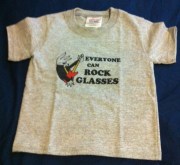
For the next giveaway, I have two shirts. Both have the text “Everyone can rock glasses!” The first is a grey, 24 month t-shirt with a bird playing guitar:
The second is a grey, 12 month onesie, with a cat playing drums:
To enter this giveaway, leave a comment with the shirt you’d like to win, and your favorite comment you’ve received from a stranger about your child’s glasses. Or if you don’t have a favorite comment, what would you like to hear?
I’ll use a random number generator to draw winners for the shirts on Tuesday, April 3
And here’s the promised giveaway, today it’s for two of the new glasses cards.
Glasses rock card
The first card features a stylish cat rocking out on the guitar with the words “Glasses Rock!” The inside message reads, “…and you’re rocking your glasses!” The card is 5″x7″ (12.7 cm x 17.8 cm).
glasses parade card
The second card is a parade of two children and a bunny, all wearing glasses. The inside message reads, “Happy new glasses day!” This card is smaller, 5.6″ x 4″ (14.2 cm x 10.2 cm).
(Both cards are available in both sizes from the store).
So, if you’d like a chance to win either of the cards, leave a comment here, how about, with your favorite color of glasses frames for kids, and include which card you hope to win. I’ll do two drawings on Saturday, March 31, one for each of the cards.
One of the cards for new glasses. The flag reads "Hooray for glasses!", the inside reads "Happy new glasses day!"
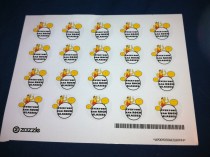
I’m pretty excited to let everyone know that I’ve started a Zazzle store with some Little Four Eyes items. I asked Meagan Nishi, the artist behind a lot of our coloring pages, to create some images for new glasses cards, t-shirts, and stickers. At the moment, there are 3 designs for cards, 2 designs for shirts, and 3 designs for stickers.
Take a look!
I’m especially excited about the cards, since I think they could be a fun way to celebrate a child getting their first pair of glasses (or even a new pair of glasses).
I ordered a few of the items to make sure that the quality was good, so I have a few pieces to give away: 2 new glasses cards, and 2 shirts (a 24 month t-shirt and a 12 month onesie). I’ll post those giveaways separately over the next few days.
Janine has asked me to post a survey about eye patching, she writes:
I am the mother of a little boy who is having difficulty accepting his glasses after 4 months. We have now started to patch and this has just added to his, and his Mummy’s and Daddy’s, frustration. Added to the worries and questions that we have about about his sight are those regarding what people see when they look at him and how he will feel about himself as he gets older (I won’t elaborate as I know that each of you have asked yourself the same questions at some point in your journey).
And so I decided to write a book for my little boy that celebrates all that he is. I think it’s pretty good and plan to submit it to a publisher, but need to do a bit of research first. Please help me to get started by filling out this quick survey.
Your time and effort is greatly appreciated.
(Ann Z here), I wanted to note that while there are a lot of books about glasses, there are very few that talk about patching – we only have 4 on our list. As a librarian, I think having more books for our kids is a fantastic thing.
Children’s Eye Foundation’s 2012 Visions of Home calendar (click to see a pdf of the full calendar)
Update #2: There have been some technical issues with voting. Any computer will be able to vote for a photo only once (not once a day, just once). This means that parents who have entered their child can’t bug friends and family to vote for their picture more than once.
If you haven’t already, please take a moment to look through the photos here and the photos on the site and vote for any that make you smile!
Update: Check out the photos below that have been submitted by readers. Click on any picture to be taken to the page to vote – please take a moment to vote for them or any other photos you like if you have a chance. And please leave a comment to let me know if you’ve also entered a picture so I can add it to the list! Scroll down for details about the contest and how to enter
Star BrightSweet LilyHappy to seeTwins in glassesIOLs+Bifocals = Amazing PeepersThe bravest girl we know … LilaPinktasticLittle CutieThis is my beautifulsurfer dude
~~~
It is once again time for the annual Children’s Eye Foundation’s photo contest. The photo contest is run each year to choose pictures for the foundation’s Eye Care for Eye Care calendar. Take a look at last year’s calendar, it’s a beautiful calendar, with a number of Little Four Eyes readers’ children included.
This year’s theme is “Jeepers, Creepers…Amazing Peepers.” The top ten vote-getting photos will win a digital camera. A panel of judges will also choose 12 photos from the submissions to use in the 2013 calendar.
If you do submit a photo, would you let me know by leaving a comment? I’ll start a post listing the photos that have been submitted by the community so that others can vote for them if they’d like.

















 For Little Eyes