four eyes are better than one?

I loved the Mr. Men and Little Miss books as a kid, so I was excited when Dr. Holser at Advanced Eye Care in Grand Rapids posted a video of the three characters from that series that wear glasses (Little Miss Whoops, Mr. Persnickety, and Mr. Nervous) doing a glasses are cool rap.

But after watching it, I was a bit less excited.  It’s pretty catchy and funny, and I’m all for songs and characters that portray glasses positively.  But with the refrain of “four eyes are better than one”, and a scene of one of the glasses guys (Mr. Persnickety) fighting a pirate with an eye patch, and winning, I think this is not a good video for encouraging patching, which is really too bad.  At first, I thought perhaps the characters were targeted at an older group, that is less likely to be patching, but according to the Mr Men Show website, the show is targeted at kids age 4-7, which is when a lot of patching for amblyopia happens.  And the more I think about it, the less I like that the personalities of the characters that wear glasses feel a bit stereotypical, but I could very well be overly sensitive.

thankful

Thursday is Thanksgiving in the US, the day that we pause for a moment to give thanks for all that we have.  But I feel like starting a bit early.  So in the spirit of giving thanks, here are a few things that I have to be thankful for:

  • That Zoe’s vision problems were caught early, are treatable, and are being treated.
  • That we can afford to pay for her glasses (two pair, even), for prescription changes, new frames, and for her regular exams.
  • That I have had the chance to meet (even if mostly only through the computer) so many wonderful people through this blog, and I have learned so much.
  • That Zoe is not particularly hard on her glasses, and has not attempted to bend either of her current frames into an unrecognizable shape.
  • That somehow, against all odds, we have not lost any of her glasses, not even her sunglasses.
  • That Zoe now puts her glasses on herself, and reminds me to put my glasses on.
  • That there is a good children’s eyeglasses shop only a mile away, staffed with people who are kind, and willing to do many, many, many glasses adjustments for us.
  • That at Disney World, when we went to our second 3-d show, Zoe reached for the image once.  She completely failed the 3-d vision test at our last appointment in May, but I have hope that it’s beginning to develop.
  • That glasses today are so dang cute!

I’m sure more will come to me in the next few days.  What are you thankful for?

when are children prescribed glasses

I recently got a question about when a doctor might not prescribe glasses for a child, even if the child was nearsighted or farsighted.  I did some research and found consensus guidelines for prescribing glasses published by the American Academy of Ophthalmology (Pediatric Eye Evaluations: Screening and Comprehensive Ophthalmic Evaluation, 2007, link to full text).

Before jumping to the guidelines, it’s worth emphasizing that these are general guidelines only, based on professional experience and not scientifically researched data.  Let me repeat that: there are no good studies showing when a child should be prescribed glasses – this is in part due to the fact that prescribing glasses is complicated.  Each doctor needs to take into account everything about the individual patient and there are many things that would lead a doctor to prescribe glasses at much lower refractive errors.  These include strabismus or history of strabismus, developmental delays, other medical issues, visual acuity, acceptance of glasses, among other factors.

Prescribing Glasses to Children with Anisometropia

Children who have a significant difference in refractive error between their eyes (called “anisometropia”) are more likely to be prescribed glasses.  This is because anisometropia is a significant factor is causing amblyopia.  If one eye sees much better than the other, the brain is more likely to favor the vision from the “good” eye, leading to amblyopia.

Condition and refractive error for prescribing glasses to children with anisometropia (eyes have different refractive errors):
Age
Condition 1 year and younger 1 to 2 years 2 to 3 years
nearsighted (myopia) -2.5 or worse -2.5 or worse -2 or worse
farsighted (hyperopia) +2.5 or worse +2 or worse +1.5 or worse
astigmatism 2.5 or worse 2 or worse 2 or worse

~~~

Prescribing Glasses to Children with Isometropia

For children whose eyes have similar refractive errors (so both eyes are seeing similarly), also called “isometropia”, doctors are less likely to prescribe glasses at lower refractive errors.  In this case, there is a difference in prescribing guidelines for farsighted children depending on whether or not the child has strabismus or misaligned eyes.  Again, this is due to the increased risk of developing amblyopia if strabismus is present.

Condition and refractive error for prescribing glasses to children with isometropia (eyes have similar refractive errors): Age
Condition 1 year and younger 1 to 2 years 2 to 3 years
nearsighted (myopia) -5 or worse -4 or worse -3 or worse
farsighted (hyperopia) with strabismus +3 or worse +2 or worse +1.5 or worse
farsighted (hyperopia) with no strabismus +6 or worse +5 or worse +4.5 or worse
astigmatism 3 or worse 2.5 or worse 2 or worse

It is again worth noting that these are only guidelines, and in fact, other studies have shown that many doctors prefer to prescribe glasses at lower refractive errors (Spectacle prescribing recommendations of AAPOS members).

The guidelines do fit closely with our own experience.  When we first took Zoe in to the ophthalmologist, she was not crossing her eyes often, or severely.  In fact, in some of the pictures we took with us, while it looked like her eyes were crossed, when you looked at the reflection of the flash in her pupils, they were actually aligned.  Her refractive error at that time was probably around +4.5 or +5, high enough that the ophthalmologist told us to keep a close eye out for her eyes crossing and told us to come back in 6 months for a follow-up.  Four months later, her eyes started crossing significantly, and her ophthalmologist had us back in and got her into glasses.

If you ever have a question as to why your doctor is or is not prescribing glasses for your child, please ask your doctor for an explanation.  If you still are unsure, or if that explanation does not make sense, a second opinion may well be in order.

Happy News

I’m very happy to announce that Amomofelly gave birth to a little boy on Nov. 7. They’re hoping to head home from the hospital today.

She writes, “Elly is in LOVE with him and tries to give him tons of kisses and hugs. We are already running into a glasses issue as his skin is so sensitive and she wants to get cheek to cheek with him. When I told her she has to be really careful that her glasses don’t scratch him, those glasses flew off quicker than you could imagine and she was rubbing her cheek to his. (very sweet, but will need close monitoring!)”

Story about a corneal surgery to save a baby’s sight

Melissa from Children’s Hospital Boston’s pediatric blog, Thrive, wrote about a baby undergoing a new surgical procedure, called keratoprosthesis to replace her damaged cornea with an artificial one.  It’s an interesting story with a hopeful ending.  I have to say, writing this blog has given me a new appreciation for vision, and how fragile it can be, and some of the amazing advances in medicine.  I feel like I’m forever learning more and more (that’s a good thing).

Reader question: glasses and physical activity classes

I just got this question from Jenny.  Her daughter is almost 4 and has just (this weekend) gotten glasses for strabismus, amblyopia, and farsightedness.  She’s wondering whether her daughter should wear her glasses in her gymnastics and skating classes.  She was also thinking of signing her up for skiing class this winter, but is hesitant now with her daughter in glasses.  What, if any, physical activities has your child done with glasses?  Any constraints or tips?

Monday round-up: November 2, 2009

  • Humor and patching – at Insights, a sweet post about her daughter’s sense of humor around patching.
  • Interview about Corneal Reshaping – Dr. Bonilla-Warford (Bright Eyes News) has an interview with Dr. Despotitis, an author and Doctor of Optometry who specializes in Orthokeratology (corneal reshaping – I wrote about it here).  He has written a book, My Children Are Nearsighted Too, about children with myopia.  From the interview, “even though I prescribe eyeglasses daily, when my young children needed eyeglasses, I was upset, even distraught.”

Reader question: siblings of a child in glasses

This came up in a comment from Erin, “I would love to hear what people say about the younger siblings is the glasses.  My son is ALWAYS grabbing at mine and my husbands and we’re not as close to the ground as my daughter is.”

Zoe is an only child, so we don’t have any experience with this, but I’ve always wondered about this particular question.  So those of you with more than one kid, have you run into problems with grabbing of glasses or jealousy or teasing by the child without glasses?  Any advice?

Monday round up – October 26, 2009

Wow, it’s been a long time since I’ve done one of these…

  • Pictures – Amblyopia Kids has a post about her daughter’s preschool pictures.  When her daughter got out of school that day, she said that the photographer took her glasses off for the picture.  Do you have pictures taken of your child with or without your glasses?  Would you want a photographer to take their glasses off?  Stop by and leave your thoughts.
  • Strabismus Surgery – Motherhood and Potatoes has a wonderful and thorough post about their experience with her daughter C’s strabismus surgery (everything went fine and she’s recovering well).
  • Eye of the Tigger event in Toronto – parents of children with strabismus are invited to an event in Toronto, Canada to learn more about treatment options from professions.  November 14, starting at 10:00 am.  Check out the website or the facebook group for more details.
  • Call for blogs – I’ve organized the list of blogs on the resources for parents page and added a few more.  Who am I missing?

Polls: How often have you replaced your child’s glasses for non-prescription change reasons?

Since GeorgeB asked…  How often have you had to replace your child’s frames or lenses in the past year for non-prescription related reasons (that would be broken or scratched lenses, or outgrown, broken, bent, twisted, or otherwise destroyed frames).  I did two polls, one for lenses and one for frames.  You can vote more than once if you have more than one child in glasses.

how often do your child’s glasses prescriptions change

A friend asked me this morning how often you could expect a child’s glasses prescription to change, and I don’t have a good answer (though I’ll try to do some research when I get a chance).  The answer will no doubt depend on your child’s age, and their vision, but I wanted to get a sense of how often children need their glasses prescriptions updated.   Zoe’s prescription changed 3 times her first year, and hasn’t changed yet this second year.

vision screenings vs comprehensive eye exams

In Tami’s story, her daughter Lilly passed the vision screening that their school system required for kindergarten, but was found to have amblyopia at an eye exam at an ophthalmologists   (read the whole story) .  As I was looking in to this, I was surprised to learn that this isn’t all that uncommon.  Children can and do pass the quick vision screenings at their doctors or at school, when in fact, they do have vision problems that need to be treated.  In the United States, most states require some vision screening before a child starts school (though 16 states have no requirement at all), only 3 states require a comprehensive eye exam.  I’d love to hear from readers in other countries about whether they have any vision screenings or exams that are required of children before they start school.

What’s the difference between a vision screening and a comprehensive eye exam?  A comprehensive eye exam is performed by an opthalmologist or optometrist and includes a visual acuity test using one eye, and then the other, cover testing, and then dilating drops and retinoscopy (if you’re reading this because your child wears glasses, this would be the very familiar eye exam).  The screenings, on the other hand, vary from place to place, but most typically involve reading an eye chart or vision acuity cards, though some use refractors that measure the refractive error of the eye without dilating the eye first.  Screenings may be done by pediatricians, school nurses, technicians or trained lay persons.  There is no question that the full comprehensive eye exam is necessary to get the complete picture of a someone’s vision needs.  The question is whether a screening can identify kids with vision issues and get them to an eye exam to figure out exactly what treatment is needed.

The Report of the National Commission of Vision and Health on Children’s Vision that was released this summer does a nice job of compiling and explaining studies that have been done to compare vision screenings to vision exams (the report is here, start on page 9 for the section on screenings and exams).  Vision in Preschoolers, or VIP, is one such study, conducted in 2001-2004, by the National Eye Institute, which compared 11 vision screening tests to see which were the most accurate.  The three best tests still missed more than 30% of kids with vision problems (though they did identify 90% of children with the most severe vision problems).

At least one study cited in the report found that the additional cost of having all children go through a comprehensive eye exam is easily offset by the increase in the number of children whose amblyopia could be detected earlier and treated successfully, compared with the numbers detected and treated with a vision screening program (full text of that study is here).

I know that I’m preaching to the choir here at Little Four Eyes, but please encourage friends and family to have their children’s vision checked out at a full eye exam, rather than relying on vision screenings.  Programs such as InfantSEE (at infantSEE.org) provide exams at no cost for infants, and many insurance programs cover comprehensive eye exams once a year or once every two years.

Reader Posts: the importance of thorough vision exams and pediatric specialists.

Tami sent me this story about her experiences in getting her daughter diagnosed.  I have more to write about the importance of vision exams over vision screenings, but there is so much good advice in this story, that I wanted to publish it on its own.  -Ann Z

My daughter, Lilly, turned 5 in June. During her annual check up we were sent to the optometrist’s office to read the eye chart. That is the only thing that is required by our school system for kindergarten entrance. There was no specific line for her to stand on, the lady just told us to stand in an approximate spot about 4 feet from the chart and read as many lines as possible with both eyes. Next she was told to cover her left eye with her hand and read as many lines as possible. Then the same with the right eye covered. We were handed a slip of paper saying she had 20/20 vision.

I knew our health insurance covered one eye exam a year as long as we saw an ophthalmologist. We don’t have vision insurance and I have been wearing corrective lenses since I was 10 so I always take advantage of that. I had also taken Lilly in before she started preschool when she was 3. He didn’t find any problems at that time. Her preschool also had the Lion’s club in doing eye checks and there were not problems found.

I had an exam already scheduled for her the next week after her annual pediatrician’s exam (June 30th). I figured it was a good idea to get her in before she started kindergarten, just to be sure there were no problems.

After going back to the office she sat in the exam chair and was told by the nurse to read the chart with both eyes, no problem. Then the dr came in. He had her read the chart with both eyes, no problem at all. Then asked her to cover her left eye with the plastic thing, no problem. Next he told her to cover her right eye, she sat there for a moment, then started moving the plastic thing and cheating. I could tell the dr was getting annoyed by it so I went over and covered her eye. To my complete shock, she could not read it! Not even the top line. My heart sank. How could I not know that my baby couldn’t see out of one eye?

Next the dr put dilating drops in and asked us to wait in the hall for a few minutes. When we went back in he did all the usual things optometrists and ophthalmologists do with adults. Looking into her eyes, changing lenses to find the right prescription the reading the charts again.

Sadly this dr was not very good about explaining her situation. He told me she had good vision in the right and bad vision in the left along with an astigmatism. She would need glasses and I would need to put atropine drops in the good eye every day. That was about it. As soon as I left the office I was on the phone leaving a message with a friend who’s daughter also wears glasses, just to get  some general information from her such as a good place to buy glasses.

After a night of stewing, not sleeping and worrying about how we were going to pay for all of this with no vision insurance I talked to the nurse and she informed me that it was called Amblyopia and that our health insurance would probably pay for it. So, I called the insurance company, they told me that yes it was a medical diagnosis so insurance would pay for exams, but not glasses. I find that crazy. If you break a bone your insurance pays for getting a cast put on!

I was talking to the mother of one of Lilly’s t-ball teammates. Her daughter had amblyopia also and they had a wonderful pediatric specialist that they really liked in another city about 45 minutes away. I decided we’d go back for her re-check the next month and see what the dr said.

A month later (August 6) we had to go back for a re-check. After reading the eye chart and looking at her eyes he tells us that she’s had tremendous improvement and we could stop the drops, continue wearing the glasses and come back in a year.

After all that I had read on the internet, I didn’t like what I heard. So I called the specialist I had been told about, and actually had heard his name from a few other people too. It was hard to get an appointment (September 6) and I had to take Lilly out of school for half the day, but I had no choice unless I wanted to wait until January.

I am totally sold on the pediatric ophthalmologist! When we were called back into the exam room the assistant asked us what brought us there and I explained everything up until that point. That place is fantastic. What a difference going to a place that is geared toward children! The staff is so much more patient and they have so many tricks to making the kids cooperate. In the first room Lilly read the eye chart with her glasses on and the lady took her glasses for a bit to check them. Then she dilated both her eyes and sent her into the waiting room filled with toys and a Disney movie playing.

After a few minutes we were sent into a different room to wait for the dr. When he came in he asked us to again tell him the story of what brought us to his office. He seemed very irritated by us being told that everything was fine after a month. He told us that treating amblyopia can take many months and even years to treat. He did all the same things as the other dr, but he was much more patient with her and had the tools to get her to cooperate for him, such as animals and movies to draw her attention.

At the end of the exam he told us that she definitely needed to return to treatment and gave us the option of doing the drops again or try patching. She also needed new lenses in her glasses, a stronger prescription for the bad eye. He told us that if the drops didn’t make enough improvement we would have to start patching and also warned us that it was possible that she would need surgery if the the patching didn’t work. He asked if we had ever noticed the lazy eye , which we hadn’t, so he made her eye drift off so we could see what was going on. He was also very thorough about telling us all about the condition, such as most of the time children have it from birth and how often it goes undiagnosed. He waited to see if we had any more questions for him before he left too. Nothing is worse than a dr that darts out of the room before you have a moment to think about things.

I walked out of that office feeling much better about the situation than I ever had. I will NEVER deal with someone who is not a pediatric specialist for anything again. The original dr is a good dr for me, but not for her!

We go back next month (November 5th) to see if she’s improving with the drops.
Pumpkin “Patch” Time

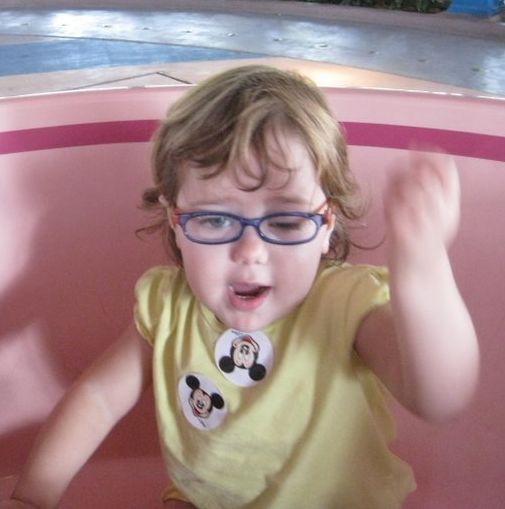
Elly was super excited about patching at the pumpkin patch today!   Using  a stack of foam from the dollar store, a black permanent marker, packing tape, scissors and an exacto knife… we came up with this patch.  I would say it is only sturdy enough for a one or two time use, but we had a ton of fun making and wearing it!  IMG_4087

Reader question: School help in getting child to wear glasses

This question was posted by a reader on the Little Four Eyes facebook group.  -Ann Z

We found out a few weeks ago our child is near-sighted. Can anyone speak to whether doctors usually write notes to inform schools that a child needs to wear glasses? We have written two notes so far this first month of school and the teacher has reminded my daughter once and the rest of the time her glasses are stowed away in her desk. My child is 6. The past couple of days her eyes looked strained, puffy, tired and bloodshot. At what point should I involve the principal or should I try popping in unexpectedly and interrupting the class in order to remind her myself? Thanks in advance.