I just got the following note from the mother of Nicholas who is in our photo gallery. How exciting! I thought I’d pass it along…
PBS KIDS Sprout Network, (the 24-hour preschool network) has chosen our 3 year old son to appear on TV for one of their cartoon spots in episode called Time, scheduled to air during The Sunny Side Up Show between 11:00 a.m. and Noon ET on September 4, 2009! YAY! 🙂
A few weeks ago we left the PO’s office with some discouraging news. Nicholas’s left eye was not doing as well as in previous visits. Upon reading the eye chart, he was only able to identify the figures to 20/50 R and barely 20/200 L. We were 20/50 in both just 3 months prior. While the prescription had not changed, the left eye was not doing as well as previously. Our PO ordered increased patching, up from 2 hours per day to 4-5 hours per day. We left with a deflating ‘we may have to discuss removing the lens at some point’ close to our appointment with the PO.
(Our son Nicholas, 3yo, has Bilateral Ectopia Lentis (dislocated lenses), with a Rx of -7.5R and -18L and anisometropic amblyopia. He’s been in glasses since 6 months of age, and patched 2 hours daily until this point.)
Fast forward, we’re business as usual. A couple mornings of increased objections, but we are able to achieve the required 4-5 hours, with assistance of his daycare staff, and a few well timed ‘Dr. Nelson says..’ to aid in overcoming any reluctance.
(His repertoire of tactics has increased exponentially with age… “I have dirt/dust in my eye”, “no patch today”, “I just wore my patch already”, along with a host of grunts, groans, pains, and fits..real or feigned…but we always come out on top : ) despite his efforts.)
In the past 10 days or so, we began to notice some differing behavior. A pirate squint here, pulling the weaker left eye closed there, some random grimaces and rubbing about the eyes, particularly the left. We thought at first it was some transient adjustment to the patching…adjusting to the longer hours..or maybe light sensitivity (we were at the beach…so maybe the glare after patching was a bother?), but the behavior persisted.
Upon returning home, and an additional few days later, the behaviors continued…a definite change we agreed. Better to err on the side of caution. I left a message for the PO, voicing our concerns about a possible change in vision in the left eye. Call returned, we were scheduled for a visit next day. Meanwhile, our minds begin the process of what if, what next, and so on. Has there been a shift of the lens? Is the brain shutting down the left eye? What if it’s time for the lens to come out?
To the doctor’s office yesterday… For the first time N went in, climbed up and sat down in the chair all by himself. Lights here, look there, follow this, cover this eye, now that eye, put these on, etc ..
We both sat waiting nervously for the doctor to voice some negative finding.
“Ok now Nicholas, do you want to read the pictures for me?”
There’s never been a response before, and then only after much reassurance a barely whispered naming of objects.
Yesterday, “Yeah.”
Left eye covered. “Bird, cake, hand, phone…” 20/30 Right.
Now right eye covered. “… “
Uh, oh.
Then, with a little encouraging…“Bird”
Down a line..”Cake. Hand.”
Down again.. “a bird, a cake, a hand, a phone” 20/50 Left eye.
From 20/200 to 20/50 in the intervening three weeks since increasing the patching.
In the end, the behaviors we observed were more a three year old being a three year old..living..learning..experiencing through his two eyes. Correct to side with caution, was the PO’s counsel. But all things considered he’s doing excellently. We’ll take it and keep moving forward.
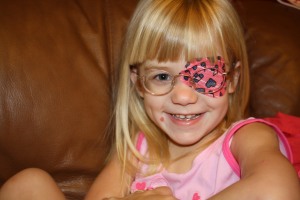
Welcome to our patch challenge- WEEK 7. My daughter is 3 and has Amblyiopia. We are currently trying to help her brain recognize her right eye. She has -1.5 in her left eye and -8.5 in her right. We have stepped up the patching since her vision has actually decreased the last 2 visits. For the first year of patching we were using only Ortopad patches and had some resistance in keeping them on. Elly would fold them, cut them, flush them, eat them, anything and everything so that we could not re-stick them back on.
Cost: Price: $14.80 per box50 individually wrapped patches per box plus shipping
Ratings given 1-5 for the following criteria.
1 Doesn’t meet my expectations, 5 Exceeds my expectations
Cuteness Factor 4
Durability 2
Full Eye Occlusion 5
Performs with sweat 2
Patching Support 5
Reusable No
Total patching hours for the week, maybe 5 minutes.
There was NO way Elly was going to keep these on. Before we found the reusable Framehugger patches, she would keep these on around 45 minutes at a time, up to 2 hours if she was very distracted.
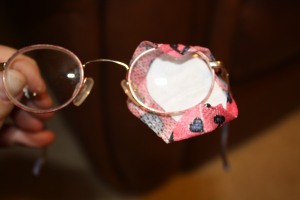
Elly’s response: Can I take it off now? I like it much better on my glasses like this…
ortopad Elly's way
Mom’s response; When we first started patching, I was given a sample packet of the Ortopad patches and a recommendation from the Opthamologist that these are the best at blocking vision. I will have to agree that they are light- weight and fully block the child’s vision in that eye. She did not have any skin sensitivity and only got a little pink irritation around her eye a couple times from ripping the patch off so quickly. I personally, was not a big fan of the color choices and liked the MYI Patches options better. We also had tons of problems with keeping them on for the required time. As stated before Elly did everything imaginable to make sure the patch was not re-usable after she removed it. The second we turned our heads, the patch would be off and they are not made to be re-used. The cost of patching was atrocious. My husband and I took turns wearing these patches and it was hard. They got itchy and sweaty and we wanted to take them off right away.
Additionally, our family and another patching family in town, have found it very difficult to keep the patch on in hot and humid weather. As soon as the kids sweat, the patch slides off. This limits the patching time to when you are inside and not being active.
Don’t get me wrong, there are quite a few great things about these patches and I would highly recommend you to try them, especially if you are just starting out or do not have to patch for a long time. They do have some great patching support. We really enjoyed the patching princess poster as a way to keep track and celebrate our patching time and as I was visiting their website today, I noticed that they offer stuffed animal patching pals as well. Additionally, they are one of the few places that offer patches small enough for infants and small toddlers.
If you have not tried out Ortopad yet and would like to, send me an e-mail. I have a box of Girls Medium patches that I can split up and send to some families that are interested. They are sitting in my pantry and I would rather see them be used! ajrenchin@yahoo.com
I’m swamped at work right now – it’s the beginning of the school year – so posting will be pretty light the next couple of weeks. If anyone has any thoughts on topics or wants to write a post, just email it my way (ann@shinypebble.com) and I’ll try to get it posted quickly.
I ran across a tweet this afternoon that got me thinking:
VisionExpo 73% of American’s believe a person’s choice of eyeglasses reflect their personality, data courtesy of VisionWatch… What do you think???
Do your kids’ glasses reflect their personalities? Do they reflect yours? Or do they reflect the often paltry selection that you have to choose from in many places. We were lucky to have a place with a wide selection, and I think it’s too bad that more places don’t have great selections for kids’ glasses so they can reflect all the different personalities of our kids. Though in our case, I’m pretty sure Zoe ended up with two pairs that were more a reflection of what her dad and I like (me the blue pair, him the red pair) combined with our knowledge of her personality. But she wasn’t really old enough to pick her own out at that point. Her next pair(s) she’ll probably have more to say about which ones she wants.
I received an email from Michelle whose daughter was diagnosed recently with Brown Syndrome (a rare form of strabismus). She’s looking for other parents of children with Brown Syndrome to connect with. If you fit the bill, can you leave a comment and I’ll put you in touch with Michelle?
I have a whole lot of questions and things to post, I’m trying to get through stuff in my inbox (which reminds me, if you have questions or topics you want posted, email me ann@shinypebble.com or just post a comment). So here are some links I wanted to pass along:
Charlotte in her cocoon sunglasses
Another sunglasses option – I read about the cocoon sunglasses on the Insights blog. They are sunglasses that go over the glasses. They don’t come in a kids sizes, but the small size worked for Meghan’s daughter, Charlotte. I’m going to get the information posted to the round up of sunglasses post.
JC Penney optical coupon – I think this probably only good in the US, but JC Penney is running a kid’s eyeglasses package for $49 for frames, lenses, and warranty. Bifocals are extra, but it’s a good price. The coupon is good until Sept. 12, 2009.
Child Vision Care Report (pdf) – this report talks about children’s vision care in the United States and makes a series of recommendations. There’s a lot of good stuff in there that’s not specific to the States. I’m planning on writing more about some of the recommendations, but thought I’d pass it along in case you also find this stuff interesting.
Our daughters’ eyesight seems to have a mind of it’s own. Unfortunately, as she is growing, so are her eyes. They are getting longer and as a result, her prescription is increasing. Since we are patching her stronger eye full time and doing a TON of hand-eye coordination activities with her, I felt like we have hit a road block. What else can we do???
Here are some additional options, which all seem to have the generic term “Vision Therapy,” and are options to consider and talk over with your child’s primary Ophthalmologist. Please remember, my credentials are that of a parent who wants the best for your child and these are the “therapy” choices that are available to us. If you have found out more choices, or have more information, please feel free to add on. This is just a brief post on what I have learned in the past couple weeks.
Occupational Therapy (OT); When I asked our Pediatric Ophthalmologist what else we can do , she said that maybe it is time to try occupational therapy and referred us to one that has training and is familiar with the needs of children with vision issues. OT is luckily covered by our insurance and ends up to be around $15 per session. We just completed our initial evaluation last week.
Home Visits from an early intervention specialist We were connected to our home visitation specialist by calling our local public school systems early learning division. This service is free as it is connected with the public school system. Qualifying sight and vision issues vary for each city and program. Most will accept only moderate or severe vision in BOTH eyes. We are only qualifying to receive “temporary services” I am considering attending the trainings this year in our neighboring city for these organizations.
Vision Therapy with a trained Optometrist. This is some thing that our OT suggested we look into. I believe it is a “therapy session” where the kids are give computer programs that progress in difficulty in an intense 30 minute session. This is NOT covered by insurances and can get expensive. Some Optometrists require the children to come each week, others are more flexible. This is the website of one closest to us. http://www.visionsource-brighteyes.com/index.cfm?fuseaction=site.services we still have not talked to the Pediatric Ophthalmologist about it. I won’t rule it out, but we have not committed to it yet. I am still researching it more.
I’m posting this from Meredith Braunstein who along with her husband wrote the book “Don’t I Look Smart?!” for their son Zachary. The book is published through blurb.com – a company that allows you to write and create and publish your own book. I really like the idea of being able to write a book especially for your child, so I asked Meredith to talk a little more about her book. You can see a preview of the book here. -Ann Z
“Don’t I Look Smart?!” is a book inspired by our son Zachary whose glasses have become his trademark. Zachary was diagnosed with Bi-Lateral Strabismus at nine months old and had corrective eye surgery just after his first birthday. As part of his treatment, it was recommended by our doctor that we get him glasses in order to strengthen his eye muscles and help with his farsightedness.
Zach
This started as a personal project for Zachary so he could have a book that would inspire confidence and make him proud to wear his glasses. The book is filled with imagination and the endless possibilities and experiences that wearing glasses can bring to those who need a little extra help seeing. It also teaches him that many successful people in this world wear glasses just like he does.
We feel that this book has the ability to get children excited about wearing their glasses and to see their glasses as a key to a magical world of opportunity.
Had to share this t-shirt that we found online at Threadless. It’s titled “I Love Fairy Tales” and I knew the first time I saw it that I’d have to get it for Zoe. She loves frogs and yellow, so it was a no brainer, and now she asks to wear it almost every morning.
For a while now, I’ve had links on the Gear page to other sites that sell t-shirts that are specifically for kids in glasses or kids with patches, but I’ve never felt compelled to get any for Zoe. I think it’s the fact that this shirt wasn’t specifically intended for kids with glasses, it’s just a cute frog – that just ate a fairy – that just happens to be wearing glasses.
Do any of you have any apparel for your kids that feature glasses?
This question just came in from Queenie. I’ve tossed around the idea of starting a page where people could list references to ophthalmologists, optometrists, optical shops and others that they recommend, but I’m not sure if that’s opening a can of worms or not. -Ann Z
Our eight-months old child has just been diagnosed with infantile esotropia and needs eye muscle surgery. However, the current waiting time for surgery is about 10 months in our country (i.e. Canada). We would like to bring her to US for consultation and possibly for surgery. Could anyone recommend a reputable pediatric ophthalmologist in New York State? Thanks.
If you have a toddler or pre-school child in glasses, the book, “What Can Pinky See? (Lift-The-Flap Book).” “What Can Pinky See” is a must have. I bought it at a garage sale last month and couldn’t be happier with our find! We REALLY like it!
The story begins with an introduction to Pinky. The author, Lucy Cousins, tells us that Pinky “wears glasses so he can see well.” Then Pinky goes on an adventure finding new things to see in different places. At the end, Pinky goes to bed and there is an illustration of him and his glasses on the table beside his bed.
Not only does this book have great illustrations that are simple, colorful, and easy to see, but the book is also highly interactive with a lift-the-flap on each page. It is also great for vocabulary development as it uses some great words for places; hedge, stable, hutch. Last, but not least, I really appreciate that the story addresses that the glasses help Pinky see better, but the main focus of the story is on what he finds. It truly is an enjoyable little story that has been read many times in our household!
Activities to do before or after reading the story
Go on your own exploring walk. Use the same pattern as the book. What can (your child’s name) see in the (place, ie- kitchen)?
Make a picture matching activity and have you child match
Birds to the hedge
Fish to the pond
Bug to the grass
Donkey to the stable
Rabbit to the hutch
Practice eye tracking by putting a picture of one of the animals from the story on a popsicle stick.
This question came in from Theresa, whose son had strabismus surgery earlier this month. -Ann Z
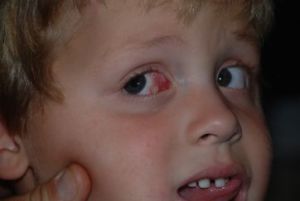
Nicholas' eye
Well, Nicholas had his surgery on August 5th and has been doing quite well, however, what we thought was just a stitch is not. I found out today that it is a conjunctival cyst. I am very upset about this. His doctor says that it might go away on its own, however, if it does not it will have to be surgically removed.
Any suggestions or insight you could provide would be greatly appreciated.
I’m wondering if any of you worked specifically on teaching your children how to put their glasses on. At what age did you let them start putting them on themselves?
When we first got Zoe her glasses, one of my concerns was how to help a 14 month old learn to put glasses on without either breaking the frames, or poking herself in the eye. So for that first year, we always insisted on putting the glasses on her face ourselves. She got her current pairs of glasses at age 2, and these have the flex hinges. I started noticing that if I got her glasses on wrong, she’d fix them herself (I’m constantly getting the temples caught in her hair, or missing her ears altogether). So we’ve let her put them on herself for the past six months of so, without really teaching her anything. For the most part, she does great, though every once in while, she’ll twist the frames in ways that have clearly contributed to the grey hairs on my head. And about half the time she tries to first put them on upside down.
Oh, and how about cleaning glasses? Zoe now insists on “cleaning” her glasses – usually right after one of us has cleaned them. Her cleanings are about as effective as brushing your teeth with a chocolate bar.
I just read a fantastic post over at Christopher’s Eyes that I wanted to pass along. Christopher is three, and has congenital glaucoma, which means many, many appointments to check his eye pressure. For young kids, this means an exam under anesthesia (EUA), which is a huge production requiring a trip to a hospital and a lot of preparation, because the child will be put under anesthesia. Most doctors will say that EUA’s are needed until a child is at least 6 because no child will sit still enough for the adult pressure checks. Christopher’s Dad talks in great detail about the process they went through to help Christopher feel comfortable at the doctor’s office, and to understand what was going on, and to sit still for successful eye pressure checks at the doctor.
Even if your child won’t need an EUA, the post is a good one for thinking about compassionate and helpful ways to help your child feel comfortable in exams or with unfamiliar procedures.
PBS KIDS Sprout Network, (the 24-hour preschool network) has chosen our 3 year old son to appear on TV for one of their cartoon spots in episode called Time, scheduled to air during The Sunny Side Up Show between 11:00 a.m. and Noon ET on September 4, 2009! YAY! 🙂





 “What Can Pinky See” is a must have. I bought it at a garage sale last month and couldn’t be happier with our find! We REALLY like it!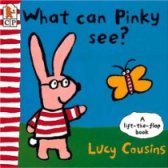
 For Little Eyes